Showing posts with label TV. Show all posts

Monday, 22 July 2019

Star Trek Magazine #71: Picard, the Borg, Jeri Ryan and Jonathan Del Arco

Anyone with even half an eye on events at this past weekend's San Diego Comic-Con 2019 can't have failed to notice the revelations about the forthcoming Patrick Stewart-starring Star Trek: Picard. The biggest surprise at the Hall H panel on the Saturday was the announcement that both Jeri Ryan – Star Trek: Voyager's Seven of Nine – and Jonathan Del Arco – Star Trek: The Next Generation's Hugh Borg – will be making appearances in the show (as will Brent Spiner, Jonathan Frakes and Marina Sirtis, as Data, Riker and Troi respectively). So it would be remiss of me not to point out that both Ryan and Del Arco are interviewed in the current Star Trek Magazine, issue #71 (#198 in the UK) – a Borg 30th anniversary special, still on sale now.


Clearly I was exhibiting some form of precognition when I commissioned those interviews... and Ryan wasn't exactly fibbing when, in answer to the question would she ever return as Seven, she replied, "Never say never."


If you're interested in reading Ryan and Del Arco's thoughts on the Borg – or indeed former Star Trek executive producer Rick Berman's reminiscences about Borg creator Maurice Hurley (among many other Borg- and non-Borg-related Trek matters) – Star Trek Magazine #71 is available at newsagents, in specialist sci-fi and comic stores, or direct from Titan Magazines.

Friday, 31 August 2018

Star Trek: Discovery: The Official Companion (Titan, 2018)

When is a book not a book? Or rather, when is a magazine not a magazine? Actually it's kind of moot, because the answer is the same:


When it's a bookazine. In this instance, Star Trek: Discovery: The Official Companion, a guide to the first season of the newest Star Trek show, arriving in bookshops and comic shops and online outlets in the US in the next few days (having made its debut at the Star Trek Las Vegas convention earlier in August, under the shiny gold-logoed con-exclusive cover above), and in newsagents in the UK on 26 September. In other words, in plenty of time for the November DVD/Blu-ray release of Discovery Season 1, to which the Companion will make a fine, er, companion.


How do I know this? Because I edited the thing, conceiving and assembling it with the indispensable assistance of designer Dan Bura, CBS's Marian Cordry, and a crack team of writers culled from the official Star Trek Magazine (of which I am also editor).


My grand plan for the Companion, such as it was, was to try and tell the story of Discovery Season 1 from both sides of the camera. So while in one sense it's an episode guide, with plot summaries, cast and crew credits, pertinent character quotes and plenty of pictures, in another it's a behind-the-scenes 'making of', with production insights and commentary from many of the principal creative types – such as Season 1 executive producers and showrunners Gretchen J. Berg and Aaron Harberts; production designer Tamara Deverell; costume designer Gersha Phillips; prosthetics and make-up maestros Glenn Hetrick and James MacKinnon, and VFX supervisor Jason Zimmerman – along with actors Mary Wiseman (who plays Sylvia Tilly), Mary Chieffo (the Klingon L'Rell) and others.


I wouldn't say it's as exhaustive a document of the making of Discovery as, say, Larry Nemecek's venerated (not least by me) Star Trek: The Next Generation Companion was of the making of TNG, but it's a decent opening shot, I reckon, ahead of any more thorough making-ofs that may materialise down the line.


In any case, I'm quite pleased with it. And as further inducement for anyone minded to pick up a copy, there are four fetching covers to choose from: the aforementioned Star Trek Las Vegas cover; a newsstand one; a Diamond Exclusive one, and a hardcover edition. Collect the set and be the envy of all your friends – or at least those with a more-than-passing interest in Star Trek.

Monday, 30 April 2018

To Boldly Go (Again)

There's a line in Star Trek Generations – the 1994 big screen baton handover between the original series and Next Generation crews, and a film of which I'm fonder than I have any reasonable right to be – that's been resonating with me recently. It comes during the sequence in the extra-dimensional Nexus, when James T. Kirk is rebuffing Jean-Luc Picard's exhortations to join him in saving the world (well, a world) one last time. As he strides up the stairs in his beautiful Rocky Mountains log cabin towards his doubtless equally beautiful waiting wife, Kirk declares: "This time it's going to be different."

Of course, directly after that Kirk realises that the Nexus is a sham and joins Picard in his battle against planet-destroying El-Aurian nutcase Soran and winds up getting killed (spoiler alert!), but even so, that line has lodged in my mind since late last year, when I once again became editor of the official Star Trek Magazine.


I say 'once again' because it's not the first time I've been editor of Star Trek Magazine. I previously edited it for a couple of years in the early 2000s (when it was known as Star Trek Monthly and was a little slimmer than it is now, as well as being, as its title suggests, monthly, as opposed to the current bimonthly... ish), having quit a career as a music journalist in order to do so – much to the bemusement of more than one friend at the time, who couldn't comprehend why I'd abandon such a 'trendy' profession in order to go and edit a magazine about Star Trek.


And maybe they had a point. Looking back, I spent much of that 25-issue stint in charge of the magazine bending it into shapes that perhaps better suited me and my background – a music special, funny captions, endless best-ofs – than the mag itself – and always with an eye to other opportunities at Titan, the publisher of Star Trek Magazine. (To my credit, that last one did work out: I subsequently got to run the Titan graphic novels dept for five years.)


So this time I think maybe it will be different. This time, and coinciding with my reignited fervour for science fiction and space opera, I'm much more interested in Star Trek itself; in digging into how it is (and was) written, produced, filmed – how it's made; how it works – as well as chronicling its latest incarnation, Star Trek: Discovery. In fact, what with Discovery – the first season of which I loved – and the Abrams/Kelvinverse films – the first two of which I loved... and the third of which I actually didn't mind – right now I'm probably more into Trek than at any time since the heyday of Deep Space Nine 20 years ago, and possibly even since TNG was first on telly.


My first issue back in the captain's chair, #66 (March/April 2018), came out earlier this year, and my second, #67 (Summer 2018), is out in the US now and in the UK in a few weeks; I'm pretty pleased with how that one in particular – a DS9 anniversary issue which delves into how that show's first season came together 25 years ago (plus some Discovery stuff, including an interview I did with Wilson Cruz) – has turned out. Whether or not I can extend my prior two-year tenure as editor into a five-year mission – or even an ongoing one – remains to be seen, but I've plenty of plans for the main magazine and its various spin-off specials (including a Discovery one later this year; more on that anon).

As Captain Kirk says to Captain Picard in Generations: "Don't let them promote you... don't let them transfer you... don't let them do anything that takes you off the bridge of that ship, because while you're there... you can make a difference."


The covers illustrating this post are by Star Trek Magazine's regular designer, the supremely talented Commander Martin Stiff from Amazing15.

Friday, 19 February 2016

Bandits by Elmore Leonard (Viking, 1987)


According to Elmore LeonardBandits (Viking, 1987, dust jacket illustration by James Hussey, jacket design by Bet Ayer), much like his previous novel, Glitz (1985), grew out of an idea for a film. (Glitz had begun life, bizarrely enough, as an Ernest Tidyman screenplay for a Sidney Poitier-starring sequel to In the Heat of the Night.) Leonard told John Williams for Williams's 1991 book on crime fiction and America, Into the Badlands: "Bandits came about when a film producer said, 'How would you like to write the script of a big caper movie: several old pros get together for one last heist,' and I said, 'Sure, but I want to write it as a book first and I want to set it in New Orleans.'"


Leonard's researcher, Gregg Sutter, however, remembers it differently. In an article for the spring 1986 issue of The Armchair Detective ("Advance Man: Researching Elmore Leonard's Novels Part 2"), Sutter explains how Leonard was hired by TV producer David Gerber "to write a cop action-adventure series – with total freedom to select subject matter, characters, and location". The show, Wilder, never made it past the script stage, "But just as Split Images spawned Cat Chaser, Wilder would provide the foundation for Bandits."


Whatever the case, Bandits is a curious entry in Leonard's canon – "perhaps a little over-researched and occasionally uncertain in tone" in Williams's (fair) assessment, certainly one of the writer's more overtly political novels. Starring one Jack Delaney – thief (his speciality is turning over hotel rooms), ex-con, and another in a long line of lovable Leonard rogues (see also Jack Ryan from The Big Bounce and Unknown Man No. 89, Ernest Stickley, Jr. from Swag and Stick, and Jack Foley from Out of Sight and Road Dogs) – the story deals with the struggle between the Nicaraguan Sandanistas and Contras, except as already noted it's set in New Orleans and, this being an Elmore Leonard novel, there's a sizeable score to be taken down too.

"[P]lanning the book, I had to think of something for these guys to steal," Leonard told Williams, "so I read in the paper about money being collected privately for the Contras. And I thought that this money could be sitting in one place and these guys could find out about it so I introduced the ex-nun who enlists them and told them what was going on down in Nicaragua. But I've been asked if I wrote that book to get my political views across. I didn't. It was only something for these guys to steal. Of course you do get politically involved when you have to explain what's going on and you have to show some passion for one side or the other... and of course it's going to be for the former nun against the Contras."

For sure, by the novel's close it's pretty clear where Leonard's sympathies lie, but then the book is all about choosing sides; more than once Jack wonders which side the various protagonists are on, indeed whether he himself is "on the side he thought he was on or on a different side". That Jack eventually reaches the same conclusions as his creator shouldn't come as a huge surprise – his deliberations reflect Leonard's own, the author literally working things out for himself on the page as the novel progresses – but the getting there is engrossing, and as a glimpse of a questing and inquisitive creative mind at work, Bandits has much to recommend it.


Elmore Leonard's next book after Bandits was Touch – at least, his next published book; Touch was actually written in the 1970s. The next book he wrote, however, was Freaky Deaky (1988).

NB: Proffered for this Friday's Forgotten Books roundup.

Thursday, 15 October 2015

Jimmy Sangster's John Smith Spy Novels: private i (Triton, 1967); Signed Inscribed First Editions

NB: Linked in Friday's Forgotten Books, 16/10/15.

When Jimmy Sangster died four years ago, his obituaries naturally concentrated largely on his film and TV work (see The Guardian, The Independent, The Telegraph and The New York Times). Sangster was a key figure in the revival of Hammer Films in the late 1950s and through the 1960s; he wrote The Curse of Frankenstein (1957), Dracula (1958), The Mummy (1959) and two dozen other Hammer horrors before moving to America, where he wrote for The Six Million Dollar Man, Kolchak: The Night Stalker, Ironside, Wonder Woman and a bunch more US TV shows.

But Sangster also penned eight novels (plus a couple of novelisations of his own screenplays) besides his film and television work: three murder mysteries published from 1986–88 (1989–90 in the UK) starring expat former Scotland Yard investigator James Reed; one standalone thriller-cum-farce published in 1971 starring gun-running adventurer Anthony Bridges; two spy thrillers published from 1968–70 starring British Intelligence agent Katy Touchfeather; and two half-spy/half-mystery novels published from 1967–68 starring ex-British Intelligence operative turned private investigator John Smith, the first of which is this:


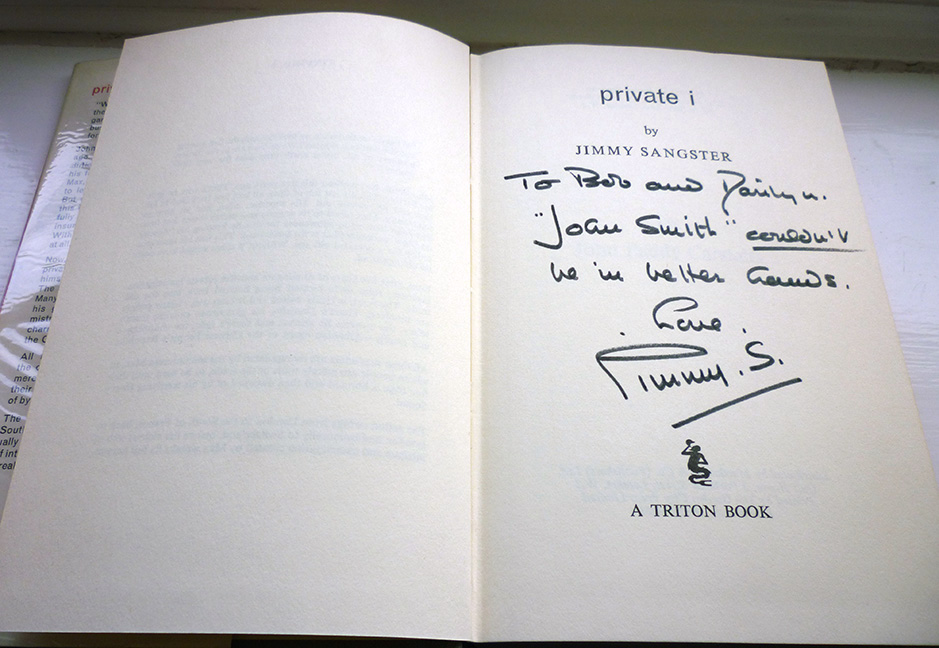
Or rather, these: private i, published by Triton in 1967, dust jacket design by Collis Clements. Now, I suppose the immediate question here is, why do I have two copies of the same book? Answer being, having learned about Sangster's parallel career as a writer of spy fiction (from screenwriter and novelist Stephen Gallagher, no less), I went in search of a first edition of his debut novel – private i – and came across two copies, both of which boasted intriguing inscriptions (written by Sangster, as far as I can determine; the handwriting is a little different in each book, but there are enough similarities – the same black maker pen used, corresponding letterforms – that I'm fairly confident they're from the same hand), one of which being an association copy. And since both books were relatively inexpensive – and being the hopeless case that I am – I bought both of them. (Whether or not I'll keep both of them remains to be seen – I'm planning on doing some eBaying soon.)

The copy on the left has a poem inscribed on the front free endpaper:


It reads:

Roses are Red.
Violets are Blue.
I'll lay odds
I'm higher than you.

Violets are Blue
Roses are Red
If I could find the strength
I'd drag you to bed

Drifting around in a Pale Velvet haze
What a wonderfull way to pass all our days.

Love, Jim xxxx

I've no idea who the poem was written for (although I'd dearly love to find out), but I do know who the other copy of the book, the association copy, was inscribed to, this time on the title page:


The inscription reads:

To Bob and Marilyn.

"John Smith" couldn't be in better hands.

Love

Jimmy S.

Bob and Marilyn are the American actor Robert Horton and his wife; Horton starred in Wagon Train from 1957–1962 and featured in numerous other television series, films and TV movies, one of which being the 1969 television film The Spy Killer, directed by Roy Ward Baker, produced by Jimmy Sangster and with a teleplay by Sangster based on his own novel... private i.


I've not seen The Spy Killer – although there is a clip on YouTube of the opening five minutes, featuring Horton as John Smith walking through Berwick Street Market to the baritone strains of what sounds like Scott Walker (although actually the rather less-well-known John Rowles), and the reviews on IMDB are positive – but I have read private i, and can report that it's a cracking piece of spy fiction – kind of early le Carré crossed with Len Deighton's unnamed working class secret agent and with a dash of Adam Hall's Quiller mixed in for good measure. Narrated by Smith, one-time operative with the Service – i.e. British Intelligence – turned down-at-heel private investigator, it starts out in a cut-price seedy gumshoe vein, with Smith employed by his ex-wife to obtain evidence of her new husband's gay affair, before taking a sharp left turn into the dangerous world of international espionage, as Smith is press-ganged back into service by his former boss, the ruthless and manipulative Max.

The plot is suitably murky and twisty, involving murder, coded secrets and both the Chinese and Russian security services, but it's Smith's sardonic narration which really lifts the thing. When three pages into a spy novel the lead states that he's "nearly two stone overweight, that my digestive system plays up constantly, that my teeth aren't particularly good, and that I have suffered periodically from halitosis, B.O., prickly heat and dandruff", you know you're not in the realm of Bond, and Smith spends the remainder of the novel boozing, leching, failing to get it up with his indifferent girlfriend and crashing around like the low rent – and yet, on occasion, lowly cunning – loser that he is. The only real downside is a regrettable streak of homophobia which runs through the narrative, but even that can be put down to Smith's boorish nature and the prevailing attitudes of the time rather than to whatever prejudices Sangster might or might not have held. And anyway, I can forgive a multitude of sins in any example of the spy fiction form which contains an irreverent passage like this one:

I poured myself a large drink, and read the evening paper. I washed up some dirty dishes and rinsed out a couple of pairs of socks. I washed a nylon shirt and hung it up to dry. I had another drink which I took with me to the bath. I trimmed my toenails, had a crap, read the evening paper again, and then had a shave. After that there seemed to be nothing left to do but to phone Berat's contact and tell him about the rendezvous.


The second and final John Smith spy thriller, Foreign Exchange, was published by Triton in 1968 (and filmed for television in 1970, again with Robert Horton in the lead role), and it's almost as good as private i, sending Smith to Russia as part of a complicated Cold War spy swap plot. A full review will have to wait for another time, however; this post is quite long enough as it is. For now, I invite anyone interested in learning more about the novel – and in reading contemporaneous reviews of private i – to click on the above images of the dust jacket of the Triton edition (designed by Alison Storey).

Monday, 12 October 2015

Big Morning Blues by Gordon Williams (Hodder, 1974): Signed and Inscribed First Edition

Authors inscribe books to all sorts of people and for all sorts of reasons. Sometimes they inscribe them for fans, to add a personal touch; sometimes they inscribe them to friends or confidants, to associates, acquaintances or correspondents, to family or loved ones. Sometimes they inscribe them to fellow writers and their spouses, to journalists, interviewers, filmmakers and, yes, bloggers. They might inscribe them to folk who've helped them in some way with that book or with their career – to their publisher or editor, their translator or again some friends – or who they've worked with in film or TV – a co-writer maybe, or an actress. Or they might inscribe a book with the express intention of seeing that book turned into a television series, as is the case with this one:


Big Morning Blues by Gordon Williams, published by Hodder & Stoughton in 1974, dust jacket design by Jeff Godwin, who I'm guessing is Jefferson Godwin, designer of the jacket for the 1973 Hodder edition of Brian Garfield's Death Wish; in any case, I've added Godwin's jacket for Big Morning Blues to British Thriller Book Cover Design of the 1970s and 1980s, even though the novel's not so much a thriller as an evocation of London's hard-drinking underworld, or "The Rookery", as the story has it (reviews here and here).

Williams is probably best known these days as the writer of The Siege of Trencher's Farm (1969), filmed by Sam Peckinpah in 1971 as Straw Dogs, but he has well over a dozen other novels to his credit, including The Man Who Had Power Over Women (1967), which was filmed in 1970, and four novels co-written with football manager Terry Venables, three of them a series (published by Macmillan from 1974–76 under Williams and Venables' joint pen name, P. B. Yuill) starring cockney private eye James Hazell which begat an ITV show, Hazell, in 1978.


Evidently Williams imagined Big Morning Blues had telly potential too, because this copy of the book – which I acquired from book dealer Jamie Sturgeon – has the following inscription on the half-title page:


The inscription reads:

Dear Jacky,

Could you read this quickly with a view to making an offer for network dramatisation?

Best wishes,

Gordon

I've not been able to work out who "Jacky" is – Williams's agent? A television producer? – but I don't believe the novel ever did make it onto the telly (at least not according to IMDB). Unlike the next inscribed book I'll be blogging about: a 1967 spy thriller by a writer who was instrumental in the rebirth of Hammer Films.

Thursday, 23 October 2014

Lost Callan Episode and Short Stories by James Mitchell Collected for First Time


Quick bit of news: crime writer and critic Mike Ripley has drawn my attention to Callan Uncovered: The Collected and Missing Files, a newly published – by Mike's Top Notch Thrillers imprint – anthology of long-out-of-print Callan short stories plus a never-before-seen treatment and script by Callan TV show creator and writer James Mitchell. Mike "spent the best part of a year tracking down the stories for the collection" – 24 of which originally ran in the Sunday Express from 1973–1976, with one, the first Callan story, appearing in the TV Times in 1967 – "with the help of the British Library and a network of die-hard Callan fans". In addition, as Mike explains in an article on the Ostara Publishing (TNT's parent publisher) website, Peter Mitchell, the late James Mitchell's son, unearthed "an outline treatment for an episode of Callan and a complete script, originally called The Senator’s Daughter but then changed by James Mitchell to Goodbye Mary Lee. Although Mitchell was credited with writing the scripts for some 30 episodes of the highly successful television show between 1969 and 1972, it seemed that Goodbye Mary Lee was one script which had never been filmed and which could genuinely be called the 'lost Callan episode', not having been read by anyone outside the Mitchell family for more than forty years."

I'm told by Mike there's a copy of Callan Uncovered on its way to me, so I shall be giving it a thorough going over as soon as possible. In the meantime, allow me to point anyone interested in Callan and James Mitchell to these previous posts:

A Magnum for Schneider Book Review

The Callan Spy Thriller Series by James Mitchell

The Man Who Sold Death: James Mitchell alias James Munro

Russian Roulette Book Review

First Editions of Bonfire Night and The Money That Money Can't Buy

Wednesday, 15 October 2014

Doctor Who: The Twelfth Doctor #1 by Robbie Morrison and Dave Taylor (Titan Comics, 2014): Comic Review


This must be one of my timeliest reviews ever – I'm posting this the morning of the day the comic in question, Doctor Who: The Twelfth Doctor #1, arrives in comic shops (whereas in the ordinary run of things my reviews tend to appear months, if not years, if not decades after a comic or, more typically, book has been published) – which, considering that comic stars a Time Lord, is doubly apposite. And the twelfth incarnation of that Time Lord, no less, the one currently being brilliantly played on telly by Peter Capaldi, here making his comics debut... if we discount the comic strip starring the Twelfth Doctor which has been running in Doctor Who Magazine for a couple of months, that is. But no matter: this is the Twelfth Doctor's comic book debut, the latest addition to Titan's fast-expanding line of Doctor Who comics, and it's a nicely crafted, faithful and, on the whole, successful affair.


One's reaction to it, I suspect, will very much depend on one's reaction to the TV Twelfth Doctor, so convincingly do writer Robbie Morrison and artist Dave Taylor channel him: irritable, irascible, airily dismissive of almost everyone he meets and prone to dispensing withering putdowns left, right and centre – in other words, as enormously entertaining on the page as he is on the screen. Taylor, an artist I've admired since I encountered his work on the late-1990s Dark Horse series Tongue*Lash (an aside: when I myself was working at Titan in the mid-2000s he was on my list of artists I'd loved to have found projects for), is good on Capaldi (those eyes...) but less so on the Doctor's assistant, Clara Oswald; he hasn't quite got the hang of Jenna Coleman's subtly characterful phiz yet, although there is the odd panel where Clara clicks visually. In any case, Morrison's dialogue captures her perfectly, notably her trademark exasperation at – and attendant sarcastic rejoinders to – the Doctor.


The story is a bit Star Trek III: The Search for Spock-y, involving as it does accelerated planetary terraforming gone awry, but much like the current series, where even the more workmanlike stories are made magical by Capaldi's towering, glowering performances – and Coleman's quieter but no less important countering foil – here a so-so story is enlivened by choice character interplay and some cracking dialogue. And the story shouldn't really be discounted out of hand; there are seeds being sown here – bits of Gallifreyan business, some kind of ancient evil – which may produce satisfying fruit down the line.


First issues are always a tricky business, still more so first issues of licensed comics, where there are more often than not innumerable additional hurdles, hoops and other more confounding and baffling obstacles which must be negotiated over and above the usual editorial ones. Rare is the licensed comic which emerges from that process unscathed, so the fact that Doctor Who: The Twelfth Doctor #1 retains much of the feel and heart(s) of the TV show is only to be applauded. A creditable job all round.


Incidentally, in addition to the regular cover by Alice X. Zhang there are 30 variant covers, all of which can be seen in the back of the comic. Admittedly the vast majority of these are retailer specific covers – i.e. produced for individual comic shops and online retailers – and I can see how the economics of that would work for Titan, but still – that's quite a lot of covers for one comic.

Friday, 2 May 2014

High Tide by P. M. Hubbard (Macmillan, 1971): First Edition, Book Review

NB: Proffered as part of Friday's Forgotten Books, 2/5/14.

Three years ago, in an unrelated comment on this post on an obscure crime fiction novel, my friend and fellow blogger Book Glutton brought the work of suspense novelist P. M. Hubbard to my attention. Since then (for what it's worth) I've written about Hubbard repeatedly – reviewing novels and showcasing first editions, signed books and even a handwritten letter and some publishing paraphernalia – indeed this very missive constitutes part of a current run of posts on the author; but it's taken me until now to get round to the Hubbard novel Book Glutton highlighted in that comment, the first Hubbard novel he himself read:


High Tide, published in hardback by Macmillan in the UK in 1971, striking dust jacket design by Bush Hollyhead of Nicholas Thirkell Associates (who also designed the wrapper of the Macmillan edition of Hubbard's The Dancing Man that same year). Hubbard's tenth novel, it's the first-person account of one Peter Curtis, recently released from prison after serving four years for manslaughter and now travelling across the south of England, driving by night, sleeping by day, with a hazy eventual aim of buying a boat and making a new life for himself somewhere in the west country. But an encounter with an associate of the man he killed sets him on a different course: to a Cornish coastal town where the testing tides of the estuary lead to a deserted farmhouse, the damaged wife of a local novelist, and a secret that Curtis's opponents are willing to resort to murder to uncover.


High Tide was the second of two Hubbard novels I read in quick succession, the first being The Whisper in the Glen (1972); I'd expected to like High Tide more than The Whisper in the Glen – The Whisper in the Glen being more of a gothic romance than a suspense novel – but I was quite surprised when the opposite turned out to be the case. High Tide is a good book, don't get me wrong, but for me it's missing some of the depth of The Whisper in the Glen. Hubbard's evocation of place – in this case the estuary at the fictional town of Leremouth, with its surging tides and dangerous quicksands – is as strong as ever, and in common with The Whisper in the Glen – and other Hubbard novels – there's a romantic infatuation at the heart of the story which unbalances the narrative in a manner I find fascinating; but the MacGuffin which drives the plot is disappointingly prosaic, and the novel lacks those elements that, in addition to Hubbard's feel for locale, make him such a compelling writer – the pervading sense of doom of The Whisper in the Glen, say, or the persuasively creepy atmosphere of A Thirsty Evil (1974) or A Hive of Glass (1965), the latter with its memorably deranged narrator.

That said, it's also for those reasons that I could see High Tide lending itself well to adaptation – which indeed it did, in 1980 as part of ITV's Armchair Thriller series, with Ian McShane (Lovejoy, Deadwood) as Peter Curtis. Shot entirely on film and on location (unlike a lot of similar British television productions of the era, which utilised video and studio shoots), by most accounts dramatiser Andrew Brown and director Colin Bucksey made a pretty good fist of turning the novel into a four-part television drama; I've half a mind to give it a go (it's available on DVD). And it's in seemingly excellent company as well: the subsequent Armchair Thriller story was a six-part adaptation of Desmond Cory's The Circe Complex (1975), while the first series included a six-part adaptation of Patricia Highsmith's A Dog's Ransom (1972).


A final note on High Tide: in a lull before the novel's climax, Peter Curtis has to spend the night in the abandoned farmhouse with only a choice of two novels for company. One is by the aforementioned local author; the other is a Lemmy Caution novel, written by Peter Cheyney – and by chance it's to Cheyney that I'll be turning in the next-post-but-one. First, though, one last Hubbard book (for the time being): a 1972 hardback edition of perhaps the quintessential Hubbard novel.

Thursday, 17 April 2014

The Assassination Run by Jack Gerson (BBC Books, 1980): Signed Association First Edition, Inscribed to Mary Tamm

Linked in Friday's Forgotten Books, 18/4/14.

The next signed book I'm showcasing was given to me by my friend Adam, proprietor of Withnail Books in Penrith, to sweeten the deal on the signed 1970 Dell paperback of Elmore Leonard's The Moonshine War I blogged about earlier in the week:


The Assassination Run, by Jack Gerson, published in hardback by BBC Books in 1980, with a dust jacket – which I've naturally added to British Thriller Book Cover Design of the 1970s and 1980s – which sports a photograph by Graham Ross. For those who don't know – and I numbered myself among them until I looked it up online – The Assassination Run was a three-part BBC TV spy thriller which aired in 1980, reportedly a kind of loose sequel to 1979 serial Running Blind (which was based on a Desmond Bagley novel). Starring Malcolm Stoddard as British agent Mark Fraser and the late Mary Tamm – perhaps best known for her role as Time Lord Romana, playing opposite Tom Baker in Doctor Who from 1978–1979 – as his kidnapped wife Jill, it was penned, like its predecessor (and like its 1981 three-part sequel, The Treachery Game), by Gerson, a television scriptwriter who, according to his Herald obituary, "cut his teeth writing episodes of Z Cars and went on to work on some of the most popular TV drama series of the time including Sutherland's Law and This Man Craig" – although IMDB suggests a rather different order of events.


His best-remembered telly work these days is probably The Omega Factor, which he created (and which guest-starred his daughter, Natasha, who would go on to feature as Brenda in Gregory's Girl). But Gerson also published around a dozen novels, many of them based on his various television endeavours – The Regiment (Pan, 1973), The Omega Factor (BBC Books, 1979), The Whitehall Sanction (WH Allen, 1983) and so forth – The Assassination Run being a case in point.


Gerson's inscription on the front free endpaper of this copy of The Assassination Run reads "To Mary who is Jill and Lauren who was there too!" You can see Adam's pencilled bookseller note above this, identifying the inscription as "by the author to his inspiration for one of the characters". But I did a spot of idle googling when the book arrived in the post, and having learned that the TV series of The Assassination Run starred Mary Tamm, I began to strongly suspect that the "Mary who is Jill" that the book was inscribed to wasn't merely the inspiration for one of the characters in the show, but actually played that character – i.e. that this was at one time Mary Tamm's copy of the book. Gerson included Tamm, under her first name, in the dedication opposite the prologue:


Alongside Stoddard and the cast and crew of the television series; but what sealed it for me was discovering that Tamm had a daughter, Lauren, who was born in November 1979 – which means if The Assassination Run was filmed the year before its 1980 broadcast, Tamm would have been pregnant during filming – hence the slightly oddly worded "Lauren who was there too!"


It's a fascinating provenance for the book, not just for anyone – like myself and, to an even greater extent, Adam – with an interest in Doctor Who, but anyone – me again (and probably Adam too) – with an interest in inscribed editions, especially association ones; witness, for example, these posts on books bearing inscriptions by Patricia Highsmith, Donald E. Westlake, P. M. Hubbard (with attendant letter), Andrew MacKenzie, Elmore Leonard, Colin Forbes, Gavin Lyall, Joe Gores and Anthony Price. That said, if a book counts as one of your favourites in a series, as the next book I'll be blogging about does, sometimes just a flat signature is enough – even if that signature consists of merely the author's initials.

Monday, 7 April 2014

James Mitchell, alias James Munro: First Editions of Bonfire Night (Callan Spy Novel #5, 2002) and The Money That Money Can't Buy (John Craig Spy Novel #3, 1967)

Television writer and producer James Mitchell penned two series of spy novels of note in his near-fifty year career. The first, a four-book series starring gunrunner-turned-secret agent John Craig, written under the pen name James Munro, ran from 1964–1969; the second, a five-book series starring British Intelligence assassin David Callan, spinning out of the Mitchell-created Callan TV show, ran from 1969–2002. I profiled both series last year, reviewing the first book in each – respectively The Man Who Sold Death and A Magnum for Schneider, alias A Red File for Callan – and showcasing first editions of almost all of the other novels – almost all, because there were two I hadn't at that point got my clammy hands on. Fortunately, in the interim, I have; and so, seeing as I reviewed the second Callan book, Russian Roulette (1973), last week, I figured now's as good a time as any to showcase them. Oldest first, I think:


The Money That Money Can't Buy by James Munro, published in hardback by Hammond in 1967 (dust jacket design uncredited). The third John Craig spy thriller, Kirkus Reviews describe it as "Just so much spy schmaltz", which seems a little harsh to me; of the Craig novels, I've only read The Man Who Sold Death thus far, and though I wasn't as keen on it as I was A Magnum for Schneider, it wasn't that bad, and given the kind of writer Mitchell was, I can't imagine the quality of the series plummets too dramatically – a supposition supported by Existential Ennui reader Darryl Crawford, who commented on my John Craig post that the later books have "some of the coolest villains this side of Modesty Blaise", and Randall Mastellar at Spy Guys & Gals, for whom "the stories are good reads and the character does come up with a couple of the greatest one-liners I've ever read".


I found this first edition on an all-too-rare-these-days trip up to London (I moved down to Lewes from London nearly six years ago), in the basement of Any Amount of Books on Charing Cross Road. (On the same trip I also secured a vinyl copy of my album of the year from last year, Everything Everything's Arc, in Sister Ray on Berwick Street, which I was immensely pleased about because it's incredibly hard to come by on vinyl.) I think I paid about a fiver for it, which isn't bad considering the Hammond first isn't exactly in abundant supply – there are at present only half a dozen copies for sale online – and especially not in the UK, where I can currently only see one jacketless (I believe) copy for sale online (offered, coincidentally enough, by fellow Lewes exile, and fellow blogger, Steerforth).


Even scarcer, however, unless you're prepared to put up with an ex-library copy, is the Callan novel I secured:


Bonfire Night by James Mitchell, published by Severn House in 2002 (shortly before Mitchell's death that same year), jacket photograph by Ute Klaphake. The fifth and final Callan novel, there was a near-thirty year gap between this and the previous one, 1975's Smear Job, and according to reports from Existential Ennui commenters it's either "a bit weird" (Stuart Radmore), "confusing, and reads more like a script than a book" (Saz), or is "Mitchell... operating at the very top of his game in this dense narrative" (the aforementioned Darryl Crawford). Given which, the best thing to do, I imagine, is to read the book oneself and make one's own mind up, which ordinarily would mean stumping up at least twenty-five quid for an ex-library copy of the Severn House edition – the sole edition of the novel to date. Seems the vast majority of the print run of the Severn House edition went to public lending libraries, and even my copy, which I won on eBay (in the end for less than twenty quid), while it isn't ex-library, was evidently intended for libraries:


The book's case replicates the jacket front and back as a PLC (printed laminated cover), rather than the more usual Arlin over boards, suggesting it was bound with libraries in mind. Where it actually ended up, though, was with Mitchell's agent, as evidenced by this stamp on the front free endpaper:


All of which makes one wonder if the entire print run was bound for libraries. Anybody own a copy of the Severn House edition which doesn't sport a PLC...?