Showing posts with label journalism. Show all posts

Thursday, 13 November 2014

Killshot by Elmore Leonard (Viking, 1989): Signed and Inscribed to Writer Philip Oakes; Book Review

Back in May, in this post on Patricia Highsmith's Tales of Natural and Unnatural Catastrophes, I expatiated on signed editions – how signed books, in particular inscribed and association/presentation copies, have become an increasingly important aspect of my book collecting, especially books signed or inscribed by my favourite authors. Until very recently I owned five books signed by Elmore Leonard – who, it may be gleaned from the number of times I've posted about him, is indeed one of my favourite authors: a 1970 Dell paperback of The Moonshine War and a 1993 Viking first of Pronto, both flat signed; a signed and dated 1984 Allen Lane first of Stick; an inscribed 1977 Secker & Warburg first of Unknown Man No. 89; and an association copy of the 1984 Viking edition of LaBrava. All of those books I considered good deals, as in I managed to acquire each of them for less than one might ordinarily expect to pay. However, this has to be the best deal of all:


Killshot, published in hardback by Viking in 1989 (dust jacket design uncredited, but it's virtually identical to that on the US Arbor House edition, published the same year). I picked up this copy of the British first edition online for a fiver – somewhat less than the going rate for an unsigned British first in near fine condition – which this copy is – and certainly a lot less than the going rate for a signed one; I can see just a single signed copy of the Viking first available online, listed at over £80. This isn't merely a flat signed copy, however:
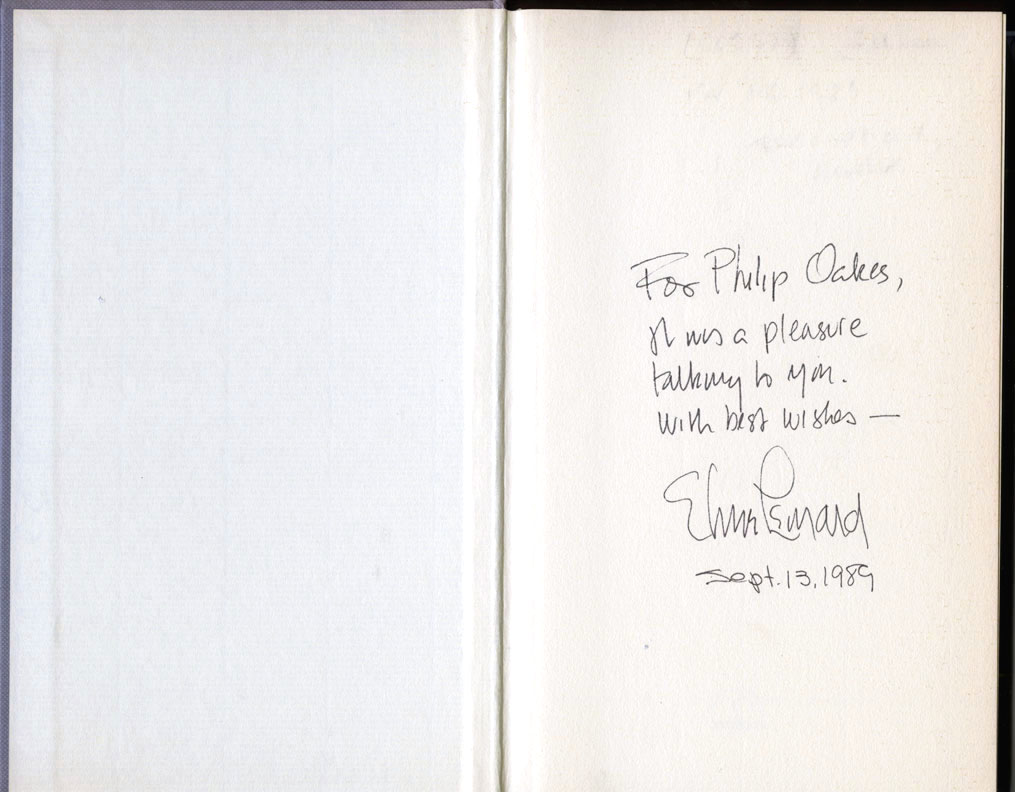

It's an association copy, inscribed on the front free endpaper to the journalist (and poet) Philip Oakes. The inscription reads:

For Philip Oakes,

It was a pleasure talking to you. With best wishes –

Elmore Leonard

Sept. 13, 1989

Oakes was an admirer of and sometimes reviewer of Leonard's work; there's an extract from an Oakes review of Freaky Deaky on the back cover of the Viking edition of Killshot, taken from the Literary Review, for which Oakes frequently reviewed crime fiction. This copy of the book came came from Oakes's own library and was evidently presented to him by Leonard shortly after Oakes had interviewed the author, as implied by the inscription. This we can further establish thanks to the BBC's recently launched (in a test version) Genome Project: there's a listing on 31 October, 1989 at 7.05pm for a Radio 3 (the Beeb's classical music station) programme titled Third Ear, in which "Philip Oakes talks with the American crime novelist and Western screenwriter Elmore Leonard". I think it's safe to conclude that that was the conversation referred to in Leonard's inscription, which means that, remarkably, there's a BBC licence fee-funded provenance for this particular copy of Killshot readily viewable online. And potentially, if the relevant edition of Third Ear itself is ever made available online, an audio provenance too. 


Killshot is another example, in a different sort of way, of something I was banging on about in last week's post on Elmore Leonard's 1983 novel Cat Chaser: the romantic element in the writer's work. In the case of Killshot, however, the romance is a more mature one, between ironworker Wayne Colson and his wife Carmen, who fall foul of two killers: Native American hitman (working for the Canadian mob) Armand Degas, alias the Blackbird, and murderous career criminal Richie Nix. Much of the novel is concerned with Armand and Richie's repeated attempts to kill Wayne and Carmen, and throughout the novel Leonard contrasts the dynamics of the two sets of relationships (in the non-Biblical sense in Armand and Richie's case, although they do share Richie's ex-prison guard girlfriend): wary, edgy and dangerous on Armand and Richie's part, warm, genuine and occasionally argumentative on Wayne and Carmen's.

The tenderness between Wayne and Carmen and the contrast between those two and Armand and Richie is something which was raised by Anthony May in a 1991 interview with Leonard (available via Contrapasso Magazine). In that interview Leonard also notes how Wayne "was gonna be the main character in Killshot but it was so obvious that I had to change it" – to Armand, although Carmen is arguably as much the main character as the Blackbird is – and discusses something else which is applicable to Killshot: the author's approach to story. Leonard told May: "It's not a big story I do, it's just little situations and they end up. There's always a way to end them up." This is a theme that bubbles beneath the surface of Killshot, a subtext which becomes explicit late in the novel, when Richie muses, "It was weird how one thing could lead to another"; when Carmen mulls the 1975 Antonioni movie The Passenger and how in the film Jack Nicholson "lets his new life happen... lets it carry him along as a passenger to the end"; and when Armand reflects, "He had come this far, now he was along for the ride."


"Little situations", one leading to another: an apt summation of Leonard's work in general and Killshot in particular. And as Leonard said, there's always a way to end them up – usually involving violence, as here. But though the ending of Killshot may be among the tensest Leonard concocted – with Carmen menaced by the two killers and Wayne racing across country to reach her – as ever in Leonard stories, much as in life, it's not so much about the destination as about "the ride", as Armand puts it. And Killshot, with its diverting detours and engaging characters, is as hypnotically meandering a ride as you'll find in the author's canon.

Friday, 1 August 2014

Michael Frayn's Debut Novel, The Tin Men (Collins, 1965): Book Review

NB: Proffered as part of this Friday's Forgotten Books roundup.

In his 2005 essay for The Guardian on novels about journalism, "Fleet Street's finest", Christopher Hitchens extolled the virtues of Michael Frayn's second novel, Towards the End of the Morning (1967), noting that it "used to have the status of a cult book among the hacks" and that it had "more or less everything". But Hitchens then ventured that "Admirers of Frayn's second novel are sneered at by those of us who are in the know, and who appreciate that it is his first novel about journalism that really demonstrates his genius."


The Tin Men was first published in hardback by Collins in 1965 – actually Frayn's fourth book for the publisher; Collins had previously published three collections of his columns for The Guardian and The Observer (The Day of the Dog, 1962; The Book of Fub, 1963; On the Outskirts, 1964). I bought this copy of the first edition, with its rather battered silver dust jacket (designed by Brian Russell; I've added it to the Existential Ennui Beautiful British Book Jacket Design of the 1950s and 1960s page alongside Russell's other covers), in Any Amount of Books on Charing Cross Road last year for a fiver – something of an impulse purchase I suppose you'd call it, based on my having read and loved Towards the End of the Morning in 2012 and knowing that The Tin Men too was about journalism (a subject that's long been of interest to me, not least because I used to be a journo – of sorts – myself).


In part anyway. Because while newspaper journalism, especially the tabloid end of the industry, does feature, the novel is actually about the activities of the employees of the William Morris Institute of Automation Research, who are endeavouring to relieve mankind of the onerous burden of having to, for instance, watch sport, or go to church, or read the newspaper – or indeed write for a newspaper: one member of staff, Goldwasser, comes up with "Unit Headline Language", a method of programming a computer so that it automatically generates headlines which will appeal to readers and then fits news stories to those headlines. And not only that:

UHL, Goldwasser quickly realised, was an ideal answer to the problem of making a story run from day to day in an automated paper. Say, for example, that the randomiser turned up

STRIKE THREAT

By adding one unit at random to the formula each day the story could go:

STRIKE THREAT BID
STRIKE THREAT PROBE
STRIKE THREAT PLEA

And so on. Or the units could be added cumulatively:

STRIKE THREAT PLEA
STRIKE THREAT PLEA PROBE
STRIKE THREAT PLEA PROBE MOVE
STRIKE THREAT PLEA PROBE MOVE SHOCK
STRIKE THREAT PLEA PROBE MOVE SHOCK HOPE
STRIKE THREAT PLEA PROBE MOVE SHOCK HOPE STORM

Or the units could be used entirely at random:

LEAK ROW LOOMS
TEST ROW LEAK
LEAK HOPE DASH BID
TEST DEAL RACE
HATE PLEA MOVE
RACE HATE PLEA MOVE DEAL


Into this entirely plausible lunacy Frayn injects an impending visit by the Queen, who is slated to open the Institute's new Ethics Wing, leading to a series of farcical dress rehearsals and an equally farcical climax. As entertaining as all of this is, however, and despite Christopher Hitchens' assertions to the contrary, what's lacking in The Tin Men is the depth of characterisation that Frayn would bring to his sophomore effort. Hugh Rowe's vainglorious and doomed attempts to write the great English novel are amusing enough, but he isn't as convincing a character as Towards the End of the Morning's Bob Bell, and nor is the officious Nunn as persuasive a creation as John Dyson. That said, as someone who likes to think of himself as an open-minded sort – an attitude which can on occasion lead to vacillation – Frayn's description of Haugh, the Head of the Institute's Fashion Department, did give me pause:

...Haugh had an open mind. It was open at the front, and it was open at the back. Opinions, beliefs, philosophies entered, sojourned briefly, and were pushed out at the other end by the press of incoming convictions and systems. Lamarckism, Montanism, Leninism, Buchmanism, Kleinism, Spenglerism – they all blew in with the draught, whirled cheerfully around, and sailed out again. It depended on who had spoken to him last. On Tuesday morning he would meet a man who believed in acupuncture, cheap money, and hand-blocked Victorian wallpaper, and throughout the day he would go round with the sort of quiet, sincere devotion to these ideals that would clearly withstand torture and martyrdom. But on Tuesday evening he would meet a man who pointed out that there were certain elementary logical flaws in the idea of acupuncture, cheap money, and hand-blocked Victorian wallpaper, and on Wednesday he would be radiant with a gentle pity for all those naive and credulous souls who had been taken in by them... He was a profoundly modest man, and in his modesty he knew that since he had evidently been wrong so often in the past, he was in no position now to cast stones at any idea, however wretched, or to refuse to take it in and give it shelter.


Incidentally, I was on the train the other Friday, coming back from London – I'd been up in town for The Art of Neil Gaiman launch that evening – and sitting around the same table as me were three slightly pissed teenage girls. I was minding my own business, reading my first edition of The Tin Men, when I noticed one of the girls was blearily studying the back of the book. She looked at the quotes on the back for quite a while before muttering, "Michael Frayn. We did some of his at school." Guessing that she meant some of Frayn's later work – I think Spies (2002) went onto the syllabus in 2006 – I reported that I'd only read some of his early stuff, which I liked, and asked her what she thought of what she'd read. She gave me a small drunken smile and said, "Bit boring."

Thursday, 9 January 2014

My Journo Mum: Dr. Finlay's Casebook at the BBC, and Morecambe & Wise, in Woman's Mirror, Mid-1960s

Having spotlighted my bob-a-dance dad's starring role in a Picture Post feature, it would, I feel, be remiss of me not to make at least passing mention of my mum's magazine adventures too – in her case behind the scenes, as a writer for Woman's Mirror magazine from 1963 to 1967 (before me and my sister came along and ruined her life). Mum did a sterling job scanning the Picture Post piece, so I got her to scan a couple of her old article as well, both of which she thinks date from 1964/65, before she married Dad – hence the byline of Jill Bury rather than Jones. Here's one about a visit to the BBC to witness the filming of Dr. Finlay's Casebook:


Click on the images to enlarge. And here's an interview with comedy legends Morecambe and Wise:


I remember Mum showing me this one before – and recalling how, true to form, Eric Morecambe never stopped cracking jokes when she met him – but I don't think I've seen the BBC one previously, nor many others of her articles – which, given that I myself was at one time a magazine writer (and editor), is astonishingly incurious of me. (What was that I said in the Picture Post, er, post about being an ungrateful bastard...?) Indeed the BBC one reminds me of a piece I wrote about Orbital appearing on Later... with Jools Holland at BBC Television Centre. As penance, perhaps I should dig that article out, and some others too, scan them (barely any of my magazine work is available online, dating, as it does, mostly from the 1990s), and present them for the soon-come Existential Ennui thousandth post. That should be a suitably deflating and embarrassing way in which to celebrate my millennial.

Tuesday, 7 January 2014

My Bob-a-Dance Dad: Ballroom Dancing for Hire in the Picture Post, 30 June, 1951

Here's something I nabbed on eBay over the festive period:


The 30 June 1951 edition of Picture Post. Not the sort of thing I normally buy on eBay, I must admit – after all, as the subtitle, not to mention the substance, of Existential Ennui attests, I tend to collect old books, not old photojournal magazines – but I had a particular reason for picking this issue up, to do with the article on pages 20–23:


"Bob-a-Dance Men Wait to Be Asked". The feature spotlights an intriguing innovation in Britain's dance halls at the time, the male hired dance partner. Hired dance partners – taxi dancers in American parlance – had been around since the early twentieth century, but by and large they tended to be female; the male variety was much more uncommon. So when the newly opened Lyceum Ballroom in London introduced them in the early 1950s, they exerted a certain fascination, as evidenced by this Picture Post piece. These "bob-a-dance men" – so named because they charged a shilling, or a bob, a turn round the dancefloor – were obliged to remain in "the Pen" at the Lyceum – a closed off area guarded by a lady with a cash box – until their services were required. They weren't allowed to leave the Pen, or ask anyone to dance themselves – they could only be asked – but they could read if they wished, or drink coffee, or just sit and wait.


Unfortunately, sitting and waiting was precisely what they did most of the time. The bob-a-dance men had been attracted to this new career by the prospect of a commission of half a shilling per dance on top of a £7-a-week wage. But as they quickly learned, the commission only kicked in once they'd "sold £7 worth of dances in a week" – and none of them managed to get anywhere near that. Instead, as the page above demonstrates (click on the image to enlarge), they spent the majority of their time cooped up in the Pen. The bottom left photo shows a packed Lyceum, but in the top left photo, there the bob-a-dance men sit, clearly bored out of their skulls, chatting amongst themselves or to their female counterparts, or sneakily fraternising through the railings with a prospective partner.

Indeed, it's the fellow doing the illicit fraternising who was my reason for purchasing this copy of the Picture Post. Here he is again on the next page:


On the far left of the top photo, gazing gloomily into the distance. He's named in the caption as Fred, a former "warehouseman", although his surname is never given. In point of fact it's the same as mine: Jones. And I know this because he's my dad.

You see, over Christmas, while Rachel and Edie and I were staying at my parents' house, Dad showed us his treasured copy of this edition of the Picture Post. It was in a dreadful state: worn, torn – literally falling apart in his hands. At one time he'd owned a second copy in much better condition, but it had been lent to someone and, to Dad's lasting regret, never returned. Accordingly he'd figured he'd just have to make do with his battered copy... Except of course in this day and age, for someone like me, tracking down old magazines (or, more ordinarily, books) is often as simple a matter as picking up a smartphone and hitting a few keys. Within minutes I'd found a nice-looking copy of the Picture Post in question on eBay, and snapped it up for a tenner. A couple of days later it arrived at my folks' house, and now my dad has a splendid new copy (kindly scanned for me by Mum... who, now I come to think of it, herself has a notable background in magazines...) of one of his most prized possessions.

Dad wasn't a bob-a-dance man for very long, but he did go on to become a ballroom dance instructor. Though my sister, Alison, made good use of these skills (for a while, anyway), I, in typically contrary and obstinate fashion – traits, ironically enough, I think I've inherited from Dad – elected not to. Which, given the renewed rise to prominence of ballroom dance in the wake of Strictly Come Dancing, was decidedly shortsighted of me. Later, Dad changed his career and became a driving instructor. Once again, while my sister took full advantage of this, learning to drive as soon as she possibly could, I declined any and all offers of assistance and only passed my driving test last year, at the age of forty-three, having paid a small fortune for the privilege.

Basically, I've always been an ungrateful bastard, and while buying my father an old magazine hardly makes up for decades of taking him for granted, I suppose it's something.

Or at least it would have been, if, unbeknownst to me until later, he hadn't slipped Rachel twenty quid to cover the cost.

Tuesday, 10 September 2013

The Secondhand Bookshops of Suffolk: Halesworth, Guest-Starring C. S. Forester and Ferreira de Castro

After a brief stopover in Essex, we begin the main Suffolk stretch of the thinly-veiled excuse to visit as many secondhand bookshops as possible in a week commonly known as the Jones-Day family holiday at our – i.e. mine and Rachel and little Edie's – base location: Halesworth, a reasonably attractive market town about fifty minutes' drive north of Ipswich. Our friends Ben and Emma had kindly lent us their holiday cottage for the week, and so it was entirely fortuitous (honest, guv) that Halesworth itself turned out to have a secondhand bookshop: Ann Green Secondhand Books, up the top end of the Thoroughfare. Sadly it was closed when we first got there:


not that Edie was too fussed, as you can see; but it was open again by the Tuesday:


and though much of the stock in the shop's single slim room wouldn't look out of place in yer average charity shop, Edie and I both came away with a good selection of books. Two of my finds I'll be blogging about separately as Suffolk Scores – they deserve dedicated posts – but I also found this in a box outside the shop for a quid:


A 1959 Michael Joseph first edition of C. S. Forester's Hunting the Bismarck (alias The Last Nine Days of the Bismarck, and later filmed as Sink the Bismarck!). Forester was recommended to me by spy novelist Anthony Price back in 2011, and although I still haven't made much headway with the particular Forester novel Mr. Price pointed me to – The Sky and the Forest – a flick through Hunting the Bismarck leads me to believe I'll have more luck with this semi-fictionalised account of the pursuit and destruction of Germany's most powerful battleship in 1941. The dust jacket design is by Kenneth Farnhill, to whom I devoted a post last year, and it's strong enough, I feel, to join his other wrappers in my Beautiful British Book Jacket Design of the 1950s and 1960s gallery. As is the jacket of the book I found here:


Revival Antiques and Collectables, one of Halesworth's handful of antique centres. This particular one boasts a couple of bookcases, from which I plucked this, again for a pound:


A pristine 1963 Hamish Hamilton first edition of The Mission by Portuguese writer and journalist Jose Maria Ferreira de Castro. Not the sort of thing I usually go for, I must admit, but it's an intriguing-looking novella, and quite uncommon in English translation, the Hamilton first being, I believe, the only English-language edition (which I guess explains why there are only three copies available on AbeBooks at present). The wrapper design is by a new name to me – Patricia Davey, who also designed distinctive dust jackets for books by, among others, Truman Capote (Breakfast at Tiffany's, Hamilton, 1958), Raymond Chandler (Playback, Hamilton, 1958), Robert Ruark (Uhuru, Hamilton, 1962) and Iris Murdoch (Bruno's Dream, Chatto, 1969). Her jacket for The Mission is certainly a worthy candidate for inclusion in Beautiful British Book Jacket Design of the 1950s and 1960s – and I can reveal that there'll be further additions to the gallery before these Suffolk posts are done.

Before we get to those, though, let's take a look at another Ann Green find – a very special copy of an autobiography by one of my favourite authors...

Wednesday, 24 April 2013

Guest Post: It's Impossible to Be Objective About Evelyn; Michael Barber on Evelyn Waugh


It's been over a year since I last hosted a guest post, so I reckon it's long past time for another one. And so I'm delighted to welcome back to Existential Ennui writer, broadcaster and critic Michael Barber. Michael has twice before contributed terrific articles to this 'ere blog, on authors in whom he knew I had an interest: a piece on Zachary Leader's biography of Kingsley Amis, and one on Dennis Wheatley, both of which appeared in January 2011. Michael's latest offering is on another author I've blogged about, only very recently in fact – Evelyn Waugh, whose archetypal "novel about journalists", Scoop, I wrote about in a Penguin paperback edition in March. Coincidentally, around the same time Michael's short biography of Waugh was published by Hesperus Press as part of their Brief Lives series, and Michael suggested I might like to run the preface to the book, along with a specially written introduction.

Naturally I leapt at the chance; apart from my admiration of Michael's writing, unashamed opportunist that I am I knew it would give me the opportunity to showcase a 1977 Heinemann Evelyn Waugh Omnibus I'd acquired but was struggling to find anything interesting to say about – you can see its cover above and below. So without further ado, over to Michael.

. . . . . . . . . .


Evelyn Waugh, by Michael Barber


In September 1975 I interviewed Christopher Sykes for the BBC World Service about his biography of Evelyn Waugh. Nearly forty years later I was commissioned to write a book about Waugh myself. I can't pretend that this was always my ambition. Waugh may have been the greatest English novelist of his generation, the 'Commanding Officer' mourned by Graham Greene. But as a subject he had less appeal for me than, say, contemporaries of his like Anthony Powell and Cyril Connolly, neither of whom shared Waugh's militant Catholic faith.

On the other hand you do not spend your life in Grub Street without learning that it's a crime to waste material. Over the years I had accumulated innumerable anecdotes about Waugh and his circle. I had also covered Sword of Honour, his war trilogy, in two radio series I wrote and presented. Meanwhile interest in Waugh, which had declined rapidly following his death in 1966, was reawakened by the publication of his Diaries and Letters and by the alluring television adaptation of Brideshead Revisited. His novels continue to sell briskly and OUP are planning a scholarly edition of all his works.

One of Waugh's earliest biographers, Frederick Stopp, said that 'several quite different books' could be written about the writer, a view echoed by Christopher Sykes in the preface to his biography. My aim has been to try and produce a 'short, popular life', like Waugh himself did of the Jesuit martyr, Edmund Campion, selecting the incidents that strike me as important and relating them in a single narrative. I hope to amuse the reader as well as instruct him (or her), my target being the sort of person who would welcome an appetizer rather than a banquet.

. . . . . . . . . .


Preface to Evelyn Waugh (Brief Lives), Hesperus Press, 2013


Lunching one day at the Beefsteak club with the historian High Trevor-Roper, Christopher Sykes spoke of the 'terrible difficulty' of writing the life of a man 'whose every action showed him to be a shit'. The man in question was his old friend, Evelyn Waugh, probably the most paradoxical figure in modern English literature. Waugh wrote some of the funniest passages in the English language, yet for the last twenty years of his life he suffered from chronic melancholia. Again, he gave away large sums of money to Catholic charities and, unprompted, went out of his way to commend other writers whose work he admired; yet he was also a merciless bully, particularly of those whoe were not equipped to answer back. In later life he behaved like a country gentleman, but spoilt the effect by dressing like a bookie in loud check suits and a grey bowler hat. His second home was White's club in St James's, yet his intimates were tough, opinionated females like Nancy Mitford, Ann Fleming and Diana Cooper. And so disillusioned did he become with his one-time favourite novel, Brideshead Revisited, that he mocked it in the final volume of his war trilogy, Sword of Honour.

Sykes's 'terribly difficulty' was all too apparent to Kingsley Amis, who began his review of the biography by saying that this book reinforced his thankfulness that he never met Evelyn Waugh. But would Waugh have written so well had he not been such a shit? Amis – of whom one could ask the same question – thought not: '[W]ithout this compulsion to say the unsayable he would never have come to be the writer he was.' John Carey, writing later, made a similar point: 'The acid refinement of his style required a certain part of his brain to remain dead. His blanket denunciation of fellow humans would have been impossible for a fully formed intelligence.' He was at his best with rogues like Basil Seal and Captain Grimes. When he tried to create a righteous character like the saintly Mr Crouchback senior, he asked too much of his reader: the old man was simply too good to be true.

Waugh's friends, all of whom knew how badly he could behave, forgave him his trespasses because they were outweighed by his qualities. 'What a monster!' wrote Nancy Mitford. 'How I miss him!' She died before the publication of his diaries reawakened an interest in his life and work that continues to this day. Whether this would have flattered Waugh himself is another matter. When an inoffensive American woman with whom he was dining praised Brideshead Revisited, he replied: 'I though it was good myself, but now that I know a boring, common American woman like yourself admires it, I am not so sure.' No wonder Waugh's fellow-novelist, Anthony Powell, told Sykes, 'It's impossible to be objective about Evelyn.'

Tuesday, 5 March 2013

Scoop, by Evelyn Waugh; First Penguin Paperback Edition (Penguin #455, 1943)

Back in December 2012, I intimated at the close of my month-long series of posts on vintage paperbacks that there'd be further paperback posts on Existential Ennui in the new year. Not entirely unpredictably – this is, after all, a blog about old books (although ones of the hardback variety for the most part) – so it has proved: I posted a 1962 Peter Rabe sleaze softcover at the end of last week – with plenty more non-sleaze Rabe softcovers to come – and now I have for you an even more recent online purchase, the first of a handful of random paperbacks I'll be showcasing in an intermittent fashion over the coming weeks. It's one of my favourite novels, but I've never owned it in any edition of note – until now.


It's the first Penguin paperback edition of Evelyn Waugh's Scoop, published in 1943 (Penguin #455), five years after the Chapman & Hall first edition (although, curiously, the copyright line in the Penguin edition states the novel was first published in 1933). Still the preeminent "Novel About Journalists" (as the subtitle has it) – up to a point, Lord Copper; Michael Frayn's Towards the End of the Morning (1967) is, I'd suggest, just as sublime – there have been umpteen impressions and resets of the Penguin paperback over the decades, some of them bearing very similar front covers to this iconic design. But true first impressions are quite uncommon (at time of writing there's only one other copy on AbeBooks, for example), a consequence, perhaps, of the edition's wartime provenance – apart from anything else, the book is printed on very thin paper stock and therefore prone, I imagine, to damage – and, related to that, unique features. Such as the back cover:


where an ARP warden evinces the evident benefits of Eno's Fruit Salt via a toothsome grin worthy of a Terry Gilliam Monty Python animation. Or the inside front cover and first page:


where an advert for Norvic Shoes rather overshadows the admission from Penguin that "war-time production difficulties" have buggered up their backlist. And there's one further advert to be found, on the inside back cover, promoting a confectionery that's very close to my heart:


the good old Mars Bar. Although as the ad's small print states, due to wartime zoning, at the time Mars's "sustaining", "energising", "nourishing" properties could apparently only be enjoyed by citizens in the "Southern Counties". Well, at least I'd have been OK down here in Lewes. "So here's hoping for a quick victory," it adds cheerily, "and plenty of Mars for everyone – everywhere." Hear hear.


Next: finally, the Great Tom Ripley Reread resumes, with The Boy Who Followed Ripley.

Wednesday, 16 May 2012

Towards the End of the Morning, by Michael Frayn (Collins First Edition, 1967): Book Review

Let's round off this run of posts on journalistic books with a review of a novel which is held in high regard by many journalists themselves...


Michael Frayn's Towards the End of the Morning was first published in hardback in the UK by Collins in 1967, under a dustjacket designed by Charles Gorham. First editions/first impressions of the book in any kind of wrapper are quite hard to come by these days (possibly because most first editions are ensconced in the book collections of those aforementioned journos); there are currently only three copies of the Collins first on AbeBooks – one of those sans jacket, another a second impression, and the third with a wrapper that's missing a chunk of the back cover – although there is, at present, an ex-library copy available here. Mine was a lucky eBay win, and is a 1st/1st with a complete jacket (albeit with a few small tears).


Towards the End of the Morning was Frayn's third novel, but although, as the late Christopher Hitchens noted, there are plenty of admirers of others of Frayn's works – not only his novels, such his debut, The Tin Men (1965), but also his many plays, among them Noises Off (1982) – for hacks, Towards the End of the Morning is the text that means the most. Largely set in an unnamed Fleet Street newspaper – reportedly a cross between The Guardian and The Observer (Frayn worked for both) – the novel follows a handful of employees of the paper as they go about their lives toiling in a backwater department of the daily, dreaming of a more exciting existence, and experiencing a series of comical setbacks.


Inevitably, comparisons have been made to the preeminent novel about journalism, Evelyn Waugh's sublime Scoop (1938), but Scoop, with its stylish skewering of the sheep-like herd mentality of the press, actually has more in common with the last book I reviewed, Donald E. Westlake's Trust Me on This (well, up to a point, Lord Copper). Towards the End of the Morning, on the other hand, is an altogether quieter affair. There's no breaking news here, no frantic chasing of stories, merely the everyday, plodding grind of subbing readers' letters (or indeed completely rewriting them), chasing copy from recalcitrant clergymen and trying to keep the stock of crossword puzzles topped up.

There's no real plot to speak of, either. It's a very episodic novel, switching between chapters set in the office, where perpetually perplexed department head John Dyson bemoans his overwhelming workload (whilst not actually seeming to do very much work) while his placid, underachieving subordinate Bob Bell chews toffees, writes book reviews for the New Statesman and occasionally marks up copy (and old Eddy Moulton, keeper of the "Years Gone By" column, snoozes in the background), and those where Frayn delves into the humdrum home lives of the players, detailing Dyson's ongoing battle with a neighbour who persists in dumping his rubbish into Dyson's back garden and Bob's indifferent non-romance with his young girlfriend, Tess, with the occasional calamitous interlude. But what it lacks in plot, Towards the End of the Morning more than makes up for in rich characterisation, beautifully judged dialogue and witty and playful prose.

Almost every page brings a line or passage to relish, whether it be Dyson's frequent, despairing "Oh God!" exclamations at his lot in life, the cross-purpose conversations of the hacks down the pub at lunchtime, or Bob's elaborate evasion of the (possibly imagined) advances of his landlady (also the wife of the paper's irascible picture editor, Mounce, who, throughout the book, blithely ignores the fact that he's effectively been sacked – in a roundabout sort of way – by the distant editor). One excruciatingly farcical episode sees Dyson achieving a long-held ambition by participating in a late-night television discussion programme, only to spend the duration of the broadcast, buoyed by boozy bonhomie, gesticulating wildly, smoking like a chimney and telling his fellow panelists how interesting their points are. (His slow realisation later of how disastrous his performance was is utterly devastating, although, in the event, it turns out barely anyone saw the programme).

Quite apart from the humour, however, there's an elegiac quality to the novel. Even by 1967 there was change was in the wind for Fleet Street, personified in the book by Erskine Morris, a languorously ambitious young graduate latterly installed in Dyson's department. Using an electric typewriter rather than writing longhand, Morris makes short work of the "Years Gone By" column before going on to correct Bob's corrected copy and make in-roads into the features and leaders departments, all to the exasperation of Dyson and the admiration of Bob, who is dazzled by Morris's seemingly effortless momentum and trendy friends. At one point Morris tells Bob he sees himself owning a paper one day, and it's easy to imagine him achieving just that.


Clive James called Towards the End of the Morning "the best Fleet Street novel", but while it's almost certainly that, it's so much more besides. It's a comic study of ordinary folk stuck in dead end office jobs and dull, comfortable relationships, their dreams thwarted by their own lack of ambition or purpose – a book, then, about you, me, and most of the people we know. As Jannie, Dyson's wife, reflects late in the novel: "Life was all thumbs, she thought, a long series of wrong numbers."

Towards the End of the Morning is easily the best book I've read so far this year, with the potential, I suspect, to become one of my favourite ever novels (and as a result of having read it, I'll be returning to Michael Frayn on Existential Ennui before too long). So it's entirely fitting that its elegant Charles Gorham-designed dustjacket – evoking, perhaps, printer's registration colours (while colour would not arrive in British newspapers until the 1980s, colour supplements had been introduced by the Sunday Times and The Observer in, respectively, 1962 and 1964, so those hues on the cover could be taken as another signifier of change on Fleet Street) – will shortly be joining my Beautiful British Book Jacket Design of the 1950s and 1960s gallery – along with one or two other new additions...

Monday, 14 May 2012

Book Review: Trust Me on This, by Donald E. Westlake (Mysterious Press, 1988 / Allison & Busby, 1989)

NB: A version of this post also appears on The Violent World of Parker blog.

Following on from a post on The Right Stuff, journalist Tom Wolfe's novelistic account of the space race, to finish off this run of journalism and media-related missives we turn to the first of two novels about journalism – and return to the author who kicked off this series: Donald E. Westlake.


Trust Me on This was first published by Mysterious Press in the US in 1988 and by Allison & Busby in the UK in 1989, which is the edition you can see above (and which I blogged about as a Westlake Score aaalllll the way back in August 2010). Our leads are Jack Ingersoll, an editor at the Florida-based Weekly Galaxy, and Sara Joslyn, a newly recruited reporter for the Galaxy, who, whilst driving to the paper on her first day, chances across a car on the hard shoulder, in which is the body of a man who's been shot in the head. Sara reports the body to the guard at the Galaxy gate, and then gets swept up in her new job, only occasionally wondering about the dead man – how he got there, who killed him, and whether the killer has anything to do with the Galaxy.

If that makes Trust Me on This sound like a murder mystery, then let me assure you that it's really not – or rather, only in passing. Westlake is much more interested in the goings-on at the Galaxy – essentially a stand-in for supermarket tabloid The National Enquirer (and indeed for muckraking British papers like The Sun, the Daily Star, and the late, unlamented News of the World) – than he is in the mechanics of a whodunnit – so much so that the murder subplot feels slightly tacked on, as if Westlake felt he had to include it in order to get his readers to buy a novel about gutter journalism.

Because it's the inner workings of the Galaxy that are the real draw here. Populated by a cast of memorable grotesques, among them slimy, feline editor (and rival to Jack) Boy Cartwright, obsequious editor-in-chief Jacob Harsch, and hard-nosed, amoral reporter Ida Gavin, the Galaxy is owned by publisher Bruno deMassi – "Massa", as his employees call him – whose office is in an elevator, moving from floor to floor as his needs arise. Each morning Massa gathers his various editorial departments around his desk – which slides out of the elevator – to pick over their offerings, drawing a red line through those which displease him, and responding enthusiastically to the likes of "Does Sex Cure Gallstones?" and "The Galaxy Clones a Human Being".

But the story Massa wants above all others is John Michael Mercer, star of the network TV smash Breakpoint. Massa is obsessed with Mercer – who in turn despises the Galaxy – so when word reaches the Galaxy that Mercer is to be wed, all of the paper's considerable resources are dedicated to finding out to whom, where, and when, culminating in Jack's entire editorial team decamping to Martha's Vineyard and launching an all-out assault on the wedding – by land, sea and air.


Trust Me on This is, at root, a comic novel – and a very good one at that – but there's much within it that rings true. As Westlake notes in "A Word in Your Ear" at the start of the book, "Were there a factual equivalent to the Weekly Galaxy, it would be much worse than the paper I have invented, its staff and ownership even more lost to all considerations of truth, taste, proportion, honor, morality or any shred of common humanity." The novel frequently returns to the blurry line between reporting the news, and creating it. In its less offensive form, concocting news can mean actively seeking out a quote to fit a story, but the ultimate corollary of that is, of course, wholesale fabrication. One relatively minor episode neatly illustrates this. Drawing a blank on the backstory of Mercer's romance with his wife-to-be, Felicia, Jack invents a story about how Felicia and Mercer met, then instructs Ida to find a friend of Mercer's and get him to recite the tale on the phone so that the Galaxy will have it on tape, thus standing the story up both to the paper's fact-checkers and in the event of any future legal action.

It's hard to believe those kinds of practices occur out here in the "real" world (although perhaps easier to credit in the wake of the phone hacking scandal), but funnily enough, around the same time I read that sequence, George Michael was tweeting about a very similar News of the World sting:


All that said, however, and despite the didactic intentions expressed in his preface, Westlake almost revels in the antics of the Galaxy's reporters, delighting in their often ingenious schemes to get the stories that Massa demands. Certainly he liked Jack and Sara enough to spin them off into a sequel, Baby, Would I Lie? (1994), and the final unveiling of the killer comes as something of an afterthought, overshadowed by an unhinged quest to capture a photograph of recently deceased country singer Johnny Crawfish in his casket. The methods deployed by Jack and co. may be underhand (and occasionally illegal), and the Galaxy – with its pressure cooker atmosphere and bizarre layout (cubicles are denoted merely by lines on the floor, but woe betide anyone who walks through these invisible "walls") – may come across as a horrible place to work, but in the course of their duties, the various (well-paid) editors and reporters have rather more fun than that which might reasonably be expected of players in a purely cautionary tale...


By the time Trust Me on This was published in the States, the newspaper trade in the UK had changed beyond all recognition, as the great papers deserted their traditional home of Fleet Street in favour of Wapping and Docklands. But the final novel I'll be reviewing in this run of posts was written and published in Britain a good two decades prior to Trust Me on This, and paints a very different picture of the trade of journalism...

Friday, 11 May 2012

The Right Stuff by Tom Wolfe (Jonathan Cape First Edition, 1979): Lewes Bookshop Bargain

This next book in this series of posts on journalistic-type tomes is, in truth, closer in style and tone to a novel than it is to non-fiction. But it was written by a journalist, and it is essentially factual, and I can't think of any other forthcoming series of posts in which it will fit, so here it shall reside:


It's a UK hardback first edition/first impression of Tom Wolfe's The Right Stuff, published by Jonathan Cape in 1979 under a dustjacket designed by Craig Dodd. I bought this copy in Lewes' Bow Windows Bookshop, and while it may not have been, strictly speaking, a "bargain", it was certainly reasonably priced, given that 1st/1sts on AbeBooks – of which there are only about ten – range from £20 to over £40. (Historically – or at least as long as I've lived in Lewes, which is about four years – Bow Windows' modern first have been priced... shall we say, somewhat optimistically, but recently they've been pricing their newer acquisitions at much more agreeable – and affordable – levels, with the consequence that I've found myself buying more books there this year.)


As I'm sure we're all well aware, The Right Stuff is an ardent account of the early years of the space race, charting the adventures of the US air force pilots who formed the vanguard of the American space programme – John Glenn, Gus Grissom, Alan Shepard, etc., and especially Chuck Yeager. It originally appeared as a four-part article in Rolling Stone magazine in 1973, and was a prime example of "the new journalism", i.e. that writing by Wolfe, Truman Capote, Hunter S. Thompson, Norman Mailer, Joan Didion and others in the 1960s and '70s which took a more literary approach to journalism.


As a book, The Right Stuff certainly reads more like a work of fiction than non-fiction: though written in the third person, Wolfe frequently ventures inside the heads of the various protagonists, and artfully constructs a propulsive narrative far removed from that of a dry biography. And that's what really makes the book such a joy to read: Wolfe's special knack for colourfully communicating the sheer, breathless excitement of it all, as, led by Yeager, the test pilots break the sound barrier and then are supplanted by the Mercury astronauts, hand-picked to be blasted into space atop towering rockets instead of at the stick of a rocket-propelled plane – "spam in a can", as one of the Mercury seven, Gordon Cooper, so memorably put it – but actually more concerned about retaining the respect of their pilot peers.

Like the previous two books in this series of posts, I originally read The Right Stuff years ago, and was bowled over by it – and by the terrific 1983 Philip Kaufman film adaptation, starring, among others, Scott Glen as Shepard, Fred Ward as Grissom, Ed Harris as Glenn and Sam Shepard as Yeager. Both book and movie brought a number of hitherto arcane phrases into common parlance – "pushing the envelope" among them – and helped ignite a passion for space exploration in a generation too young to have witnessed Project Mercury first hand (myself being a case in point). It is, by any yardstick, a brilliant book, and if you haven't read it, I urge you to do so.

The Right Stuff is, as I say, novelistic in approach, but the final two books I'll be reviewing in this run of posts are both yer actual, proper novels. Each is set in a newsroom – one in 1980s Florida, the other 1960s Fleet Street – and each is comically illuminating as to what journalists actually do (or don't do, in some cases) – although the two papers concerned couldn't be more different...

Wednesday, 9 May 2012

Just the One: The Wives and Times of Jeffrey Bernard, by Graham Lord (Biography, Sinclair-Stevenson, 1992): Book Review

From a 1986 collection of journalist and epic boozer Jeffrey Bernard's Low Life columns, we move on in this series of posts on journalism and media-related books to a 1992 biography of Bernard:


First published in hardback in the UK by Sinclair-Stevenson, Just the One: The Wives and Times of Jeffrey Bernard by Graham Lord is a warts-and-all account of Bernard's life – and there are, it has to be said, numerous warts within. For while Bernard subjected his own day-to-day existence to what appeared to be forensic scrutiny in Low Life – detailing hilarious drunken episodes but also charting his deteriorating health with admirable frankness – Just the One reveals that there was much that Bernard didn't cover in his columns. Lord had known Bernard for getting on for fifteen years by the time he came to write this biography, and he turned up all manner of interesting nuggets in the course of his research – both from Bernard himself and from his many friends, associates and enemies. As Lord reports in his introduction: 

Slowly the secrets started emerging. That his childhood had shimmered with lust for his mother. That his 'mad' sister Sally had been certified and committed to an asylum in 1953 but was still living in South London in 1992. That many of his friends are convinced that he went through a homosexual phase late in his teens and early twenties. That his first wife Anna's real name wasn't Anna at all, a revelation that astonished Bernard when I told him. That she was forced to give up her illegitimate daughter Alfreda for adoption and regretted it ever after. That her mysterious – perhaps sinister – suicide happened neither when nor how he had thought it had. That Alfreda herself later changed her name to Sally Bernard and claimed to be the mother of Jeffrey's grandchildren. That Bernard too had made several suicide attempts. That his third wife's daughter, Isabel, was not his child and that Isabel, now twenty-two, had known this for five years but had kept it from him to protect his feelings. That he had in fact been sterile from puberty. That his marriages had been disturbingly violent.


Jeffrey Bernard's Low Life column was, of course – and as a later paperback printing of the first collection (a second collection, More Low Life, was published by Pan in 1989) had it – "A Kind of Autobiography", but Lord also reports that he had "for years tried to persuade [Bernard] to write his autobiography but he was always too lazy (and often too 'unwell') to do more than doodle a few notes. This did not of course prevent him from accepting several large advances from naively optimistic publishers for this non-existent biography..." One of those advances famously led Bernard to write to the New Statesman, stating he'd be "grateful to any of your readers who could tell me what I was doing between 1960 and 1974" – prompting a response from the Daily Mirror's Michael J. Molloy, who replied that "on a certain evening in September 1969, you rang my mother to inform her that you were going to murder her only son".


I originally read Just the One many moons ago – my mum has a first edition on her shelves – but the copy seen in this post was a much more recent acquisition. The biography has been out of print for years – a Headline paperback printing followed the Sinclair-Stevenson edition in 1993, but that was it – and is in fairly short supply. But on a recent sojourn to the excellent Slightly Foxed secondhand bookshop on Gloucester Road (I was in town for the London Book Fair, and managed to slope off for an hour) I found a fine first of Just the One in the shop's basement for a fiver (I ferreted out some other nice books in the shop too, two of which, Anne Chamberlain's The Tall Dark Man and Mary Kelly's A Cold Coming, with their Peter Rudland-designed wrappers, have already made it into my Beautiful British Book Jacket Design of the 1950s and 1960s gallery). The jacket design on the Sinclair-Stevenson edition, by the way, is by Button Design Co., and the splendid painting of Bernard on the front is by Michael Corkrey.


A few final notes before we move on from Mr. Bernard: journalist Ian Penman drew my attention on Twitter to a couple of other Bernard-related books, neither of which I'd come across before. One, The Big One, the Black One, the Fat One and the Other One: My Life in Showbiz (Michael O'Mara, 1992), is a collection of William Donaldson's Independent columns, and features, according to Ian, a "long section written in a boozy persona parodying Jeffrey Bernard", while the other, You're Barred, You Bastards: The Memoirs of a Soho Publican (Sidgwick & Jackson, 1991), is the memoir of Norman Balon (co-written with Spencer Bright), the landlord of Bernard's Soho watering hole of choice, The Coach and Horses, and is, Ian reckons, "not half bad at all". And it was the Coach that was the venue for perhaps my favourite Jeffrey Bernard story, which occurred around the time mobile phones were first appearing. Having trouble attracting Norman's attention in the Coach one day, Bernard spied a city type next to him at the bar talking on his mobile. Bernard asked to borrow the phone, and then rang the Coach on it. When Norman answered, Bernard barked: "Is there any chance of getting a fucking drink in this place?"


And from Jeffrey Bernard's low life, next in this series on journalistic books we turn to a rather more high altitude existence, with an excitable account of man's envelope-pushing attempts to conquer space...