Showing posts with label Calder and Behrens. Show all posts

Tuesday, 7 March 2017

The Terrorists, alias Double, Double: a Calder and Behrens Story by Michael Gilbert

Among the 185 short stories that British crime and mystery author Michael Gilbert wrote over the course of his 50-year career are 24 spy stories starring Daniel Calder and Samuel Behrens, malevolent late middle-aged operatives of the External Branch of the Joint Services Standing Intelligence Committee. Originally published in Ellery Queen's Mystery Magazine in the US and Argosy in the UK, almost all of the Calder and Behrens stories were collected in two Gilbert anthologies – the sublime Game Without Rules (1967) and the almost as brilliant Mr. Calder & Mr. Behrens (1982). (Gilbert also wrote 16 radio plays featuring his ageing secret agents, which I discussed last month.) But there is one Calder and Behrens story which doesn't feature in either of those books. It first appeared in 1967 under the title "The Terrorists" in Ellery Queen's Mystery Magazine and "Double, Double" in Argosy, before being collected in this anthology:


Ellery Queen's Mystery Parade, published by Gollancz in 1969 under one of that publisher's iconic yellow typographic dust jackets. Being a UK edition of a US collection – the book was originally published by New American Library in the States in 1968 – the title of "The Terrorists" was retained; it wasn't until 2007 that the story was published in book form under its British title of "Double, Double", when it was included in the posthumous Michael Gilbert collection Even Murderers Take Holidays.

I'm not sure why it wasn't collected in the 1982 Calder and Behrens anthology (it appeared in Ellery Queen's Mystery Magazine and Argosy too late to have been included in Game Without Rules) but I can hazard a guess or two. In Argosy, it was published under the overarching series title of "Agents in Action" in the April 1967 issue. Part one of that series, "Upon the King", was published in the March issue and collected in Game Without Rules, while part three, "Twilight of the Gods", was published in the May issue and collected in Mr. Calder & Mr. Behrens, so perhaps "The Terrorists" fell between two stools. Or it could be that it was simply overlooked; on first inspection, Calder and Behrens barely seem to feature at all in the story, merely getting a couple of mentions towards the end.


In fact for the unsuspecting Calder/Behrens enthusiast only a passing reference to Fortescue – Calder and Behrens' boss – at the start of the tale gives the game (without rules) away that "The Terrorists" is a part of their canon. The pair do appear throughout, but under assumed names and identities, both of them operating undercover as a means of unpicking a plot by a middle-eastern terrorist cell to set off a bomb in London (there's a nice, explicitly acknowledged, bit of misdirection as to which of the terrorists Calder and/or Behrens is). It's a good story, well worth the effort, I would say – at least for those aforementioned Calder/Behrens enthusiasts – of tracking it down – something that shouldn't prove too difficult for anyone so inclined; while the Gollancz edition is pretty scarce and the New American Library edition not much more common, there are at least half a dozen copies of the 1969 Signet paperback edition available online as I type, and fairly cheaply too.


For my part, having now collected and read "The Terrorists", Game Without Rules and Mr. Calder & Mr. Behrens (and the two published radio plays in The Murder of Diana Devon), I'm left in the sorry situation of having no more Calder and Behrens stories to track down. At least, that I'm aware of...

Linked in Friday's Forgotten Books, 10/4/17.

Wednesday, 1 February 2017

Michael Gilbert's Calder & Behrens: a Signed Book and Some Radio Plays

Today is Existential Ennui's tenth birthday. I celebrated Existential Ennui's fifth birthday with a post on Michael Gilbert's malevolent middle-aged spies Calder and Behrens (and their handler, Fortescue) and their first collection of stories, the brilliant Game Without Rules (1967), and in an entirely fortuitous turn of events – I can only stress how unintentional this is, making its serendipity actually slightly unnerving – I'm celebrating Existential Ennui's tenth birthday with a return to those self-same Calder and Behrens (and their handler, Fortescue) in the shape of this:


An American first edition of the second and final Calder and Behrens collection, Mr. Calder & Mr. Behrens, published by Harper & Row in 1982 (under a dust jacket designed by One + One Studio). I wrote about the British first edition of the collection a few years ago, but I couldn't resist this copy of the US first when I came across it for the reason that it's been signed and inscribed ("With best wishes from the author") on the half-title page.


Signed Michael Gilbert books are in relatively plentiful supply – there are around a hundred such items on AbeBooks alone – but signed Michael Gilbert books starring Calder and Behrens are somewhat less so – just three on AbeBooks at present, an American and two British firsts of Mr. Calder & Mr. Behrens – and still less, I'd wager, signed and inscribed ones. Which for a Calder and Behrens fan and collector of signed and especially inscribed books like myself, makes this copy quite a splendid thing to own.


Something else a Calder and Behrens fan might wish to own is this:


The Murder of Diana Devon and Other Mysteries, a collection of Michael Gilbert stories published posthumously by Robert Hale in 2009 (dust jacket artwork by Hale mainstay Derek Colligan). Besides the Calder and Behrens short stories collected in Game Without Rules and Mr. Calder & Mr. Behrens, Gilbert wrote 16 radio plays starring his secret agents which were broadcast under the overarching title Game Without Rules on BBC Radio 2 in autumn/winter 1968/9 across 20 episodes (some of the plays were split over two nights). Most of them were either based on or have similarities with the stories in the two Calder and Behrens collections, but two of them – "Churchill's Men" and "St Ethelburga and the Angel of Death" – only ever appeared as plays, and it's these that are included in The Murder of Diana Devon.

Of the two, "St Ethelburga..." is the better story, seeing Calder inserted into a boarding school in the guise of a teacher in order to determine which of the other teachers might be Dr. Konrad Fleischmann, alias the Nazi Angel of Death, director of Hitler's extermination programme, who has supposedly been in hiding in Britan since the end of the war. In traditional Calder and Behrens fashion, while Calder works away at the problem from his end, probing each staff member whilst trying to maintain his cover (with the assistance of two willing pupils), Behrens attacks the opposite end, working to unearth details of Fleischmann's life before he became a Nazi. There's a nice twist in the tale, one which seems to have its basis in the anecdote which follows the story, "The Great German Spy Hunt", in which Gilbert relates an episode from his own boyhood boarding school days. As for "Churchill's Men", that concerns Calder and Behrens' attempts to prevent a number of active overseas agents being exposed via a civil libel action in court – a setting Gilbert, as a lawyer, knew a fair bit about.


While most of the Calder and Behrens tales can be found in Game Without Rules and Mr. Calder & Mr. Behrens – and the two available radio plays in The Murder of Diana Devon – there is one other Calder and Behrens story that doesn't appear in any of those books. I shall take a look at that story in a separate post.

Linked in Friday's Forgotten Books, 3/2/17.

Thursday, 23 January 2014

The History of Spies, Spying and Spy Fiction: John Buchan, Somerset Maugham, Compton Mackenzie, Graham Greene, Ian Fleming and Michael Gilbert in Eric Ambler's To Catch a Spy (Bodley Head, 1964)

NB: Linked in this week's Friday's Forgotten Books.

Like Alfred Hitchcock's Sinister Spies (Max Reindhart, 1967), the second short spy story anthology I'm reviewing this week also boasts a Calder and Behrens story by Michael Gilbert, an Ashenden story by W. Somerset Maugham and a story by Eric Ambler. In this instance, however, the anthology was also compiled by Ambler, who provides a much more thorough introduction than Hitchcock's genially superficial one for Sinister Spies, as well as introductions to each individual tale.


To Catch a Spy was published by The Bodley Head in 1964 under a terrific typographical dust jacket designed by Michael Harvey (which I've added to the Existential Ennui Beautiful British Book Jacket Design of the 1950s and 1960s page). I bought this copy a year or two ago for £7.50 – not a bad price for a first edition, the only real defects being some light wear on the wrapper and foxing on the page edges. I must admit that as with Alfred Hitchcock's Sinister Spies it was the wrapper that initially attracted me, and I was only prompted to read the book more recently when, in the wake of returning to Michael Gilbert's Calder and Behrens spy stories, I took a closer look at Sinister Spies and found myself unexpectedly moved by the Maugham story therein: "The Traitor", taken from Maugham's 1928 collection of linked stories Ashenden, or, The British Agent. Realising that there was another Ashenden tale in To Catch a Spy, I headed directly for it.

That "Giulia Lazzari" is every bit as remarkable as "The Traitor" will, I'm sure, come as no surprise to anyone familiar with Maugham's original book. I don't number myself among them – not yet; I'll be rectifying that soon – but the elegance and clarity of the prose is plain for all to see, and the story is at least as affecting as that of "The Traitor", perhaps more so.

We learn a little more about cultured World War I master spy Ashenden in "Giulia Lazzari" than in "The Traitor": that he is a popular and successful novelist and playwright, a useful cover for his covert career working for Britain's secret service; that he runs a network of spies in Germany, paying their wages and forwarding on to R., his British Intelligence boss, whatever information they obtain. R. himself also features more prominently: there's a long scene set in a Parisian hotel where R. briefs Ashenden on his latest mission, during which R.'s imperialist, colonialist, even racist views become clear – views which are hard to stomach not only for the modern reader but seemingly for Ashenden as well.

Of course, whatever admiration Ashenden might have for his intended target – anti-British rule agitator Chandra Lal, an Indian who has allied himself with Germany – is of no consequence; as he tells R.: "He's declared war and he must take his chance." To that end Ashenden attempts to lure Chandra to the French side of Lake Geneva – and thus his doom – using Chandra's Italian lover, dancer and occasional prostitute Giulia Lazzari, as bait. How he does so is a vivid illustration of the heartless nature of the spymaster, who must ride roughshod over the emotions and feelings of those caught in his firing line in order to achieve his aims. As the story unfolds you remind yourself that there is a point to this cruelty, that a war is raging across Europe; but even so, one wonders whether the ends really justify the means.


In his introduction to "Giulia Lazzari", Eric Ambler notes that though the most popular Ashenden stories are probably "The Hairless Mexican", "The Traitor" and "Mr Harrington's Washing", "Giulia Lazzari" "...is the episode that I most enjoy re-reading. The preliminary scenes with R. are a perennial delight, and Madame Lazzari is so vividly presented that you can almost see the pores of her skin. It is an ugly story, but a highly satisfying one." In his introduction to To Catch a Spy as a whole, Ambler readily admits that his own early books were strongly influenced by Ashenden – "the first fictional work on the subject [espionage] by a writer of stature with first-hand knowledge of what he is writing about" – and "that there has been no body of work in the field of the same quality written since Ashenden" – high praise indeed from such an aficionado, not to mention the author of such notable spy novels himself as Epitaph for a Spy, The Mask of Dimitrios, Passage of Arms and others.

Ambler's To Catch a Spy introduction is fascinating for the way it details not merely the history of espionage writing but the history of espionage itself. He notes: "There seems to have been no period in recorded history when secret agents have not played a part... in political and military affairs. And yet, it is impossible to find any spy story of note written before the twentieth century." (As a reason for this he points to "the Dreyfus case (1894–99)... not so much on its having created a new public appetite or whetted an unfamiliar curiosity, as on the fact that it re-opened a discussion which had been firmly closed for nearly a hundred years.") Drawing a line from Erskine Childers's The Riddle of the Sands (1903) – "the first spy novel" – to Joseph Conrad's The Secret Agent (1907) – "the first attempt by a major novelist to deal realistically with the secret war, with the sub-world of conspiracy, sabotage, double-dealing and betrayal" – to William Le Quex and E. Phillips Oppenheim, Ambler arrives at John Buchan (The Thirty-Nine Steps, 1915) and the other authors he has selected for his anthology.


And what a selection: Buchan, Somerset Maugham, Compton Mackenzie, Graham Greene, Ian Fleming, Michael Gilbert and Ambler himself – that's one hell of a dinner party guest-list – all represented by some of their best work. Buchan's "The Loathly Opposite" is a fine tale of two cryptographers on opposing sides in World War I, while Ian Fleming steps up with "From a View to a Kill" (Taken from For Your Eyes Only, 1960), in which James Bond untangles a deadly plot to intercept British Secret Service communiques in France. Ambler makes note of Fleming/Bond's "shrewd and constructive... account of the difficulties of deciding what to drink in a Paris cafe" (Bond settles on "an Americano—bitter Campari, Cinzano, a large slice of lemon peel, and soda"), but adds: "Critics rarely remark on how well written the James Bond stories are. I suppose that with a man as civilized and amusing as Mr Fleming, good writing is taken for granted."

Ashenden aside, Ambler reserves special praise for Compton Mackenzie's long-out-of-print The Three Couriers (1929), from which he extracts "The First Courier". Personally I couldn't get on with it; perhaps I simply wasn't in the mood for Mackenzie's brand of, as Ambler puts it "light-hearted... absurdity and farce". Much more to my liking was Graham Greene's succinct "I Spy", which I'd read once before in Greene and his brother Hugh's The Spy's Bedside Book (1957) but which was well worth revisiting – as indeed was Michael Gilbert's excellent "On Slay Down", which I originally read in the Calder and Behrens collection Game Without Rules.


From his own fiction Ambler picks an episode from The Mask of Dimitrios (1939), declaring that "I have never written any short spy stories". I'm afraid I only skimmed over this, for the simple reason that I have every intention of reading the full novel at some point, probably in the edition I'll be blogging about next – another anthology, this time of Ambler's own work, again boasting an Ambler introduction.

Tuesday, 21 January 2014

Michael Gilbert's Calder and Behrens and W. Somerset Maugham's Ashenden in Alfred Hitchcock's Sinister Spies (Max Reindhart, 1967)

Anyone who's taken a gander at the Existential Ennui Beautiful British Book Jacket Design of the 1950s and 1960s gallery should recognise this dust jacket:


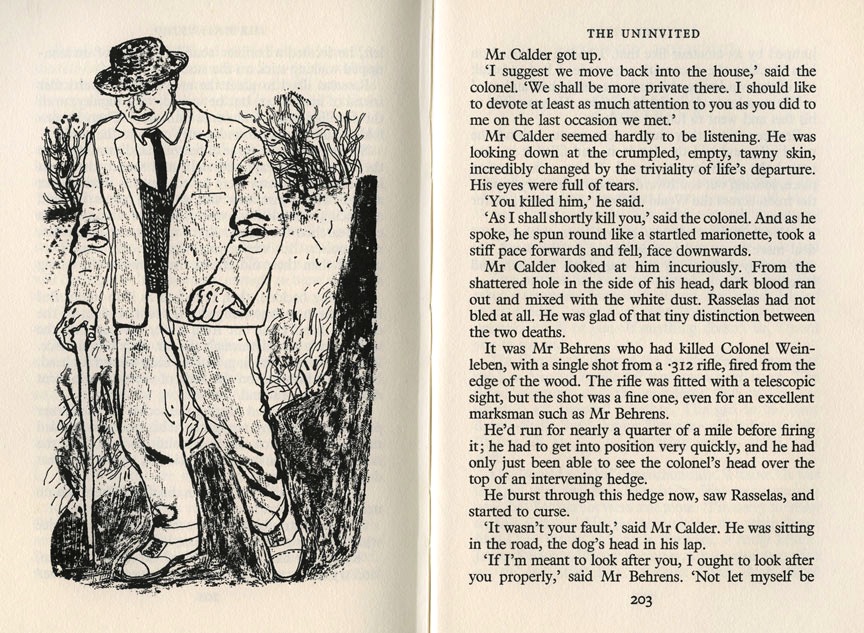
Or at least the front of it; I added it to Beautiful British Book Jacket Design in the gallery's very early days, in the second batch of book covers, I believe. Designed by Jim Russell, it wraps the British first edition of the short story collection Alfred Hitchcock's Sinister Spies, published by Max Reindhart in 1967. I bought this copy in Colin Page Antiquarian Books in Brighton (I think) a few years ago, took a picture of the cover for Beautiful British Book Jacket Design, and then didn't really look at the book again properly until late last year, when I noticed that the Michael Gilbert short story within, "The Uninvited", starring Gilbert's quietly lethal middle-aged secret agents Daniel Calder and Samuel Behrens, didn't appear to be in either of the two Calder and Behrens collections – Game Without Rules (1967) and Mr. Calder and Mr. Behrens (1982). Accordingly I got quite excited, thinking I'd found a "lost" Calder and Behrens tale (and emailed fellow enthusiast Book Glutton to that effect)... until I realised that it was merely one of the stories in Game Without Rules, "A Price of Abyssinia", under another title.


Except not quite: having compared the two – which is the kind of stupendously dreary thing I do when left to my own devices – I've found that there are differences between them, or at least between "The Uninvited" and the version of "A Price of Abyssinia" in my copy of Game Without Rules, which is the British first edition, published in 1968, the year after the US Harper and Row edition of Game Without Rules, and indeed the year after Alfred Hitchcock's Sinister Spies. Evidently someone – either Gilbert or his editor – did some minor rewriting of the story, presumably for (the British edition of) Game Without Rules, although I guess it's conceivable the rewriting was done for "The Uninvited" and "A Price of Abyssinia" is presented as it originally appeared (in Ellery Queen's Mystery Magazine most likely). In any case: largely it's things like serial commas – used much more sparingly in British publications than American ones – which have been altered, but there are more noticeable changes too. Take the opening paragraph or so. Here's how it appears in Alfred Hitchcock's Sinister Spies:

Mr Calder was silent, solitary and generous with everything, from a basket of cherries or mushrooms, to efficient first aid to a child who had tumbled. The children liked him. But their admiration was reserved for his dog.

The great, solemn, sagacious Rasselas was a deerhound. He had been born in the sunlight.

Now here's how it appears in Game Without Rules (the emphasis is mine):

Mr Calder was silent, solitary and generous with everything, from a basket of cherries or mushrooms to efficient first aid to a child who had tumbled. The children liked him. But their admiration was reserved for his deerhound.

Rasselas had been born in the sunlight.

To pick another example, here's a description of Colonel Weinleben, Calder and Behrens' opponent in the story, from Sinister Spies:

He was greatly inferior to the dog, both in birth and breeding.

And the same description in Game Without Rules:

He was the illegitimate son of a cobbler from Mainz and greatly inferior to the dog, both in birth and breeding.


I suppose it's a matter of personal taste as to which you prefer – my preference is for the Game Without Rules version – but it does shed light on how stories can change from publication to publication. However, I do have an additional point which I'm edging towards here, which is that as a result of noticing these differences I was minded to take a closer look at Sinister Spies and read some of the other stories within (each of which is accompanied by a Jim Russell illustration). There's a perfunctory introduction by Hitchcock, a very good Eric Ambler story – more on him anon – and a handful of other stories that are worth a look, but the one that proved a real revelation for me was "The Traitor" by W. Somerset Maugham.


This, I discovered, is one of the loosely linked stories which make up the book Ashenden, or, The British Agent (Heinemann, 1928), which together detail the World War I exploits of Ashenden, novelist turned spy, based on Maugham's own experiences. Not that much of that can be gleaned from "The Traitor": there's no introduction to the story in Sinister Spies, and Ashenden's parallel career as a man of letters isn't mentioned. Regardless, even read in isolation "The Traitor" stands as one of the best pieces of spy fiction I've ever come across – almost languorous in pace and yet packing an emotional punch that's uncommon in the field of espionage writing (John le Carré's Karla Trilogy comes to mind as a useful comparison).

Sent to Lucerne in Switzerland by his boss at British Intelligence, R., in order to convince Grantley Caypor, an Englishman who's been spying for the Germans, to return to Britain, Ashenden spends much of the story seemingly making very little headway in his mission, becoming mildly friendly with Caypor but otherwise idling the days away, taking pleasant naps and latterly fretting over his lack of progress. Unregistered by Ashenden, however, R. has already laid the foundations for Caypor's extraction, and Caypor's fate, even given his betrayal – and though that fate is only guessed at by Ashenden and Caypor's German wife – is vividly brought home in all its awful finality.


It's a beautifully judged, wonderfully written tale, and it left me eager to read further Ashenden stories – which, luckily for me, was as simple a matter as plucking another book from my shelves. Because I own another, slightly earlier anthology of short spy stories which also contains a (different) Ashenden tale – an anthology compiled by the aforementioned Eric Ambler.

Thursday, 16 January 2014

Mr. Calder and Mr. Behrens by Michael Gilbert (Hodder, 1982): Book Review


NB: Linked in this week's Friday's Forgotten Books. Thank you, Patti!

Michael Gilbert published two collections of short stories featuring middle-aged British Intelligence operatives Daniel Calder and Samuel Behrens (and their boss, Mr. Fortescue, who divides his time between dealing with threats to the state and managing the Westminster branch of the London and Home Counties Bank). The first, the brilliant Game Without Rules (Hodder & Stoughton, 1968), I read and reviewed early in 2012, rating it so highly that I eventually placed it at number two in my top ten for that year (and would have happily placed it at number one were it not for another Michael). As a consequence, despite owning a first edition of the second collection, Mr. Calder and Mr. Behrens (Hodder & Stoughton, 1982), for almost as long as I have Game Without Rules, I've sort of been saving it – some form of delayed gratification, I suppose. But the arrival of Edie in May of last year brought with it the realisation that there are only so many hours in the day, and there's little sense in my looking forward to reading something if I ultimately end up never getting round to reading it.


So: Mr. Calder and Mr. Behrens. As I anticipated (not entirely unaided: Olman has a review of the book at his blog), the stories in this second collection are just as good as those in the first: clipped, economical, elegantly written and drily witty. Though a fair number hew to the established format – Calder and Behrens are tasked with investigating and bringing down some traitorous type and typically approach the problem from opposite ends, meeting in the middle – there are still those that buck that trend. The opening tale, "The Twilight of the Gods", which takes us back to World War II and Behrens' role in an attempt on Hitler's life, is like a condensed forerunner of Valkyrie, although the scene where Behrens inadvertently encounters the Fuhrer could more accurately be said to prefigure the bit in Indiana Jones and the Last Crusade where Indy comes face-to-face with Hitler. The closing story, "The Last Reunion", is also Hitler themed, involving as it does Neo-Nazis and a hunt for a recording of Hitler's final message to the people of the Reich, buried at the former site of a prisoner-of-war camp.


The tale I enjoyed the most is "The Decline and Fall of Mr. Behrens" – also fairly atypical, in that no one loses their life or, to any great extent, their liberty, and that Behrens, normally an (occasionally blunt) instrument of the state, turns agent provocateur, assisting a firebrand student in her struggle against the oppressive forces of the University of Middlesex (it also has an excellent payoff which turns on Behrens' Jewish heritage). It's an indication that although Calder and Behrens are very much of the Establishment, middle age has brought with it a more nuanced outlook, one which perhaps reflects Gilbert's own.

I wonder too if Gilbert's opinions can be detected in "Emergency Exit", when Mr. Fortescue informs the Under-Secretary of State that the wife of a Navy Admiral is a Communist agent, to be met by the disbelieving exclamation, "This sounds like something Security Executive has dreamed up" – Security Executive being the fictional intelligence department in the Colonel Charles Russell series of spy novels by the avowedly right-wing William Haggard.

Also in "Emergency Exit" is the hitherto secret origin of Rasselas, Calder's Persian deerhound, whose presence in a number of other stories in Mr. Calder and Mr. Behrens suggests that those stories must be set prior to "A Prince of Abyssinia" in Game Without Rules; as Book Glutton noted in an email to me, the chronology of the tales between the two collections does throw one a tad. Book Glutton also pointed out to me, when I lamented on Twitter after finishing Mr. Calder and Mr. Behrens that there were no more Calder and Behrens stories for me to read, that there are two Calder and Behrens radio plays in the 2009 Michael Gilbert collection The Murder of Diana Devon and Other Mysteries, so I shall have to keep an eye out for that.*


And I did for a while think that I might have found one further story featuring Calder and Behrens, in an anthology of espionage short stories – except as it turned out it was a story already in Game Without Rules under an alternate title. There are some minor differences between the two, however, and the anthology did prove revelatory to me in one other respect, so I'll be exploring all of that in the next post – unless, of course, this Saturday's Lewes Book Fair turns up anything interesting.


* There is also. I later learned, one further Calder and Behrens short story that doesn't appear in either Game Without Rules or Mr. Calder & Mr. Behrens; see this post for more.

Tuesday, 14 January 2014

Michael Gilbert Joins British Thriller Book Cover Design of the 1970s and 1980s

When last I left my British Thriller Book Cover Design of the 1970s and 1980s gallery, the number of dust jackets and paperback covers therein stood at an impressive 120. But I've still not exhausted my supply of '70s and '80s thrillers, and at the head of the queue to join the gallery is Michael Gilbert.

I've written about Gilbert in any depth just twice before, when I reviewed his 1956 spy thriller Be Shot for Sixpence last year, and his 1968 collection of espionage short stories featuring middle-aged spies Mr. Calder and Mr. Behrens, Game Without Rules, the year before. But though he's only cropped up a handful of times on Existential Ennui in total, behind the scenes I've quietly been collecting all manner of Michael Gilbert first editions, the selection in this post merely representing those that fit the remit of British Thriller Book Cover Design of the 1970s and 1980s (i.e. they were published in the '70s and '80s). The remainder of those books – some of which are highly intriguing – will have to wait for another time; for now, here are the Michael Gilbert jackets – all of which wrap the British firsts of the novels – which have joined the British thriller cover design gallery.


The Body of a Girl (Hodder & Stoughton, 1972); jacket design by Rene Brown
An impulse online purchase this one, bought for a few quid from an Amazon Marketplace seller after a first edition I was watching on eBay sold for more than I was prepared to pay. Gilbert also wrote a 1958 television play with the same title, although whether the novel is based on the play I've not been able to determine. The novel's lead, DCI Mercer, would go on to feature in three short stories in the 1997 collection The Man Who Hated Banks and Other Mysteries (that info gleaned from Martin Edwards's fine overview of Michael Gilbert's life and work).


The Empty House (Hodder, 1978); dust jacket uncredited
I believe I bought this one off the legend that is Jamie Sturgeon, at the Midhurst Book Fair. Like most of the books in this post, I've yet to read The Empty House, but should you wish to learn more about it (other than reading the jacket flap copy above), there's a brief but illuminating review by author Dana Stabenow on her website.


Death of a Favourite Girl (Hodder, 1980); jacket design by Melvyn Gill
A holiday purchase, as featured in the Framlingham leg of the Jones-Day 2013 Suffolk vacation. Death of a Favourite Girl was published in the States (the same year as the Hodder edition, by Harper & Row) under the title The Killing of Katie Steelstock, a title which was subsequently adopted for the British paperback edition, published by Penguin in 1981.


Mr. Calder and Mr. Behrens (Hodder, 1982); dust jacket uncredited
Gilbert's second collection of Calder and Gilbert espionage short stories, following Game Without Rules. I shall be coming back to this one...


Trouble (Hodder, 1987); jacket by McNab Design
A Lewes Book Bargain, no less, purchased in Lewes' A&Y Cumming secondhand bookshop a good few years ago now.


Young Petrella (Hodder, 1988); dust jacket uncredited
Another short story collection, this one focusing Sergeant Patrick Petrella's adventures – the second such collection, in fact, the first being 1977's Petrella at Q. The jacket photograph uses a similar device to that on the Mr. Calder and Mr. Behrens wrapper, with the titles of the stories within shown as, respectively, notes on a pad and filing cabinet dividers. I wouldn't be at all surprised if both were the work of the same photographer – and possibly Death of a Favourite Girl, too, which would make all three the work of Melvyn Gill.

I'll be staying with Michael Gilbert for the next post, which will be on the aforementioned Calder and Behrens...

Wednesday, 1 February 2012

Game Without Rules (Hodder & Stoughton, 1968) by Michael Gilbert: Book Review, plus Mr Calder and Mr Behrens (Hodder, 1982)

Well look at that: Existential Ennui is five years old today. Now, before we get all carried away n'shit (shyeah, right), I should point out that 1 February is really only technically Existential Ennui's birthday. When I originally set this blog up in 2007, it was as a back-up to another, long-defunct blog; I didn't really begin posting properly on Existential Ennui until July 2009, and Existential Ennui didn't really become what it is today – i.e. a pompous, pretentious, prolix books blog – until the following year. So I'll forgo any celebrations, if you don't mind – not that anyone would be celebrating the anniversary of this utter waste of everybody's time anyway – and carry on regardless, with a spot more spy fiction.

And if you've been following my series of posts on spy fiction series, you might have noticed that the tendency has been to post an introductory essay to whichever spy series I'm blogging about at that juncture and follow that with one or more subsequent posts on various novels in that series. But not this time. This time, just for a change, I'm keeping it all in one single, solitary post – partly because, including Monday's post on Desmond Cory's Secret Ministry, by the end of the week I'll have posted three pretty lengthy reviews*, and I'm afraid I can only devote so much time and effort to this blog (and yes, astonishing as it may seem, a certain amount of time and effort does go into Existential Ennui); but also because this particular spy series doesn't consist of novels, but rather of short stories...


First published in hardback in the UK by Hodder & Stoughton in 1968 – the year following the 1967 US Harper and Row first edition – under an attractive dustjacket designed by the appealingly monikered Mick and Ging, Game Without Rules is a collection of short stories by crime and suspense writer (and lawyer) Michael Gilbert, starring two late-middle-aged British Intelligence operatives named Mr. Calder and Mr. Behrens. The Hodder edition seen here is quite hard to come by these days – there are only a few on AbeBooks at the moment, and a presentable example will set you back at least £50–£100 – but in truth the book isn't common in any edition; it fell out of print years ago and at time of writing AbeBooks has just twenty copies in total.


Most of the stories in this collection originally appeared in Ellery Queen's Mystery Magazine in the early- to mid-1960s – which is probably why, despite Gilbert being British, the American edition of the collection preceded the British one – and they are, quite simply, some of the best espionage tales I've ever read. Resting somewhere on the spy slide rule between John le Carré's Smiley stories and Anthony Price's David Audley novels – I wouldn't be at all surprised if Mr. Gilbert were an influence on Mr. Price in particular – the Calder and Behrens tales share with le Carré's work a healthy distrust of the establishment and with Price's an unshakable belief in the seriousness of the Soviet threat. But in common with both of those authors' novels they're also fine mysteries, with plausible scenarios, deft characterisation, believable dialogue, lashings of wry observation and wonderful pay-offs.


Both in their fifties, Samuel Behrens and Daniel Joseph Calder work for Mr. Fortescue, ostensibly the manager of the Westminster branch of the London and Home Counties Bank – where he is based – but in fact "the controller and paymaster of a bunch of middle-aged cutthroats known as the 'E' (or External) Branch of the Joint Services Standing Intelligence Committee" ("The Spoilers"). Behrens and Calder live not far from each other in the Kentish North Downs, in a fictional village named Lamperdown; Behrens lives with his aunt in the The Old Rectory, and Calder lives with his loyal Persian deerhound, Rasselas, in a cottage on Hyde Hill overlooking the village. The two men do not reside close by each other by chance; we learn that they do so in order to watch over one another, their line of work frequently being a dangerous one.


Gilbert's Calder and Behrens stories are clipped and economical – of necessity, being short – but still manage to pack a hell of a lot in; at one point in "The Spoilers" nothing less than the survival of democracy in Britain seems to be at stake, while the European chase in "Cross-Over" could fuel an entire Bond novel. Indeed, reading one of these short tales is akin to reading a full novel, so complete is the experience.

As characters, Calder and Behrens (and Fortescue) can be ruthless, but they're also pragmatic; while in "The Road to Damascus" an enemy agent is summarily executed by Mr. Calder upon a signal from Mr. Behrens, in "On Slay Down" a target is ultimately made an offer rather than, well, offed. But Calder and Behrens are certainly devious – as are the plots in which they find themselves, full of twists and hidden agendas; "Prometheus Unbound", for example, which sees Mr. Calder losing his marbles and boasts a tense pursuit and stand-off in London's Latin Quarter, genuinely keeps you guessing right up till the very end. And in Mr. Calder's dog, Rasselas, the two men possess a secret weapon who helps resolve more than a few plot points – although Rasselas also provides perhaps the most affecting moment in the entire book.


Game Without Rules isn't the only collection of Calder and Behrens stories; a second collection, Mr Calder & Mr Behrens, followed the first one in 1982, again published by Hodder & Stoughton in the UK. As with Game Without Rules, though, Mr Calder & Mr Behrens has slipped out of print, and there are currently fewer than twenty copies of any edition on AbeBooks (although they are more affordable than copies of the former). And of those (fewer than) twenty, only one is the Hodder first: an ex-library copy, possibly missing its jacket. My Hodder first came from the always-dependable Richard Sylvanus Williams of Winterton in North Lincs, but I've yet to read it. My learned friend Olman has, however, and you can find his review here, along with one or two other Michael Gilbert reviews (Olman's something of a Gilbert aficionado). There's also a good overview of all of Gilbert's work here, and a fine Guardian obituary by the late critic and crime novelist H. R. F. Keating here.

I'll be returning to Messrs Calder, Behrens and indeed Gilbert before too long – I have a couple of other Michael Gilbert books besides Mr Calder & Mr Behrens to blog about, one of which is a collection of short stories featuring a policeman who makes a brief guest appearance in Game Without Rules. Next, though: a spy series which began life as a crime series...

*UPDATE 2/2/12: At least, that was the plan. It now looks unlikely that I'll have time to finish that third review before the week's out, so it'll have to wait a while. Hey: that's blogging!