Showing posts with label association copy. Show all posts

Wednesday, 16 July 2025

Signed Patricia Highsmith Books: Edith's Diary, People Who Knock on the Door and Found in the Street

As I mentioned in my post the other week on a significant (to me, if no one else) piece of signed Patriciaphernalia relating to Ripley's Game, I also have several signed Patricia Highsmith first and other editions I've been meaning to blog about for bloody ages – which, in order of publication, are as follows:


A 1977 Heinemann first edition of Edith's Diary, Highsmith's seventeenth novel. I've blogged in brief before about a previous copy of this edition, bought in 2010 in the Chichester branch of Kim's Bookshop (which, I've only just learned, closed down last year, though the Arundel branch still seemingly prospers) and subsequently sold to, I think, my friend Ric, co-proprietor of Lewes's fine (and pretty much only these days) secondhand and antiquarian bookshop Bow Windows. (And in a pleasing instance of serendipity, just the other day Ric drew my attention to Elena Gosalvez Blanca's piece about her time as Highsmith's assistant, in which Blanca highlights Edith's Diary as her favourite Highsmith.) This copy, however, is signed on the title page:


And dated 21 November 1988, a good decade on from publication. What Highsmith was up to on that particular day I couldn't say – while I own Edith's Diary, I don't own Highsmith's Her Diaries and Notebooks, if that day is even mentioned in there – but Andrew Wilson's 2003 biography Beautiful Shadow suggests she might have been in America, where this copy came from. Evidently whatever she was doing included signing a book, and three years earlier, around summer 1985, Highsmith was also signing books:


Namely the first American edition of her nineteenth novel, People Who Knock on the Door, published by Penzler Books in a numbered, limited, signed edition in September 1985:


One of half a dozen of Highsmith's works published by Penzler in signed limited editions, this is another book I've blogged about before (again back in 2010) in its 1983 Heinemann first edition, when I was in the process of securing firsts of as many Highsmiths as I could. And would you believe it I've blogged about the final book I'm showcasing before too, although not this particular edition:


An uncorrected advance proof of Found in the Street, Highsmith's twenty-first novel, published in the US in 1987 (the year after the UK Heinemann first edition) by Atlantic Monthly Press, with whom Highsmith signed after Otto Penzler dropped her dedication to "the Palestinian people and their leaders" from the above-showcased US edition of People Who Knock on the Door. This one I can state with reasonable certainty when and where it was signed, as it's an association copy originally belonging to Greg Gatenby, founding artistic director of the Toronto International Festival of Authors; his ownership signature can be seen on the half-title page above Highsmith's signature:


In October 1987 Highsmith was a guest at the festival, where she was interviewed for Sight & Sound magazine by film critic Gerald Peary, who noted what a coup her appearance was. According to Andrew Wilson, on 20 October, as part of her festival duties, Highsmith read from Found in the Street at Toronto's Harbourfront – and that locale, I would hazard, is where this proof of the US edition was signed.

Wednesday, 11 January 2017

Signed Inscribed Tom Ripley Books: Patricia Highsmith's Ripley Under Ground and The Boy Who Followed Ripley

I'm of a mind to post some of the signed books I've acquired over the past year or two – at least, I'm of a mind as I type this; whether or not I'll remain of a mind to do so, or indeed retain any enthusiasm for blogging whatsoever, remains to be seen. For now, though, here's a pair of signed Patricia Highsmith books, both of which are novels in my abiding obsession, the Tom Ripley series.


On the left is a 1970 US Doubleday Book Club Edition of Ripley Under Ground, the second novel in the five-book Ripliad, and on the right a 1980 US Lippincott & Crowell first edition of The Boy Who Followed Ripley, the fourth novel in the Ripliad. The dust jacket design on Ripley Under Ground is by Alex Gotfryd, while the dust jacket design on The Boy Who Followed Ripley is by Pat Voehl.


Ripley Under Ground has been signed, inscribed ("Best to you") and dated (19 May 1981) by Patricia Highsmith on the half-title page – in pencil, unusually (every other signed Highsmith book I own – a dozen in total – has been signed in pen). As noted, it's a book club edition, which ordinarily would make it less interesting to me, but it's the only signed copy of Ripley Under Ground – not just one of my favourite novels in the Ripliad but one of my favourite Highsmiths, and therefore one of my favourite novels, full stop – in any edition I've ever come across, so it's a remarkable thing indeed.


The Boy Who Followed Ripley is an association copy, signed by Highsmith on the front free endpaper and inscribed to Lou Kannenstine – or rather "Kannenstein", as Highmith has misspelled it. Kannenstine, who died in 2014, was the publisher of Foul Play Press, an imprint of Countryman Press which issued crime and mystery novels by, among others, Reginald Hill, Max Allan Collins and another abiding preoccupation of mine, Donald E. Westlake (the three Grofield novels written as Richard Stark).


I've added both books to the Existential Ennui Patricia Highsmith First Edition Book Cover Gallery (under 'Patriciaphernalia'), where my inscribed association copy of the fifth Ripley novel, Ripley Under Water, also resides – meaning I now own three-fifths of the Ripliad in signed editions (two copies in the case of Ripley Under Water). And if the mood takes me, I'll be posting some other signed Highsmiths soon.

Thursday, 19 November 2015

Touch by Elmore Leonard: Signed Inscribed First Edition (Viking, 1988); Book Review


There's an introduction in the 1988 UK Viking first edition of Touch – and, I expect, in other editions of the book too, not least the 1987 US Arbor House first – wherein Elmore Leonard explains why it took ten years for the novel to be published. Falling in Leonard's backlist between Bandits (1987) and Freaky Deaky (1988), Touch was actually written in 1977 "and, within a couple of months, rejected by more than a dozen hardcover publishers", as Leonard puts it. "The rejections were cordial enough; there was no quarrel with the prose. One editor called it, 'Probably the best writing you have done to date.' Another said, 'It is simply that the subject, no matter how well written it is, seems altogether mystifying.'"

Though the novel was finally accepted for publication in 1978 as a paperback original, so difficult to categorise did the publisher find the book that it languished on their shelves for a few years thereafter while they tried to work out what the hell to do with the thing. Eventually Leonard requested that the rights be reverted "and the publisher complied, probably with a sigh of relief"; Leonard then sold the book to Arbor House.


Leonard seems to concur with his original (non-)publisher in his introduction to Touch when he states that the novel is "way off-trail compared to what I usually write", and in terms of subject matter at least he has a point: the story is about a former Franciscan monk, a young man named Juvenal, who apparently possesses the ability to heal the sick and who displays stigmata on his hands, feet and side whilst doing so – not exactly Swag or The Hunted or City Primeval, then. However, in tone, style, meandering plot and above all in terms of characters, Touch is unmistakably the work of the writer of Swag (1976), The Hunted (1977),  City Primeval (1980) and especially classics like The Big Bounce (1969), Unknown Man No. 89 (1977), Split Images (1981), Stick (1983) and LaBrava (1983). In other words, it's an Elmore Leonard novel, and one of his very best at that.

It's worth noting too that despite the ostensibly off-beam subject matter, in true Leonard fashion there is still a con and a potential payday driving the narrative, although it's not Juvenal who's doing the conning, nor Lynn Marie Faulkner, the spunky record promotor with whom he falls in love, though she does initially seek him out at the Sacred Heart Center – the Detroit detox clinic where he works – for precisely that reason. Instead it's a pair of prime Leonard grotesques who want to use Juvenal for their own ends: Bill Hill, a medallion-wearing (bearing the legend "Thank You, Jesus") former church leader – he administered the Uni-Faith Church, which boasted "The World's Tallest Illuminated Cross of Jesus, 117 feet high" (plus "the Pilgrims' Rest Cafeteria and Gift Shop, where they sold Heavenly Hash candy, ten-inch battery-operated replicas of the World's Tallest Illuminated Cross of Jesus, WTICOJ T-shirts...") – who, with one eye on the likes of Billy Graham and the other on the Frost/Nixon interviews, perceives a way of turning a profit on Juvenal; and August Murray, stiff-necked, clenched-arse copy shop owner and commander of the Gray Army of the Holy Ghost, who seeks to recruit Juvenal to his righteous cause.

Touch also touches on another abiding Leonard concern, especially around the period it was written (see also Unknown Man No. 89), that of alcohol abuse (the writer was a functioning alcoholic during much of the 1970s). But he's never judgemental about it, and nor is he, despite Bill Hill and August Murray's shortcomings, about the mystical or religious aspects of the story. "Touch is about accepting what is," he writes in the introduction, an attitude which would also inform his later novel, the Raylan Givens-starring Riding the Rap (1995), which features a psychic, Reverend Dawn (who also appears in 2009's Out of Sight sequel Road Dogs), about whom Leonard again offers no judgement. Certainly Juvenal's bizarre abilities seem genuine, best exemplified by a bravura midpoint scene in a church where Leonard (uncharacteristically) flits between five or six different character POVs in order to show Juvenal's miraculous power, and a climactic, brilliant, farcical TV interview conducted by a rictus grinning hairpiece-bedecked towering shit of a host which is about the best sequence I've read in a Leonard novel.


The copy of the Viking edition of Touch seen in this post (dust jacket design by Bet Ayer, jacket photo by James Walker), fairly recently acquired (and not to be confused with the copy I bought in Essex two years ago), is a signed one, inscribed by Elmore Leonard to a John Newland. I've no way of ascertaining whether that might be this John Newlanddirector and host of classic paranormal TV anthology series One Step Beyond, but given the subject matter of the novel, it would be rather fitting if it were (and would make my copy of the book an association one). In any case, it's a nice way to round off this current series of posts on inscribed books. I do have some more signed and inscribed books I've yet to blog about (including another Leonard one), but those will have to wait for the new year; apart from anything else, there are a couple of other Elmore Leonard books I'd like to post reviews of before I get to those.

Tuesday, 10 November 2015

Right as Rain by George Pelecanos (Little, Brown, 2001): Signed Association Copy; Derek Strange and Terry Quinn Series Book 1

I'll have news on further eBay auctions very soon, should anyone be interested, but in the meantime I've some more inscribed books I'd like to blog about. Like this one:


An American first edition/first printing of Right as Rain by George P. Pelecanos, published by Little, Brown in 2001, dust jacket design by Paul Sahre incorporating a photograph by Michael Northrup. Pelecanos's ninth novel, it's also the first in his three-book series starring Washington, DC cops-turned-private investigators Derek Strange and Terry Quinn (there are a couple more books which feature just Strange), and details how the two met: Strange is hired to look into the shooting incident which left an off-duty black cop dead and saw Quinn leave the force. I liked it a lot, at least as much if not more than the other Pelecanos novels I've read (namely The Way Home, 2009, The Cut, 2011, and What It Was, 2012); it unfolds at a deliberately measured pace and Strange in particular is a compelling creation, a generally decent man whose major fault is an unwillingness to confront his own self-destructive tendencies.


I came across this copy in the bargain basement of Any Amount of Books on Charing Cross Road, London, at the start of the year, priced at £4 – possibly at oversight on the part of the proprietors, who perhaps overlooked the presence on the title page of Pelecanos's signature and an accompanying inscription – "With admiration" – to his fellow crime novelist John Harvey:


Now, it's fair to say that signed Geoge Pelecanos books aren't exactly hard to come by: AbeBooks alone lists well over a thousand books flat signed by Pelecanos, with prices starting at a few pounds, and I imagine there are hundreds more available on eBay, Amazon Marketplace and on the websites and physical premises of any number of bookshops. (I myself own two flat-signed Pelecanos first editions: the aforementioned What It Was and a 2005 British first edition of Drama City). However, books which have been both signed and inscribed by Pelecanos – if that's the sort of thing which floats your boat (which it does mine) – are in rather shorter supply – there are more like 70 of those listed on AbeBooks at present – and signed and inscribed association copies are positively uncommon, with, as I type, just two such items listed online, one priced at over £150, the other at over £300. So I'm pretty pleased with my four quid score.

By the way, the postcard resting on the 'Also by' page, depicting William H. Johnson's Going to Church, hails from the Smithsonian American Art Institution in Washington, and was slipped inside the book, which makes me wonder whether it was enclosed by Pelecanos himself – being, as he is, a resident of DC – or perhaps by Harvey on a visit to the city; indeed, maybe that's how the book came to be inscribed.*


One of the blurbs on the back of the book is by Elmore Leonard, a writer of whom Pelecanos is an admirer – among his favourites are Valdez is Coming (1970), which actually gets a mention in Right as Rain (Terry Quinn, who's working in a used book store, tells Derek Strange it's "just about the best" western), Swag (1976) and Unknown Man No. 89 (1977; Pelecanos references that one in The Cut) – and also, arguably, his most direct descendant, both stylistically and in terms of subject matter and even characters. (Two of the bad guys in Right as Rain, Ray Boone and his "daddy", Earl, wouldn't be out of place in a Leonard story.) And it's to Leonard that I'll be turning next, with an inscribed copy of a brilliant and unjustly overlooked novel, written in the mid-1970s but not actually published until the mid-1980s.

. . . . . . . . . .

* Addendum: Shortly after I posted this I made contact with John Harvey on Twitter. John confirmed that the postcard was his – "that artist has long been a favourite" – and furthermore that George Pelecanos was also a favourite and that John hadn't intended to part with this copy of Right as Rain at all; it had got mixed up by mistake with a bunch of unwanted books – "rejects & doubles, or so I thought!" – that John sold a year or so ago. In light of which, I've offered to return Right as Rain to John, and John has kindly agreed to inscribe one of his books for me. Exactly which book, I'll reveal down the line.

Thursday, 15 October 2015

Jimmy Sangster's John Smith Spy Novels: private i (Triton, 1967); Signed Inscribed First Editions

NB: Linked in Friday's Forgotten Books, 16/10/15.

When Jimmy Sangster died four years ago, his obituaries naturally concentrated largely on his film and TV work (see The Guardian, The Independent, The Telegraph and The New York Times). Sangster was a key figure in the revival of Hammer Films in the late 1950s and through the 1960s; he wrote The Curse of Frankenstein (1957), Dracula (1958), The Mummy (1959) and two dozen other Hammer horrors before moving to America, where he wrote for The Six Million Dollar Man, Kolchak: The Night Stalker, Ironside, Wonder Woman and a bunch more US TV shows.

But Sangster also penned eight novels (plus a couple of novelisations of his own screenplays) besides his film and television work: three murder mysteries published from 1986–88 (1989–90 in the UK) starring expat former Scotland Yard investigator James Reed; one standalone thriller-cum-farce published in 1971 starring gun-running adventurer Anthony Bridges; two spy thrillers published from 1968–70 starring British Intelligence agent Katy Touchfeather; and two half-spy/half-mystery novels published from 1967–68 starring ex-British Intelligence operative turned private investigator John Smith, the first of which is this:


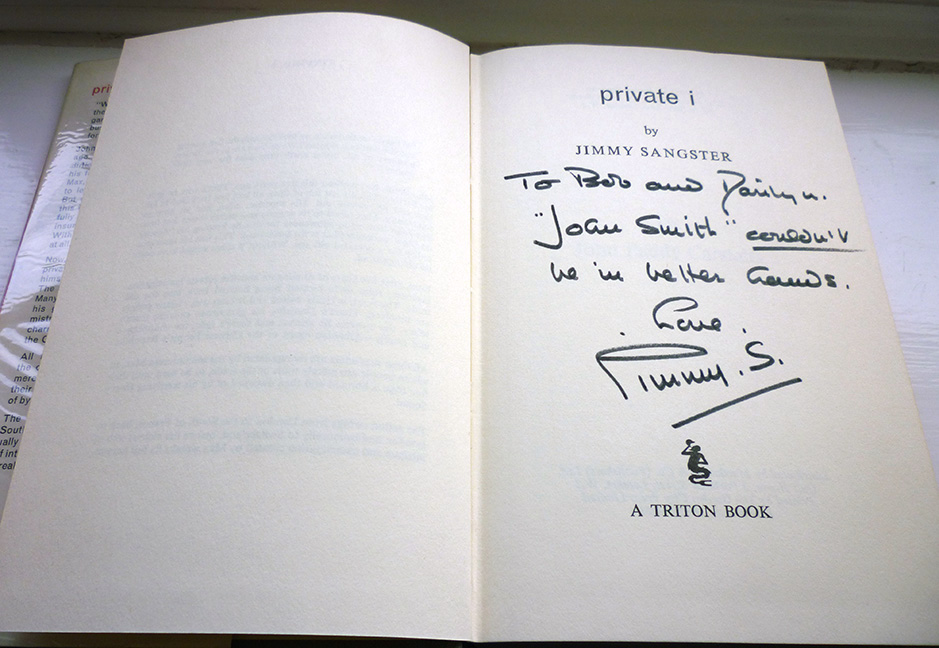
Or rather, these: private i, published by Triton in 1967, dust jacket design by Collis Clements. Now, I suppose the immediate question here is, why do I have two copies of the same book? Answer being, having learned about Sangster's parallel career as a writer of spy fiction (from screenwriter and novelist Stephen Gallagher, no less), I went in search of a first edition of his debut novel – private i – and came across two copies, both of which boasted intriguing inscriptions (written by Sangster, as far as I can determine; the handwriting is a little different in each book, but there are enough similarities – the same black maker pen used, corresponding letterforms – that I'm fairly confident they're from the same hand), one of which being an association copy. And since both books were relatively inexpensive – and being the hopeless case that I am – I bought both of them. (Whether or not I'll keep both of them remains to be seen – I'm planning on doing some eBaying soon.)

The copy on the left has a poem inscribed on the front free endpaper:


It reads:

Roses are Red.
Violets are Blue.
I'll lay odds
I'm higher than you.

Violets are Blue
Roses are Red
If I could find the strength
I'd drag you to bed

Drifting around in a Pale Velvet haze
What a wonderfull way to pass all our days.

Love, Jim xxxx

I've no idea who the poem was written for (although I'd dearly love to find out), but I do know who the other copy of the book, the association copy, was inscribed to, this time on the title page:


The inscription reads:

To Bob and Marilyn.

"John Smith" couldn't be in better hands.

Love

Jimmy S.

Bob and Marilyn are the American actor Robert Horton and his wife; Horton starred in Wagon Train from 1957–1962 and featured in numerous other television series, films and TV movies, one of which being the 1969 television film The Spy Killer, directed by Roy Ward Baker, produced by Jimmy Sangster and with a teleplay by Sangster based on his own novel... private i.


I've not seen The Spy Killer – although there is a clip on YouTube of the opening five minutes, featuring Horton as John Smith walking through Berwick Street Market to the baritone strains of what sounds like Scott Walker (although actually the rather less-well-known John Rowles), and the reviews on IMDB are positive – but I have read private i, and can report that it's a cracking piece of spy fiction – kind of early le Carré crossed with Len Deighton's unnamed working class secret agent and with a dash of Adam Hall's Quiller mixed in for good measure. Narrated by Smith, one-time operative with the Service – i.e. British Intelligence – turned down-at-heel private investigator, it starts out in a cut-price seedy gumshoe vein, with Smith employed by his ex-wife to obtain evidence of her new husband's gay affair, before taking a sharp left turn into the dangerous world of international espionage, as Smith is press-ganged back into service by his former boss, the ruthless and manipulative Max.

The plot is suitably murky and twisty, involving murder, coded secrets and both the Chinese and Russian security services, but it's Smith's sardonic narration which really lifts the thing. When three pages into a spy novel the lead states that he's "nearly two stone overweight, that my digestive system plays up constantly, that my teeth aren't particularly good, and that I have suffered periodically from halitosis, B.O., prickly heat and dandruff", you know you're not in the realm of Bond, and Smith spends the remainder of the novel boozing, leching, failing to get it up with his indifferent girlfriend and crashing around like the low rent – and yet, on occasion, lowly cunning – loser that he is. The only real downside is a regrettable streak of homophobia which runs through the narrative, but even that can be put down to Smith's boorish nature and the prevailing attitudes of the time rather than to whatever prejudices Sangster might or might not have held. And anyway, I can forgive a multitude of sins in any example of the spy fiction form which contains an irreverent passage like this one:

I poured myself a large drink, and read the evening paper. I washed up some dirty dishes and rinsed out a couple of pairs of socks. I washed a nylon shirt and hung it up to dry. I had another drink which I took with me to the bath. I trimmed my toenails, had a crap, read the evening paper again, and then had a shave. After that there seemed to be nothing left to do but to phone Berat's contact and tell him about the rendezvous.


The second and final John Smith spy thriller, Foreign Exchange, was published by Triton in 1968 (and filmed for television in 1970, again with Robert Horton in the lead role), and it's almost as good as private i, sending Smith to Russia as part of a complicated Cold War spy swap plot. A full review will have to wait for another time, however; this post is quite long enough as it is. For now, I invite anyone interested in learning more about the novel – and in reading contemporaneous reviews of private i – to click on the above images of the dust jacket of the Triton edition (designed by Alison Storey).

Monday, 12 October 2015

Big Morning Blues by Gordon Williams (Hodder, 1974): Signed and Inscribed First Edition

Authors inscribe books to all sorts of people and for all sorts of reasons. Sometimes they inscribe them for fans, to add a personal touch; sometimes they inscribe them to friends or confidants, to associates, acquaintances or correspondents, to family or loved ones. Sometimes they inscribe them to fellow writers and their spouses, to journalists, interviewers, filmmakers and, yes, bloggers. They might inscribe them to folk who've helped them in some way with that book or with their career – to their publisher or editor, their translator or again some friends – or who they've worked with in film or TV – a co-writer maybe, or an actress. Or they might inscribe a book with the express intention of seeing that book turned into a television series, as is the case with this one:


Big Morning Blues by Gordon Williams, published by Hodder & Stoughton in 1974, dust jacket design by Jeff Godwin, who I'm guessing is Jefferson Godwin, designer of the jacket for the 1973 Hodder edition of Brian Garfield's Death Wish; in any case, I've added Godwin's jacket for Big Morning Blues to British Thriller Book Cover Design of the 1970s and 1980s, even though the novel's not so much a thriller as an evocation of London's hard-drinking underworld, or "The Rookery", as the story has it (reviews here and here).

Williams is probably best known these days as the writer of The Siege of Trencher's Farm (1969), filmed by Sam Peckinpah in 1971 as Straw Dogs, but he has well over a dozen other novels to his credit, including The Man Who Had Power Over Women (1967), which was filmed in 1970, and four novels co-written with football manager Terry Venables, three of them a series (published by Macmillan from 1974–76 under Williams and Venables' joint pen name, P. B. Yuill) starring cockney private eye James Hazell which begat an ITV show, Hazell, in 1978.


Evidently Williams imagined Big Morning Blues had telly potential too, because this copy of the book – which I acquired from book dealer Jamie Sturgeon – has the following inscription on the half-title page:


The inscription reads:

Dear Jacky,

Could you read this quickly with a view to making an offer for network dramatisation?

Best wishes,

Gordon

I've not been able to work out who "Jacky" is – Williams's agent? A television producer? – but I don't believe the novel ever did make it onto the telly (at least not according to IMDB). Unlike the next inscribed book I'll be blogging about: a 1967 spy thriller by a writer who was instrumental in the rebirth of Hammer Films.

Tuesday, 6 October 2015

The 100 Kilo Club by Simon Gandolfi: Signed Inscribed First Edition (Wildwood House, 1975)

Following on from that signed and inscribed association copy of Patricia Highsmith's Ripley Under Water I blogged about last week, I thought I'd post a bunch more inscribed books, all of them relatively recently acquired. Some are books by authors I've been well into for a while and have written about on Existential Ennui before; some are by authors I've discovered in the last year or so and who consequently will be making their Existential Ennui debuts; one or two are association copies, i.e. inscribed to notable folk associated with the author or to fellow writers; and some simply sport inscriptions which are in some way intriguing. Like this book:


The 100 Kilo Club by Simon Gandolfi, published by Wildwood House in 1975, dust jacket design by Richard Ward – said dust jacket now added to the British Thriller Book Cover Design of the 1970s and 1980s gallery, being, as it is, a classic of the form (briefcase, banknotes – rolled into spliffs in this instance – and a small stack of cannabis resin, no less). The story of an international game of cat-and-mouse between FBI agent Patrick Nolan and a dope dealer named Pleasure, it was Gandolfi's second novel, following 1965's Even with the Shutters Closed. He went on to pen five spy thrillers in collaboration with Alistair MacLean – the Trent series, published from 1992 to 2000 – and more recently a travelogue, Old Man on a Bike, detailing his own exploits as a septuagenarian motorcyclist making his way across South America. Indeed it's his peripatetic inclinations which seem to have inspired the inscription in this copy of The 100 Kilo Club.


It reads: "For Nick and Sue in loving memory of eight hundred fleas, one couch, one dog and a French au pere [sic]." As tantalising as that is, though, just as curious is what's written on the rear endpaper, possibly even in the same hand:


A telephone number for La Fonda on the Plaza hotel in Santa Fe. Make of all that what you will.*


I bought this copy of The 100 Kilo Club off book dealer Jamie Sturgeon, one of a handful of inscribed books I've acquired from Jamie over the past six months (typically at the Lewes Book Fair), some of which I'll be showcasing down the line. Whether or not I'll ever get round to reading this one is a moot point, but I have read the next inscribed book I'll be blogging about: a 1958 spy thriller written under a pen name by Peter George.

* Or simply read the comments to this post.

Wednesday, 30 September 2015

Patricia Highsmith's Ripley Under Water: Signed Inscribed Association Copy (Bloomsbury, 1991)


NB: Linked in Friday's Forgotten Books, 2/10/15.

In September 1991, Patricia Highsmith travelled from her home in Tegna, Switzerland, to London in order to publicise her latest book, Ripley Under Water – her third for Bloomsbury (following 1987's Tales of Natural and Unnatural Catastrophes and 1990's Carol) and the last to be published in her lifetime (a final novel, Small G: A Summer Idyll, was published shortly after her death in 1995). One of her publicity engagements was an interview before an audience at the ICA on 27 September, conducted by the crime writer Michael Dibdin – since made available on the British Library website (archiver, incidentally, of Existential Ennui). Later that evening Highsmith signed copies of the Bloomsbury first edition of Ripley Under Water at the late lamented Murder One on Charing Cross Road (and again the following day at Waterstones in Earls Court); but at some point on the day before, 26 September, she inscribed, signed and dated a copy of the book to her publisher, Liz Calder. This copy:


Which I acquired from Suffolk bookseller Claude Cox, and which came with an accompanying letter of provenance, signed by Liz Calder, on Full Circle Editions headed paper – Full Circle being the Suffolk publishing house Calder established in 2009 – the year after she left Bloomsbury – with her husband, Louis Baum, and Genevieve and John Christie.


I wrote about Ripley Under Water, the final novel in the Ripliad, back in 2013 as part of the Great Tom Ripley Reread, when I got my hands on a 1991 London Limited Edition of the book, flat signed by Highsmith. I mentioned then how as a Highsmith and Ripley enthusiast – okay, fanatic – "owning a signed Ripley novel is quite something"; so to have now come into possession of a signed association copy of a Ripley novel – even though it be the same Ripley novel, albeit in a (slightly) different edition – inscribed to such a key figure in Highsmith's life, is properly thrilling. (The book wasn't too expensive either, certainly in comparison to another association copy of Ripley Under Water currently listed on AbeBooks, a 1992 US Knopf edition inscribed to a literary agent and priced at around £250.)

In her accompanying letter, Liz Calder states that she "met Patricia Highsmith during the last years of her life and published several of her books", making note of the time "Highsmith came to London for publication" of Ripley Under Water and how Highsmith "was a gravel-voiced, quite shy but darkly funny woman who loved whisky and cats". Writing in The Oldie the month after Highsmith's death (March 1995 issue, as quoted in Andrew Wilson's 2003 biography of Highsmith, Beautiful Shadow), Calder recalled that publicity trip to London, when Highsmith stayed at Hazlitt's Hotel on Frith Street, Soho:

I collected her there for an evening on the town, and she had discovered that so crooked were the floors that her whisky bottle slid of its own accord down the top of her chest of drawers and she was catching it with glee as it flew off the edge. She kept repeating this trick a bit like Pooh and his balloon. She had a childlike pleasure in simple things.


Ripley Under Water is not the best Tom Ripley novel, nor my favourite (that would be 1974's Ripley's Game, in both cases), but I love the Ripliad as a body of work and Ripley Under Water is an intrinsic part of that series – a sequel of sorts to the second Ripley novel, Ripley Under Ground (1970), with a handful of excellent and memorable sequences which are the equal of anything else in the Ripliad (Tom luring his nemesis, David Pritchard, to a secluded seaside Tangier cafe and then losing his rag with Pritchard and beating him up; Tom and Ed Banbury's gruesome disposal of the remains of the art dealer Murchison; the final fate of David and Janice Pritchard). So I'm delighted to add to my Highsmith collection a unique signed copy of the novel, and especially one with so firm – and firmly dated, not to mention located – a provenance.


I'll be showcasing some more inscribed books over the coming weeks – not by Highsmith, although I do have a couple of other signed books by her I'll be unveiling at some point – but by other authors, some of whom have appeared on Existential Ennui before, and some who have not.

Tuesday, 3 March 2015

Patricia Highsmith's The Man Who Wrote Books in His Head: Signed Inscribed Edition (Eurographica, 1986)

NB: Included in Friday's Forgotten Books, 6/3/15.

Much as I love a beautiful dust jacket (especially a British one dating from, say, the 1950s or the 1960s), sometimes the most extraordinary of books come in the plainest of wrappers. Like this one:


The Man Who Wrote Books in His Head and Other Stories by Patricia Highsmith, published by Eurographica of Helsinki, Finland (or Helsinki, Sweden, as newsreader Harvey Johnson has it in Die Hard), in 1986 as part of their Mystery and Spy Authors in Signed Limited Editions series (number four in that series, to be precise). Printed, as noted in the back of the book, "by Tipografia Nobili, established in Pesaro in 1823, on special Michelangelo paper made at the Magnani Paper Mills in Pescia, Italy" – and suitably and pleasingly thick and rough and deckled that paper is too – it was limited to 350 numbered copies signed by Highsmith, with "20 additional copies printed for the personal use of the author". This is one of those 20 additional copies:


Which Highsmith inscribed to a Catherine Schelbert – who may well be the translator Catherine Schelbert – in March 1990. A handful of copies of the signed and numbered run of The Man Who Wrote Books in His Head can be found on AbeBooks (for upwards of £100) – as can a similar number of Where the Action Is and Other Stories, a second limited edition of Highsmith tales published by Eurographica in 1989 – but I can't see any other copies of the "personal use" run, so this one is quite a rare item, and as such nice addition to my steadily growing collection of signed and inscribed Highsmith books (see here, here, here and here).


The four stories in The Man Who Wrote Books in His Head are taken from the 1979 collection Slowly, Slowly in the Wind, although three, "Something You Have to Live With", "Slowly, Slowly in the Wind" itself and "A Curious Suicide", were first published earlier than that, in Ellery Queen's Mystery Magazine ("A Curious Suicide" as "Who Lives, Who Dies?"). The best by far is the title story, in which Highsmith drily demonstrates, using the case of one E. Taylor Cheever, that one needn't go to the bother of actually writing any novels in order to become a celebrated novelist – a finding which, for myself, having attempted on more than one occasion to write a novel only to discover that my talents – if indeed any exist – almost certainly lie elsewhere, is music to the ears.

The other three stories are all very good too, though – the macabre and mildly gruesome "Slowly, Slowly in the Wind", with its wonderfully original method of disposing of a body, in an obvious sort of way, "Something You Have to Live With" and "A Curious Suicide" working a more subtle magic, both dealing with the lingering aftereffects of killing; "A Curious Suicide" in particular comes off like a condensed Highsmith novel, complete with a murderer who gets away with it almost in spite of himself. All of which leads me to suspect that the rest of Slowly, Slowly in the Wind will be well worth reading too – so it's a good job I have a first edition of that collection, which I'll doubtless be blogging about down the line, and adding to the Existential Ennui Patricia Highsmith First Edition Book Cover Gallery, where I've deposited The Man Who Wrote Books in His Head (under "Patriciaphernalia"). And I'll be blogging about another signed and inscribed Highsmith book before too long as well – a very special association copy of a Tom Ripley novel, no less.

Thursday, 13 November 2014

Killshot by Elmore Leonard (Viking, 1989): Signed and Inscribed to Writer Philip Oakes; Book Review

Back in May, in this post on Patricia Highsmith's Tales of Natural and Unnatural Catastrophes, I expatiated on signed editions – how signed books, in particular inscribed and association/presentation copies, have become an increasingly important aspect of my book collecting, especially books signed or inscribed by my favourite authors. Until very recently I owned five books signed by Elmore Leonard – who, it may be gleaned from the number of times I've posted about him, is indeed one of my favourite authors: a 1970 Dell paperback of The Moonshine War and a 1993 Viking first of Pronto, both flat signed; a signed and dated 1984 Allen Lane first of Stick; an inscribed 1977 Secker & Warburg first of Unknown Man No. 89; and an association copy of the 1984 Viking edition of LaBrava. All of those books I considered good deals, as in I managed to acquire each of them for less than one might ordinarily expect to pay. However, this has to be the best deal of all:


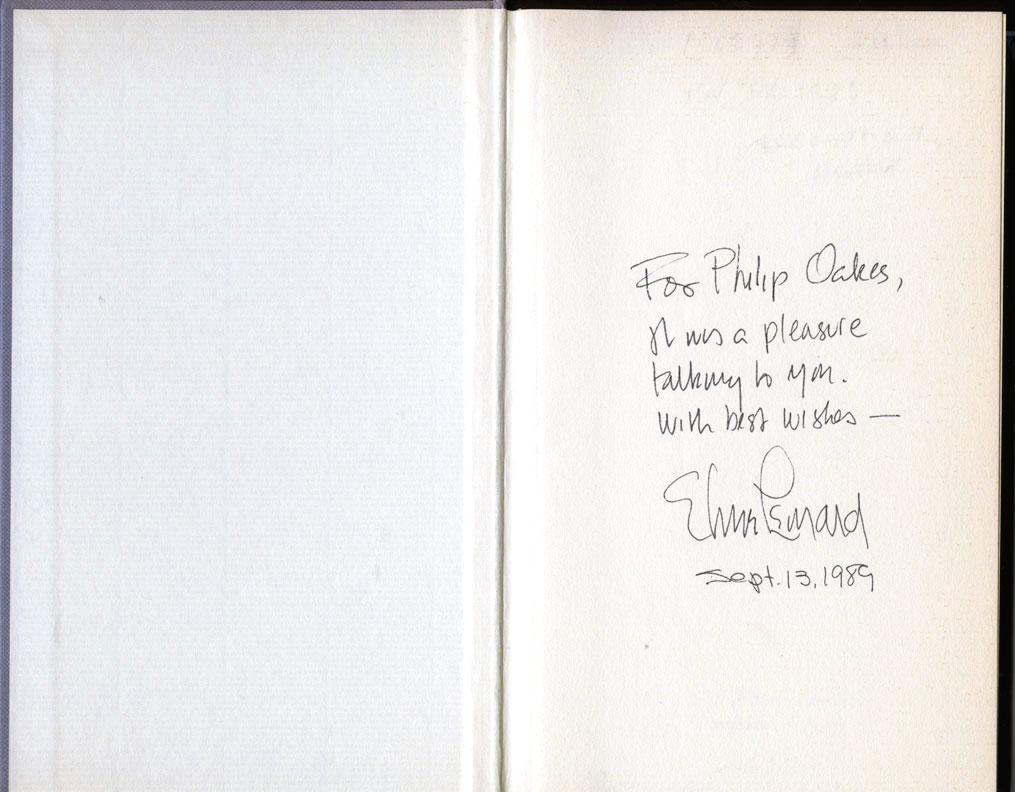
Killshot, published in hardback by Viking in 1989 (dust jacket design uncredited, but it's virtually identical to that on the US Arbor House edition, published the same year). I picked up this copy of the British first edition online for a fiversomewhat less than the going rate for an unsigned British first in near fine condition – which this copy is – and certainly a lot less than the going rate for a signed one; I can see just a single signed copy of the Viking first available online, listed at over £80. This isn't merely a flat signed copy, however:


It's an association copy, inscribed on the front free endpaper to the journalist (and poet) Philip Oakes. The inscription reads:

For Philip Oakes,

It was a pleasure talking to you. With best wishes –

Elmore Leonard

Sept. 13, 1989

Oakes was an admirer of and sometimes reviewer of Leonard's work; there's an extract from an Oakes review of Freaky Deaky on the back cover of the Viking edition of Killshot, taken from the Literary Review, for which Oakes frequently reviewed crime fiction. This copy of the book came came from Oakes's own library and was evidently presented to him by Leonard shortly after Oakes had interviewed the author, as implied by the inscription. This we can further establish thanks to the BBC's recently launched (in a test version) Genome Project: there's a listing on 31 October, 1989 at 7.05pm for a Radio 3 (the Beeb's classical music station) programme titled Third Ear, in which "Philip Oakes talks with the American crime novelist and Western screenwriter Elmore Leonard". I think it's safe to conclude that that was the conversation referred to in Leonard's inscription, which means that, remarkably, there's a BBC licence fee-funded provenance for this particular copy of Killshot readily viewable online. And potentially, if the relevant edition of Third Ear itself is ever made available online, an audio provenance too. 


Killshot is another example, in a different sort of way, of something I was banging on about in last week's post on Elmore Leonard's 1983 novel Cat Chaser: the romantic element in the writer's work. In the case of Killshot, however, the romance is a more mature one, between ironworker Wayne Colson and his wife Carmen, who fall foul of two killers: Native American hitman (working for the Canadian mob) Armand Degas, alias the Blackbird, and murderous career criminal Richie Nix. Much of the novel is concerned with Armand and Richie's repeated attempts to kill Wayne and Carmen, and throughout the novel Leonard contrasts the dynamics of the two sets of relationships (in the non-Biblical sense in Armand and Richie's case, although they do share Richie's ex-prison guard girlfriend): wary, edgy and dangerous on Armand and Richie's part, warm, genuine and occasionally argumentative on Wayne and Carmen's.

The tenderness between Wayne and Carmen and the contrast between those two and Armand and Richie is something which was raised by Anthony May in a 1991 interview with Leonard (available via Contrapasso Magazine). In that interview Leonard also notes how Wayne "was gonna be the main character in Killshot but it was so obvious that I had to change it" – to Armand, although Carmen is arguably as much the main character as the Blackbird is – and discusses something else which is applicable to Killshot: the author's approach to story. Leonard told May: "It's not a big story I do, it's just little situations and they end up. There's always a way to end them up." This is a theme that bubbles beneath the surface of Killshot, a subtext which becomes explicit late in the novel, when Richie muses, "It was weird how one thing could lead to another"; when Carmen mulls the 1975 Antonioni movie The Passenger and how in the film Jack Nicholson "lets his new life happen... lets it carry him along as a passenger to the end"; and when Armand reflects, "He had come this far, now he was along for the ride."


"Little situations", one leading to another: an apt summation of Leonard's work in general and Killshot in particular. And as Leonard said, there's always a way to end them up – usually involving violence, as here. But though the ending of Killshot may be among the tensest Leonard concocted – with Carmen menaced by the two killers and Wayne racing across country to reach her – as ever in Leonard stories, much as in life, it's not so much about the destination as about "the ride", as Armand puts it. And Killshot, with its diverting detours and engaging characters, is as hypnotically meandering a ride as you'll find in the author's canon.

Thursday, 29 May 2014

Patricia Highsmith's The Black House: Signed Inscribed Association First Edition (Heinemann, 1981) with Handwritten Letter

NB: Linked in Friday's Forgotten Books, 30//5/14.

This second of two signed and inscribed Patricia Highsmith short story collections which I've recently acquired is, I think, more remarkable than both the first edition of Tales of Natural and Unnatural Catastrophes (1987) I blogged about last week and the inscribed first of the short story collection Little Tales of Misogyny (1977) I got my hands on two years ago, for a number of reasons. Highsmith's inscription is more fullsome than in both of those books; there's a link between that inscription and one of the stories in the collection itself; and the book is accompanied by something even rarer than an inscribed Highsmith tome: a handwritten letter by the author.

The book is this:


The Black House, Highsmith's fifth collection of short stories, published in hardback in the UK by Heinemann in 1981. I bought this copy of the Heinemann first from Ashville, NY book dealer Warren Berry – thank you to Barbara Berry for answering my questions. Highsmith's inscription is on the front flyleaf:


It reads:

For Katherine Alexander

with gratitude for her reading of my works. I wish I could see Wellfleet again!

Hello also to Donald Olson – and friendliest greetings from

Patricia Highsmith

19 May 1982

Aurigeno 7771

TI CH

Katherine Alexander was described to me by Barbara Berry as a local librarian, which leads me to believe she was librarian at the Lakewood Memorial Library, a few miles from Ashville; she's mentioned a few times in this history of the library. Donald Olson I'm less sure about; Barbara described him as a local author, and I wonder whether he was the Donald Olson who frequently contributed short stories to Ellery Queen's Mystery Magazine – to which Highsmith was also a contributor – and who penned a number of paperback potboilers – The Sky Children (Avon, 1975), Beware, Sweet Maggie (Pyramid, 1977) – and hardback suspense novels – If I Don't Tell (Putnam, 1976), Sleep Before Evening (St. Martin's, 1979). Alternatively he could be Donald S. Olson, author of The Secrets of Mabel Eastlake (Knights Press, 1986), Paradise Gardens (Knights Press, 1988), The Confessions of Aubrey Beardsley (Bantam Press, 1993) and, I think, Queer Corners (Bridge City, 1999), although going by the dates of those titles, I think that's less likely.

In any case, plainly this was Highsmith's own copy of The Black House, which Highsmith sent to Katherine Alexander in May 1982 from her then-home in Auregino, Ticino, Switzerland. The accompanying letter – written on a torn-off half sheet of Manegg typewriter paper (a watermark to that effect is just about visible on the original) – sheds light on why Highsmith sent the book:


It reads:

I can't find here a copy of "A Dog's Ransom" but that should be available in Penguin —

The Black House may never be printed in USA. It is very well liked in England, France, [now?] Germany.

Best to you —

Pat H.

19 May '82

The date matches that in the inscription (although curiously it's written in a different pen); evidently Katherine Alexander had asked Highsmith for a copy of Highsmith's 1972 novel A Dog's Ransom, but instead Highsmith sent her this copy of The Black House, a book the author seemed to be proud of – at least her comment about it being "very well liked" in a handful of countries suggests as much to me – but which she feared might not be published in America. In fact it was, belatedly: Penzler Books issued it in the States in 1988 as a hardback and a limited-to-250-copies slipcased signed edition.

Taken purely on its own merits the letter is, I'd suggest, a pretty remarkable document; though it's relatively brief, it's still longer than the one other handwritten Highsmith letter I can see for sale online at present, which has a price tag of nearly £500 (rather more than I paid for my one); and on a more personal level, given that Highsmith is my favourite author, and that I've only managed to get my hands on books containing handwritten letters or notes by their authors (or other interested parties) three or four times before (see here, here and here, although there is also this), my delight at coming into possession of the letter is, I hope, understandable. Add in the inscribed book, however, and the two items become something quite extraordinary. At least one letter from Katherine Alexander to Highsmith is held by the Swiss Literary Archives (to whom Highsmith left her papers, a good many of which can be viewed online), but more intriguingly there's a mention in the inscription of a place which is significant as regards the contents of the book: Wellfleet, a coastal town on Cape Cod.

I'm unsure as to Katherine Alexander's connection to Wellfleet – although one can only assume that for Highsmith to have made note of the town in an inscription to her that she was familiar with the place – but thanks to Andrew Wilson's 2003 Patricia Highsmith biography Beautiful Shadow I do know that Highsmith stayed on Cape Cod. In 1948 she rented a house in Provincetown – the self-styled "Greenwich Village by the sea", at the tip of Cape Cod, not far from Wellfleet – with her fiancé, the writer Marc Brandel; shortly after her arrival Highsmith met Ann Clark, a painter and designer, and the two swiftly became lovers, themselves returning to Provincetown for a holiday in 1950.


All of this is pertinent because both Provincetown and to a greater degree Wellfleet feature in one of the stories in The Black House, "The Dream of the Emma C". Coming at the midpoint of the collection, it's the tale of the crew of the eponymous trawler, who fish a young woman out of the sea and are beguiled by her, variously competing for her affections, writing poetry in her honour and even coming to blows over her as they abandon logic and surrender to a strange dreamlike state. There are parallels here in the way Highsmith's out-of-the-blue encounter with Ann Clark saw her swiftly falling for the other woman, but there's a more concrete connection in that the captain of the Emma C reports the crew's find to Provincetown, and that the vessel's home port is Wellfleet, where the tale comes to a close.


It's a fine story, but it's just one among many fine stories in what is by any measure a brilliant collection, certainly stronger than the later Tales of Natural and Unnatural Catastrophes. The range of notes Highsmith hits from story to story, from the amoral ("Not One of Us") to the macabre ("Something the Cat Dragged in"), the creepy ("The Terrors of Basket-Weaving") to the criminal ("When in Rome"), is impressive enough, but the inclusion of tales which embrace themes and styles further afield from her traditional territory, like retribution and forgiveness ("Under a Dark Angel's Eye", elements of which to do with how the elderly can sometimes be a burden on the young would be reprised in "No End in Sight" in Tales of Natural and Unnatural Catastrophes), family dysfunction ("I Despise Your Life") and even farce ("Blow It"), is what makes this such a terrific book.

Best of all is "The Kite", in which a young boy channels his confusion over his sister's death and his parents' consequent arguing into building a huge kite. It's a kind of precursor to Up, or maybe more accurately Highsmith's spin on a Roald Dahl fable – Charlie and the Great Glass Elevator, say, or James and the Giant Peach, although its devastating ending marks it out as very much not a story for children. That ending is echoed in a similarly shattering climax in the subsequent story, "The Black House", which rounds out the collection, and which is representative of the array of moods and shades and murky motivations at play across the book as a whole and in each individual tale.


Reading The Black House – the Heinemann edition of which, incidentally, can also be found in the Existential Ennui Patricia Highsmith First Edition Book Cover Gallery (the inscribed copy seen here is actually the second copy of the Heinemann first I've bought) – left me in the mood for even more Highsmith, so over the next few weeks I plan on reading and then reviewing the only two Highsmith novels from the 1960s I haven't as yet got round to. Ahead of those, though, I'll be taking a look at the link between Highsmith and another favourite author of mine: Donald E. Westlake.