Showing posts with label short stories. Show all posts

Tuesday, 28 November 2017

P. M. Hubbard Short Stories in The Magazine of Fantasy & Science Fiction, 1953–1969

Cult British suspense author P. M. Hubbard published just fourteen short stories in his lifetime – a smaller number even than his published novels, of which there are eighteen (including his two children's novels). Appearing in a variety of magazines and anthologies across twenty-five years, to date the stories remain uncollected, and anyone interested in reading them must seek out the original publications in which they appeared – not a straightforward task by any means (more on one aspect of why shortly), although I haven't let that deter me from getting hold of ten of them, chiefly the seven that were published in The Magazine of Fantasy and Science Fiction. By and large that's involved strokes of good fortune in secondhand bookshops and at book fairs (notably London's Paperback & Pulp Book Fair), but for the three earliest Hubbard F&SF tales, all of which were published in the 1950s, I had to resort to downloading PDFs of the issues (from here).*

As there doesn't seem to be much online about those seven F&SF stories – apart from my own post on "The Golden Brick" that is – I thought I'd write something about them – a niche endeavour, I realise, that serves little purpose other than to interest myself and possibly Hubbard's already niche readership, but then surely that's what blogging is all about.


The first Hubbard story to appear in F&SF – and his earliest known story – was actually a reprint, having previously been published in an issue of the weekly Punch sometime in December 1952. The very short "Manuscript Found in a Vacuum" (US F&SF Vol. 5 No. 2, August 1953, cover by Jack Coggins illustrating Marion Zimmer Bradley's "The Climbing Wave") is atypical Hubbard, a wry, verbose take on vintage space opera that's mildly amusing in its own way but fairly inconsequential as regards the author's wider canon, with little evidence of the intensity of Hubbard's later work.


Much more Hubbardesque is his second short, "Botany Bay" (US F&SF Vol. 8 No. 2, February 1955, cover by Kelly Freas), which deploys his "poet's sense of concise beauty", as the story's introduction has it ("the narrow strip of tarmac reflected like water the tremendous sultry glow that lay across the tops of the hills", for example), with hints of his propensity for obliqueness and allusion ("he had a look on his face that needs describing, but isn't easy to describe – not adequately... a look of longing, a sort of shocking hunger, but so overlaid with hopelessness that the impression was one of complete passivity") in service of a story in which a motorist stops at a petrol station and encounters a victim of possible extraterrestrial interference of some kind.


Even more Hubbardian is his third short work, "Lion" (US F&SF Vol. 10 No. 3, March 1956, cover by Nicholas Solovioff illustrating Poul Anderson's "Superstition"). One of three Hubbard shorts – the others being "Special Consent" and "The House" – which might reasonably be described as dystopian or perhaps more accurately post-apocalyptic in nature – although in each case, in true Hubbard fashion, the apocalypse itself is never properly defined – it follows a regressed couple as they gather rushes in an overgrown landscape near a bronze lion statue whilst discussing their more intelligent forebears. Initially I thought that statue and the river the story locates it nearby might be one of the ones in Trafalgar Square up from the Thames, but after further investigation I believe it to be the Maiwand Lion, which stands near the River Kennet in Reading, where Hubbard was born. Anyway, Hubbard's evocative handling of the setting is typical of him, and there's a deliciously distressing twist in the tale that I shan't spoil.


The fourth Hubbard short, "The Golden Brick", I've already written about at length, but arriving at it in this essay does give me the opportunity to expand on one of the difficulties of collecting Hubbard's F&SF stories if you're based in the UK. The main source of info about Hubbard and his work is the excellent The Worlds of P. M. Hubbard, but while its bibliography does note which issues of F&SF his stories appeared in, it only gives the American numbers and dates. Here in the UK, for the first half of the 1960s a British version of F&SF was published that used the same stories as its American counterpart but not in the corresponding issues (they tended to lag behind by a number of months). So while in the US "The Golden Brick" appeared in F&SF Vol. 24 No. 1, January 1963 (cover by Ed Emsh illustrating Mack Reynolds' "Speakeasy"), in the UK it was in Vol. 4 No. 6, May 1963. In addition, in the case of "The Golden Brick", the US edition boasts a page-and-a-half introduction comparing Hubbard favourably to M. R. James and incorporating a self-penned bio ("My first novel (a thriller of sorts) just accepted for publication this autumn. Married, three children, two grandchildren. Like making things with my hands, planting and tending trees, swimming, sailing. Have cottage in Cornwall. Expect to die early in 1965, but I may crawl away over the sea yet...") that in the edited-down UK edition intro is brutally excised in its entirety.


The American intro to Hubbard's fifth short, "Special Consent" (US F&SF Vol. 24 No. 4, October 1963, cover by Chesley Bonestell), is also curtailed in the British edition (UK F&SF Vol. 5 No. 4, March 1964), although nowhere near as savagely. In this second short dystopia, Hubbard paints a scenario where women have risen to dominance after men propelled the planet back to the stone age by unleashing "the Fire". There are some interesting ideas present, but the gabby exposition – not a typical Hubbard trait – and the officious nature of the matriarchal society depicted seem to me somehow off.


A more familiar and authentic slice of Hubbard comes with his sixth short, "The Shepherd of Esdon Pen" (US F&SF Vol. 26 No. 2, February 1964, cover by Jack Guagham illustrating S. S. Johnson's "The House by the Crab Apple Tree"/UK F&SF Vol. 5 No. 7, June 1964), in which Hubbard spends a good deal of the story's length vividly establishing the ancient chalk upland surroundings and the social and religious milieu in order to deliver a tale of escalating dread centring on the eponymous horn-headed pagan herder, a carving of whom can be seen in the local church and whose serpent-like staff figures at the story's climax.


Just as good is "The House", Hubbard's ninth short story overall and his last to appear in The Magazine of Fantasy and Science Fiction (US F&SF Vol. 36 No. 4, April 1969, cover by Bert Tanner illustrating Gregory Benford's "Deeper Than the Darkness"). The third Hubbard post-apocalyptic tale, it shares with "The Shepherd of Esdon Pen" a kind of excavatory epilogue, as a man and his wife try to erect a home and start a new life on their government-allotted square mile of overgrown rubble – all that remains of North London – but find that the going is far harder than they expected. Transplanting a characteristically Hubbardian sense of a sullen rurality to a keenly rendered shattered cityscape ("fairly fine rubble, pretty wet in winter and thickly grown with scrub and the larger annuals, broken by coppices of hazel and alder"), the accruing details – the scarcity of glass, silent birds that might be deaf, the backbreaking work of shifting by hand the "infernal jigsaw" of masonry to find "a reasonably stable and compact surface" to fill in and then level up – build into a convincing portrait of English stoicism in the face of catastrophe.


Of the seven F&SF stories, I would say "Lion", "The Golden Brick", "The Shepherd of Esdon Pen" and "The House" are all approaching prime Hubbard and are well worth tracking down; the other three perhaps less so. In addition, F&SF ran three Hubbard poems, and these too are worth a read (again, they can be downloaded here). Both "Free Flight" (US F&SF Vol. 10 No. 4, April 1956, cover by Chesley Bonestell) and "Air Space Violated" (US F&SF Vol. 15 No. 5, November 1958, cover by Pederson) deal to a degree with man's efforts to escape his earthly shackles, but my favourite I think is "Nobody Hunts Witches" (US F&SF Vol. 8 No. 5, May 1955, cover by Stanley Meltzoff). It brought a smile to my face when I first read it, and in that spirit I hope I'll be forgiven for including it in full below.


*A year on from this post, I secured physical copies of all three in the basement of the Quinto Bookshop on Charing Cross Road.

Tuesday, 7 March 2017

The Terrorists, alias Double, Double: a Calder and Behrens Story by Michael Gilbert

Among the 185 short stories that British crime and mystery author Michael Gilbert wrote over the course of his 50-year career are 24 spy stories starring Daniel Calder and Samuel Behrens, malevolent late middle-aged operatives of the External Branch of the Joint Services Standing Intelligence Committee. Originally published in Ellery Queen's Mystery Magazine in the US and Argosy in the UK, almost all of the Calder and Behrens stories were collected in two Gilbert anthologies – the sublime Game Without Rules (1967) and the almost as brilliant Mr. Calder & Mr. Behrens (1982). (Gilbert also wrote 16 radio plays featuring his ageing secret agents, which I discussed last month.) But there is one Calder and Behrens story which doesn't feature in either of those books. It first appeared in 1967 under the title "The Terrorists" in Ellery Queen's Mystery Magazine and "Double, Double" in Argosy, before being collected in this anthology:


Ellery Queen's Mystery Parade, published by Gollancz in 1969 under one of that publisher's iconic yellow typographic dust jackets. Being a UK edition of a US collection – the book was originally published by New American Library in the States in 1968 – the title of "The Terrorists" was retained; it wasn't until 2007 that the story was published in book form under its British title of "Double, Double", when it was included in the posthumous Michael Gilbert collection Even Murderers Take Holidays.

I'm not sure why it wasn't collected in the 1982 Calder and Behrens anthology (it appeared in Ellery Queen's Mystery Magazine and Argosy too late to have been included in Game Without Rules) but I can hazard a guess or two. In Argosy, it was published under the overarching series title of "Agents in Action" in the April 1967 issue. Part one of that series, "Upon the King", was published in the March issue and collected in Game Without Rules, while part three, "Twilight of the Gods", was published in the May issue and collected in Mr. Calder & Mr. Behrens, so perhaps "The Terrorists" fell between two stools. Or it could be that it was simply overlooked; on first inspection, Calder and Behrens barely seem to feature at all in the story, merely getting a couple of mentions towards the end.


In fact for the unsuspecting Calder/Behrens enthusiast only a passing reference to Fortescue – Calder and Behrens' boss – at the start of the tale gives the game (without rules) away that "The Terrorists" is a part of their canon. The pair do appear throughout, but under assumed names and identities, both of them operating undercover as a means of unpicking a plot by a middle-eastern terrorist cell to set off a bomb in London (there's a nice, explicitly acknowledged, bit of misdirection as to which of the terrorists Calder and/or Behrens is). It's a good story, well worth the effort, I would say – at least for those aforementioned Calder/Behrens enthusiasts – of tracking it down – something that shouldn't prove too difficult for anyone so inclined; while the Gollancz edition is pretty scarce and the New American Library edition not much more common, there are at least half a dozen copies of the 1969 Signet paperback edition available online as I type, and fairly cheaply too.


For my part, having now collected and read "The Terrorists", Game Without Rules and Mr. Calder & Mr. Behrens (and the two published radio plays in The Murder of Diana Devon), I'm left in the sorry situation of having no more Calder and Behrens stories to track down. At least, that I'm aware of...

Linked in Friday's Forgotten Books, 10/4/17.

Tuesday, 17 January 2017

The Snail-Watcher and Other Stories by Patricia Highsmith: Signed First Edition

Two years ago I wrote about Graham Greene, Patricia Highsmith and Eleven, Highsmith's first collection of short stories, published by Heinemann in 1970. I hadn't expected to return to Eleven; as well as exploring in that post Highsmith and Greene's mutual admiration and the foreword he wrote for the book, I also reviewed the best stories contained therein, so there wasn't really much more I could have added. But then I went and bought this:


the American first edition of the collection, published by Doubleday in 1970 under the title The Snail-Watcher and Other Stories, with a dust jacket designed by Tim Lewis, and, well, here we are. There are no significant differences between the Heinemann and Doubleday editions – both contain the same eleven short stories; both boast the Graham Greene foreword (although it's titled 'Introduction' in the American edition) – so there's no excuse, really, for my buying the US first edition when I already owned the UK first edition... except that this copy of the US first edition is signed:


Curiously, it's also an ex-library copy, liberated from, according to the indented stamp on the title page, the Westbrook Memorial Library in Maine (I think; it's hard to make out and the library docket that was affixed to the rear endpaper has been removed). I'm guessing that's the Walker Memorial Library. The signature looks genuine to me, but I am intrigued as to the circumstances by which Highsmith signed a library book. Was it signed after it was removed from the library? Or while it resided in the library, during a reading or event of some kind – or perhaps even covertly during an incognito visit by Highsmith...? I don't suppose I'll ever know.


At least, that's what I figured when I first posted this. But then an hour or two later Book Glutton emailed me and drew my attention to this 2015 obituary for Bonny Muir. As Book Glutton noted, Muir was a good friend of Patricia Highsmith's who at one time lived in Portland, Maine, not far from Westbrook. An avid user of the South Portland Library, it's conceivable Muir frequented the Walker Memorial Library too, and that she acquired this copy of The Snail-Watcher there and got Highsmith to sign it at a later date. Then, when Muir died, her books were sold. Conjecture, of course, but it's plausible, and certainly excellent detective work on the part of Book Glutton.

Linked in Friday's Forgotten Books, 20/1/17.

Tuesday, 23 June 2015

Patricia Highsmith, Graham Greene and Eleven (Heinemann, 1970), alias The Snail-Watcher and Other Stories

NB: Linked in Friday's Forgotten Books, 26/6/15.

"I have said little about other people's suspense books," wrote Patricia Highsmith towards the end of her inspirational book for budding writers, Plotting and Writing Suspense Fiction (1966, revised 1981), "mainly because I seldom read them, and so I am unqualified to say that certain suspense books are good, very good, or why. I like best Graham Greene's entertainments, mainly because they are intelligent, and their prose is very skillful. He is also a moralist, even in his entertainments, and I am interested in morality, providing it isn't preached." (The only other suspense author to get much of a look-in in Plotting and Writing Suspense Fiction is Julian Symons, who warrants one page to Graham Greene's three, although non-suspense writers like Dostoevsky, Flaubert and Henry James are referenced.)

Highsmith and Greene never met in person, but they were admirers of each other's work and corresponded for years. Highsmith told film critic Gerald Peary in 1988, "I have [Greene's] telephone number but I wouldn't dream of using it" (she added: "I don't seek out writers because we all want to be alone"), while Andrew Wilson, in his 2003 biography of Highsmith, Beautiful Shadow, recounts one occasion where Greene wrote to Highsmith expressing his disgust at some of the negative reviews of Highsmith's 1972 novel A Dog's Ransom. But the best example, and certainly the most frequently quoted, of Greene's enthusiasm for Highsmith's writing comes in his foreword to Highsmith's first collection of short stories:


Eleven, published in 1970 by Heinemann in the UK and the same year, under the title The Snail-Watcher and Other Stories, by Doubleday in the US. Highsmith was so keen to have Greene write the foreword to the book that when Doubleday would only pay $100 of the $500 fee that Greene's agent had demanded, Highsmith made up the difference. Considering how widely quoted the foreword has turned out to be – excerpts appeared on the covers of a good many of her subsequent books and in numerous other places besides – it was money well spent, but one snippet has circulated especially widely, and particularly online: "Miss Highsmith is the poet of apprehension". It's an intriguing line – or rather segment of a line – but the ensuing half-paragraph is more illuminating:

Miss Highsmith is the poet of apprehension rather than fear. Fear after a time, as we all learned in the blitz, is narcotic, it can lull one by fatigue into sleep, but apprehension nags at the nerves gently and inescapably. We have to learn to live with it. Miss Highsmith's finest novel to my mind is The Tremor of Forgery, and if I were to be asked what it is about I would reply, "Apprehension."

Greene goes on to make the point: "In her short stories Miss Highsmith has naturally to adopt a different method. She is after the quick kill rather than the slow encirclement of the reader, and how admirably and with what field-craft she hunts us down." From the stories in Eleven he chooses "When the Fleet was in at Mobile" as his favourite, which with its devastating ending he commends as "Highsmith at her claustrophobic best", and further picks out "The Heroine" for being "as much a study of apprehension as [The Tremor of Forgery]... 'The Terrapin', a late Highsmith... a cruel story of childhood which can bear comparison with Saki's masterpiece, 'Sredni Vaster', and for pure physical horror, which is an emotion rarely evoked by Miss Highsmith, 'The Snail-Watcher'".


Rarely evoked perhaps, but to my mind the "pure physical horror" of "The Snail-Watcher" is matched in Eleven by "The Quest for Blank Claveringi", another tale of snails (Highsmith herself kept snails as pets) in which Professor Avery Clavering comes a cropper on the fictional Mastusas Islands at the hands – or rather teeth – of a monstrous mollusc. My own favourites in the collection are the very short, very sour "The Cries of Love", a sharp sketch of low-level internecine warfare between two auld biddies sharing a room in a retirement hotel, like a pithy precursor to Kingsley Amis's Ending Up (1974), and the powerful "Another Bridge to Cross", which in its portryal of an American man adrift in a foreign land following a bereavement and undergoing a crisis of identity explores similar territory to the aforementioned The Tremor of Forgery (1969). (In Plotting and Writing Suspense Fiction Highsmith herself singled out "Another Bridge to Cross", calling it "a tragic story", one "written from my own emotions, because I wanted to write it".)


"[Highsmith's] characters are irrational," wrote Graham Greene, "and they leap to life in their very lack of reason; suddenly we realize how unbelievably rational most fictional characters are as they lead their lives from A to Z, like commuters always taking the same train." That for me serves as more of an insight into the appeal of the best of Highsmith as that "poet of apprehension" line, and though the bulk of the stories in Eleven, splendid though they are, are designed more for "the quick kill", "Another Bridge to Cross" is as fine, albeit fleeting, an "encirclement of the reader" as can be found in her oeuvre.


I'll be returning to Graham Greene soon, with a gallery of beautiful editions of his books from the 1950s and 1960s and a review of an excellent "entertainment". But before that, another Highsmith first edition, one which will shortly be joining Eleven in the Existential Ennui Patricia Highsmith First Edition Book Cover Gallery: The Talented Mr. Ripley.

Tuesday, 3 March 2015

Patricia Highsmith's The Man Who Wrote Books in His Head: Signed Inscribed Edition (Eurographica, 1986)

NB: Included in Friday's Forgotten Books, 6/3/15.

Much as I love a beautiful dust jacket (especially a British one dating from, say, the 1950s or the 1960s), sometimes the most extraordinary of books come in the plainest of wrappers. Like this one:


The Man Who Wrote Books in His Head and Other Stories by Patricia Highsmith, published by Eurographica of Helsinki, Finland (or Helsinki, Sweden, as newsreader Harvey Johnson has it in Die Hard), in 1986 as part of their Mystery and Spy Authors in Signed Limited Editions series (number four in that series, to be precise). Printed, as noted in the back of the book, "by Tipografia Nobili, established in Pesaro in 1823, on special Michelangelo paper made at the Magnani Paper Mills in Pescia, Italy" – and suitably and pleasingly thick and rough and deckled that paper is too – it was limited to 350 numbered copies signed by Highsmith, with "20 additional copies printed for the personal use of the author". This is one of those 20 additional copies:


Which Highsmith inscribed to a Catherine Schelbert – who may well be the translator Catherine Schelbert – in March 1990. A handful of copies of the signed and numbered run of The Man Who Wrote Books in His Head can be found on AbeBooks (for upwards of £100) – as can a similar number of Where the Action Is and Other Stories, a second limited edition of Highsmith tales published by Eurographica in 1989 – but I can't see any other copies of the "personal use" run, so this one is quite a rare item, and as such nice addition to my steadily growing collection of signed and inscribed Highsmith books (see here, here, here and here).


The four stories in The Man Who Wrote Books in His Head are taken from the 1979 collection Slowly, Slowly in the Wind, although three, "Something You Have to Live With", "Slowly, Slowly in the Wind" itself and "A Curious Suicide", were first published earlier than that, in Ellery Queen's Mystery Magazine ("A Curious Suicide" as "Who Lives, Who Dies?"). The best by far is the title story, in which Highsmith drily demonstrates, using the case of one E. Taylor Cheever, that one needn't go to the bother of actually writing any novels in order to become a celebrated novelist – a finding which, for myself, having attempted on more than one occasion to write a novel only to discover that my talents – if indeed any exist – almost certainly lie elsewhere, is music to the ears.

The other three stories are all very good too, though – the macabre and mildly gruesome "Slowly, Slowly in the Wind", with its wonderfully original method of disposing of a body, in an obvious sort of way, "Something You Have to Live With" and "A Curious Suicide" working a more subtle magic, both dealing with the lingering aftereffects of killing; "A Curious Suicide" in particular comes off like a condensed Highsmith novel, complete with a murderer who gets away with it almost in spite of himself. All of which leads me to suspect that the rest of Slowly, Slowly in the Wind will be well worth reading too – so it's a good job I have a first edition of that collection, which I'll doubtless be blogging about down the line, and adding to the Existential Ennui Patricia Highsmith First Edition Book Cover Gallery, where I've deposited The Man Who Wrote Books in His Head (under "Patriciaphernalia"). And I'll be blogging about another signed and inscribed Highsmith book before too long as well – a very special association copy of a Tom Ripley novel, no less.

Friday, 19 December 2014

A Big Long List of the Books I Read in 2014: Novels, Graphic Novels and Short Story Collections

NB: Linked in Patti Nase Abbott's Friday's Forgotten Books roundup, 19/12/14. Thanks Patti!


Well that threw a spanner in the works. I had every intention of posting one last book review – of Victor Canning's third "Birdcage" novel, The Mask of Memory (1974) – before embarking on my traditional, widely reviled, even more widely ignored, still more widely unregistered, end-of-year review of the year; but then the illustrated books publisher I work for, Ilex, got bought by a bigger publishing company, Octopus, and my life was thrown into disarray (short version: in the space of less than two weeks I went from living and working in Lewes, with a walk to work of fifteen minutes, to living in Lewes and working in London, with a journey to work of at least two hours) and blogging had to take a back seat while I wrestled – continue to wrestle – with a long commute and new offices and new work colleagues and new systems and so forth. The upshot of all of which is that not only will the book review have to wait, so will the widely reviled/ignored/unregistered review of the year – possibly until this time next year; as things stand it's unlikely I'll have either the time or energy to properly unpack the year's events chez Louis XIV before 2014 draws to a close.

Instead, because it's a comparatively less taxing task, I thought I'd assemble my similarly traditional big long list of the books I read, with its equally traditional links to whatever I've written about each book (if anything) and ensuing attendant half-hearted, half-arsed analysis. And this year's list, arranged in roughly the order in which I read the books, looks like this:

Doctor Sleep by Stephen King (Hodder, 2013)
Richard Stark's Parker: Slayground by Darwyn Cooke (IDW, 2013)
Nemo: Heart of Ice by Alan Moore and Kevin O'Neill (Knockabout, 2013)
Nobody's Perfect by Donald Westlake (Hodder, 1978)
Firebreak by Richard Stark (Robert Hale, 2002; originally 2001)
Mr. Calder and Mr. Behrens by Michael Gilbert (Hodder, 1982)
To Catch a Spy, selected by Eric Ambler (The Bodley Head, 1964)
The Unwritten: Tommy Taylor and the Ship That Sank Twice by Mike Carey, Peter Gross et al (DC/Vertigo, 2013)
Batman: Detective No. 27 by Michael Uslan, Peter Snejberg et al (DC, 2003)
High-Rise by J. G. Ballard (Jonathan Cape, 1975)
Ashenden, or, The British Agent by W. Somerset Maugham (Heinemann, 1928/1934)
Point Blank by Richard Stark (Allison & Busby, 1984; originally 1962) (reread)
The Man with the Getaway Face by Richard Stark (Allison & Busby, 1984; originally 1963) (reread)
The Outfit by Richard Stark (Allison & Busby, 1984; originally 1963) (reread)
Russian Roulette by James Mitchell (Hamish Hamilton, 1973)
The Moonshine War by Elmore Leonard (Dell, 1970; originally 1969)
The Whisper in the Glen by P. M. Hubbard (Atheneum, 1972)
The Tin Men by Michael Frayn (Collins, 1965)
High Tide by P. M. Hubbard (Macmillan, 1971)
A Kiss Before Dying by Ira Levin (Michael Joseph, 1954)
Little Tales of Misogyny by Patricia Highsmith (Heinemann, 1977)
Tales of Natural and Unnatural Catastrophes by Patricia Highsmith (Bloomsbury, 1987)
The Black House by Patricia Highsmith (Heinemann, 1981)
A Suspension of Mercy by Patricia Highsmith (Heinemann, 1965)
Those Who Walk Away by Patricia Highsmith (Heinemann, 1967)
Ripley's Game by Patricia Highsmith (Heinemann, 1974) (reread)
Unsung Road by Simon Harvester (Jarrolds, 1960)
Firecrest by Victor Canning (Heinemann, 1971)
The Rainbird Pattern by Victor Canning (Heinemann, 1972)
Breakout by Richard Stark (Robert Hale, 2003; originally 2002)
Her by Harriet Lane (Weidenfeld & Nicolson, 2014)
Danger in the Dark by Patricia Carlon (Ward Lock, 1962)
City Primeval by Elmore Leonard (W. H. Allen, 1981; originally 1980)
2001: A Space Odyssey by Arthur C. Clarke (Hutchinson, 1968) (reread)
The Bookshop by Penelope Fitzgerald (Gerald Duckworth, 1978)
Split Images by Elmore Leonard (W. H. Allen, 1983; originally 1981)
Cat Chaser by Elmore Leonard (Viking, 1986; originally 1982)
The Hospital Suite by John Porcellino (Drawn & Quarterly, 2014)
Killshot by Elmore Leonard (Viking, 1989)
The Finger of Saturn by Victor Canning (Heinemann, 1973)
The Mask of Memory by Victor Canning (Heinemann, 1974)
Ant Colony by Michael DeForge (Drawn & Quarterly, 2014)
Safari Honeymoon by Jesse Jacobs (Koyama Press, 2014)
Gorky Park by Martin Cruz Smith (Collins, 1981)
The Mammoth Book of Cult Comics, edited by Ilya (Robinson, 2014)

Including Gorky Park and The Mammoth Book of Cult Comics, both of which I'm still reading but both of which I'm reasonably confident I'll finish before the end of the year (there's something to be said for commuting by train at least: I get to read more now), I make that forty-five books, which is five more than I managed to get through in 2013 – something of a surprise, I must admit: what with work and Edie and everything I had thought I was going to be down on last year's total. And of those forty-five books: all were fiction; thirty-one were novels; five were short story collections; one – Ashenden, or, The British Agent – was both a novel and a short story collection; seven were graphic novels; and one was a graphic novel short story collection.


Nine of the books were recently published, i.e. in the last year or two; three were first published in the 2000s; eight were first published in the 1980s; twelve were first published in the 1970s; eleven were first published in the 1960s; one was first published in the 1950s; and one was first published in the 1920s. The vast majority were new to me, however; there were just five that I'd read before – and one of those, Patricia Highsmith's Ripley's Game, I'd read at least a couple of times before. (I was inspired to do so again this year as a result of acquring a scarce 1989 Heinemann reissue of the novel and watching Wim Wenders's film adaptation of the novel, The American Friend – and rewatching Liliana Cavani's later adaptation Ripley's Game.)


Speaking of Highsmith, she ties with Donald E. Westlake for most-read – and reread – author this year: six books in each case (that's if you exclude Darwyn Cooke's graphic novel adaptation of Westlake/Richard Stark's Slayground, which I do). Elmore Leonard was their closest rival with five books, then Victor Canning – this year's major discovery for me – with four, and P. M. Hubbard with two. Everyone else was one book apiece. Twenty-three of the books were what one might class as crime fiction; ten were spy fiction; and the rest were a mixture of science fiction, horror, fantasy and literary works. All of which, glancing back at my lists for 2013 and 2012, suggests that the makeup and breadth of my reading was not dissimilar to that of previous years.


And as in previous years, for my next post I'll be picking my ten favourites from the books I read over the past twelve months – although whether that post will appear before 2014 breathes its last is anyone's guess.

Thursday, 29 May 2014

Patricia Highsmith's The Black House: Signed Inscribed Association First Edition (Heinemann, 1981) with Handwritten Letter

NB: Linked in Friday's Forgotten Books, 30//5/14.

This second of two signed and inscribed Patricia Highsmith short story collections which I've recently acquired is, I think, more remarkable than both the first edition of Tales of Natural and Unnatural Catastrophes (1987) I blogged about last week and the inscribed first of the short story collection Little Tales of Misogyny (1977) I got my hands on two years ago, for a number of reasons. Highsmith's inscription is more fullsome than in both of those books; there's a link between that inscription and one of the stories in the collection itself; and the book is accompanied by something even rarer than an inscribed Highsmith tome: a handwritten letter by the author.

The book is this:


The Black House, Highsmith's fifth collection of short stories, published in hardback in the UK by Heinemann in 1981. I bought this copy of the Heinemann first from Ashville, NY book dealer Warren Berry – thank you to Barbara Berry for answering my questions. Highsmith's inscription is on the front flyleaf:


It reads:

For Katherine Alexander

with gratitude for her reading of my works. I wish I could see Wellfleet again!

Hello also to Donald Olson – and friendliest greetings from

Patricia Highsmith

19 May 1982

Aurigeno 7771

TI CH

Katherine Alexander was described to me by Barbara Berry as a local librarian, which leads me to believe she was librarian at the Lakewood Memorial Library, a few miles from Ashville; she's mentioned a few times in this history of the library. Donald Olson I'm less sure about; Barbara described him as a local author, and I wonder whether he was the Donald Olson who frequently contributed short stories to Ellery Queen's Mystery Magazine – to which Highsmith was also a contributor – and who penned a number of paperback potboilers – The Sky Children (Avon, 1975), Beware, Sweet Maggie (Pyramid, 1977) – and hardback suspense novels – If I Don't Tell (Putnam, 1976), Sleep Before Evening (St. Martin's, 1979). Alternatively he could be Donald S. Olson, author of The Secrets of Mabel Eastlake (Knights Press, 1986), Paradise Gardens (Knights Press, 1988), The Confessions of Aubrey Beardsley (Bantam Press, 1993) and, I think, Queer Corners (Bridge City, 1999), although going by the dates of those titles, I think that's less likely.

In any case, plainly this was Highsmith's own copy of The Black House, which Highsmith sent to Katherine Alexander in May 1982 from her then-home in Auregino, Ticino, Switzerland. The accompanying letter – written on a torn-off half sheet of Manegg typewriter paper (a watermark to that effect is just about visible on the original) – sheds light on why Highsmith sent the book:


It reads:

I can't find here a copy of "A Dog's Ransom" but that should be available in Penguin —

The Black House may never be printed in USA. It is very well liked in England, France, [now?] Germany.

Best to you —

Pat H.

19 May '82

The date matches that in the inscription (although curiously it's written in a different pen); evidently Katherine Alexander had asked Highsmith for a copy of Highsmith's 1972 novel A Dog's Ransom, but instead Highsmith sent her this copy of The Black House, a book the author seemed to be proud of – at least her comment about it being "very well liked" in a handful of countries suggests as much to me – but which she feared might not be published in America. In fact it was, belatedly: Penzler Books issued it in the States in 1988 as a hardback and a limited-to-250-copies slipcased signed edition.

Taken purely on its own merits the letter is, I'd suggest, a pretty remarkable document; though it's relatively brief, it's still longer than the one other handwritten Highsmith letter I can see for sale online at present, which has a price tag of nearly £500 (rather more than I paid for my one); and on a more personal level, given that Highsmith is my favourite author, and that I've only managed to get my hands on books containing handwritten letters or notes by their authors (or other interested parties) three or four times before (see here, here and here, although there is also this), my delight at coming into possession of the letter is, I hope, understandable. Add in the inscribed book, however, and the two items become something quite extraordinary. At least one letter from Katherine Alexander to Highsmith is held by the Swiss Literary Archives (to whom Highsmith left her papers, a good many of which can be viewed online), but more intriguingly there's a mention in the inscription of a place which is significant as regards the contents of the book: Wellfleet, a coastal town on Cape Cod.

I'm unsure as to Katherine Alexander's connection to Wellfleet – although one can only assume that for Highsmith to have made note of the town in an inscription to her that she was familiar with the place – but thanks to Andrew Wilson's 2003 Patricia Highsmith biography Beautiful Shadow I do know that Highsmith stayed on Cape Cod. In 1948 she rented a house in Provincetown – the self-styled "Greenwich Village by the sea", at the tip of Cape Cod, not far from Wellfleet – with her fiancé, the writer Marc Brandel; shortly after her arrival Highsmith met Ann Clark, a painter and designer, and the two swiftly became lovers, themselves returning to Provincetown for a holiday in 1950.


All of this is pertinent because both Provincetown and to a greater degree Wellfleet feature in one of the stories in The Black House, "The Dream of the Emma C". Coming at the midpoint of the collection, it's the tale of the crew of the eponymous trawler, who fish a young woman out of the sea and are beguiled by her, variously competing for her affections, writing poetry in her honour and even coming to blows over her as they abandon logic and surrender to a strange dreamlike state. There are parallels here in the way Highsmith's out-of-the-blue encounter with Ann Clark saw her swiftly falling for the other woman, but there's a more concrete connection in that the captain of the Emma C reports the crew's find to Provincetown, and that the vessel's home port is Wellfleet, where the tale comes to a close.


It's a fine story, but it's just one among many fine stories in what is by any measure a brilliant collection, certainly stronger than the later Tales of Natural and Unnatural Catastrophes. The range of notes Highsmith hits from story to story, from the amoral ("Not One of Us") to the macabre ("Something the Cat Dragged in"), the creepy ("The Terrors of Basket-Weaving") to the criminal ("When in Rome"), is impressive enough, but the inclusion of tales which embrace themes and styles further afield from her traditional territory, like retribution and forgiveness ("Under a Dark Angel's Eye", elements of which to do with how the elderly can sometimes be a burden on the young would be reprised in "No End in Sight" in Tales of Natural and Unnatural Catastrophes), family dysfunction ("I Despise Your Life") and even farce ("Blow It"), is what makes this such a terrific book.

Best of all is "The Kite", in which a young boy channels his confusion over his sister's death and his parents' consequent arguing into building a huge kite. It's a kind of precursor to Up, or maybe more accurately Highsmith's spin on a Roald Dahl fable – Charlie and the Great Glass Elevator, say, or James and the Giant Peach, although its devastating ending marks it out as very much not a story for children. That ending is echoed in a similarly shattering climax in the subsequent story, "The Black House", which rounds out the collection, and which is representative of the array of moods and shades and murky motivations at play across the book as a whole and in each individual tale.


Reading The Black House – the Heinemann edition of which, incidentally, can also be found in the Existential Ennui Patricia Highsmith First Edition Book Cover Gallery (the inscribed copy seen here is actually the second copy of the Heinemann first I've bought) – left me in the mood for even more Highsmith, so over the next few weeks I plan on reading and then reviewing the only two Highsmith novels from the 1960s I haven't as yet got round to. Ahead of those, though, I'll be taking a look at the link between Highsmith and another favourite author of mine: Donald E. Westlake.

Tuesday, 21 January 2014

Michael Gilbert's Calder and Behrens and W. Somerset Maugham's Ashenden in Alfred Hitchcock's Sinister Spies (Max Reindhart, 1967)

Anyone who's taken a gander at the Existential Ennui Beautiful British Book Jacket Design of the 1950s and 1960s gallery should recognise this dust jacket:


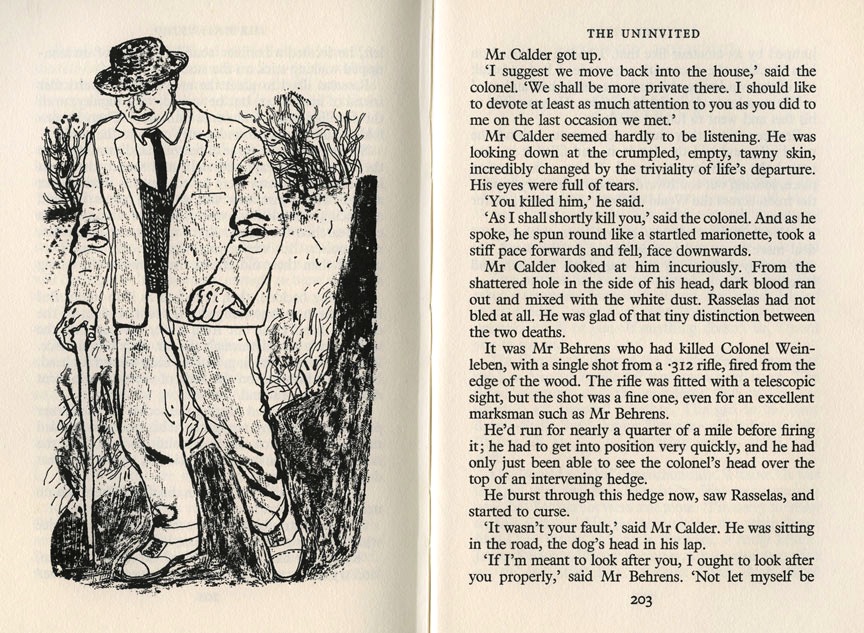
Or at least the front of it; I added it to Beautiful British Book Jacket Design in the gallery's very early days, in the second batch of book covers, I believe. Designed by Jim Russell, it wraps the British first edition of the short story collection Alfred Hitchcock's Sinister Spies, published by Max Reindhart in 1967. I bought this copy in Colin Page Antiquarian Books in Brighton (I think) a few years ago, took a picture of the cover for Beautiful British Book Jacket Design, and then didn't really look at the book again properly until late last year, when I noticed that the Michael Gilbert short story within, "The Uninvited", starring Gilbert's quietly lethal middle-aged secret agents Daniel Calder and Samuel Behrens, didn't appear to be in either of the two Calder and Behrens collections – Game Without Rules (1967) and Mr. Calder and Mr. Behrens (1982). Accordingly I got quite excited, thinking I'd found a "lost" Calder and Behrens tale (and emailed fellow enthusiast Book Glutton to that effect)... until I realised that it was merely one of the stories in Game Without Rules, "A Price of Abyssinia", under another title.


Except not quite: having compared the two – which is the kind of stupendously dreary thing I do when left to my own devices – I've found that there are differences between them, or at least between "The Uninvited" and the version of "A Price of Abyssinia" in my copy of Game Without Rules, which is the British first edition, published in 1968, the year after the US Harper and Row edition of Game Without Rules, and indeed the year after Alfred Hitchcock's Sinister Spies. Evidently someone – either Gilbert or his editor – did some minor rewriting of the story, presumably for (the British edition of) Game Without Rules, although I guess it's conceivable the rewriting was done for "The Uninvited" and "A Price of Abyssinia" is presented as it originally appeared (in Ellery Queen's Mystery Magazine most likely). In any case: largely it's things like serial commas – used much more sparingly in British publications than American ones – which have been altered, but there are more noticeable changes too. Take the opening paragraph or so. Here's how it appears in Alfred Hitchcock's Sinister Spies:

Mr Calder was silent, solitary and generous with everything, from a basket of cherries or mushrooms, to efficient first aid to a child who had tumbled. The children liked him. But their admiration was reserved for his dog.

The great, solemn, sagacious Rasselas was a deerhound. He had been born in the sunlight.

Now here's how it appears in Game Without Rules (the emphasis is mine):

Mr Calder was silent, solitary and generous with everything, from a basket of cherries or mushrooms to efficient first aid to a child who had tumbled. The children liked him. But their admiration was reserved for his deerhound.

Rasselas had been born in the sunlight.

To pick another example, here's a description of Colonel Weinleben, Calder and Behrens' opponent in the story, from Sinister Spies:

He was greatly inferior to the dog, both in birth and breeding.

And the same description in Game Without Rules:

He was the illegitimate son of a cobbler from Mainz and greatly inferior to the dog, both in birth and breeding.


I suppose it's a matter of personal taste as to which you prefer – my preference is for the Game Without Rules version – but it does shed light on how stories can change from publication to publication. However, I do have an additional point which I'm edging towards here, which is that as a result of noticing these differences I was minded to take a closer look at Sinister Spies and read some of the other stories within (each of which is accompanied by a Jim Russell illustration). There's a perfunctory introduction by Hitchcock, a very good Eric Ambler story – more on him anon – and a handful of other stories that are worth a look, but the one that proved a real revelation for me was "The Traitor" by W. Somerset Maugham.


This, I discovered, is one of the loosely linked stories which make up the book Ashenden, or, The British Agent (Heinemann, 1928), which together detail the World War I exploits of Ashenden, novelist turned spy, based on Maugham's own experiences. Not that much of that can be gleaned from "The Traitor": there's no introduction to the story in Sinister Spies, and Ashenden's parallel career as a man of letters isn't mentioned. Regardless, even read in isolation "The Traitor" stands as one of the best pieces of spy fiction I've ever come across – almost languorous in pace and yet packing an emotional punch that's uncommon in the field of espionage writing (John le Carré's Karla Trilogy comes to mind as a useful comparison).

Sent to Lucerne in Switzerland by his boss at British Intelligence, R., in order to convince Grantley Caypor, an Englishman who's been spying for the Germans, to return to Britain, Ashenden spends much of the story seemingly making very little headway in his mission, becoming mildly friendly with Caypor but otherwise idling the days away, taking pleasant naps and latterly fretting over his lack of progress. Unregistered by Ashenden, however, R. has already laid the foundations for Caypor's extraction, and Caypor's fate, even given his betrayal – and though that fate is only guessed at by Ashenden and Caypor's German wife – is vividly brought home in all its awful finality.


It's a beautifully judged, wonderfully written tale, and it left me eager to read further Ashenden stories – which, luckily for me, was as simple a matter as plucking another book from my shelves. Because I own another, slightly earlier anthology of short spy stories which also contains a (different) Ashenden tale – an anthology compiled by the aforementioned Eric Ambler.