Showing posts with label Jimmy Sangster. Show all posts

Tuesday, 22 December 2015

The Ten Best Books I Read in 2015

For this, my final post of the year, I present the ten best books I read in 2015. As has been the case with every one of my year-end books top tens since I started assembling such things six years ago, barely any of the books in this year's top ten were actually published this year – in fact just one, by an author who in 2013's top ten was the sole representative of that year's new publishing too – and so this post will as usual be of absolutely no use to anyone in discerning the prevailing trends in publishing over the past twelve months. But it may be of some use in discerning the prospective trends on Existential Ennui over the coming months, in as much as I've yet to get round to reviewing just under half of the books in this top ten – nor a good number of the books in my big long list of the books I read in 2015, from whence this top ten is drawn – and so whatever prolix piffle I eventually manage to cobble together about them may well form the substance of at least some of Existential Ennui in 2016.

Unless of course I decide not to blog about any of them. Or indeed blog at all. Merry Christmas, and a happy new year!

10. Our Man in Havana by Graham Greene (Heinemann, 1958)

Informed by Graham Greene's experiences working for the Secret Service during the war, Our Man in Havana may be a fairly frothy confection (the fate of poor Dr. Hasselbacher aside) but it still effectively skewers what Greene perceived as the credulity of British Intelligence. "It seemed to me that either the Foreign Office or the Intelligence Service had amply merited a little ridicule," he wrote of the novel in Ways of Escape. Speaking of which...

9. Ways of Escape by Graham Greene (Bodley Head, 1980)

Part autobiography, part travelogue, Greene's book-by-book saunter down memory lane is not only illuminating as to the origins of many of his novels, short stories and plays (the background to, and inspiration for, The Quiet American, for example, is extensive, incorporating diary entries) but frequently arresting and eye-opening too, not least when he discusses his fondness for opium, marijuana and cocaine.

8. Station Eleven by Emily St. John Mandel (Picador, 2014)

I noted in my top ten of the best graphic novels I read in 2015 that I'm a sucker for post-apocalyptic dystopias, and Station Eleven is a fine example of the sub-genre – elegantly written, strangely uplifting and with a fascinating and compelling internal mythology (as evidenced by the one-page Dr. Eleven comic book insert in my copy of the first edition).

7. The Holm Oaks by P. M. Hubbard (Joseph, 1965)

In my review of The Holm Oaks I ventured that it "might be the quintessential Hubbard novel", and further suggested that "the novel could almost be seen as a prototypical eco thriller". True to form I neglected to say whether it's any good or not, but its appearance in this top ten should offer some guidance there.

6. Eleven by Patricia Highsmith (Heinemann, 1970)

Graham Greene – who, as is becoming clear, features heavily in this top ten (to paraphrase New Order, everything went Greene for me this year) – wrote in his foreword to Eleven that Highsmith in her short stories "is after the quick kill rather than the slow encirclement of the reader, and how admirably and with what field-craft she hunts us down". Quite so.

= 5. private i / Foreign Exchange by Jimmy Sangster (Triton, 1967 / 1968)

I think Hammer Horror-meister Jimmy Sangster's two spy/crime thrillers starring ex-British Intelligence operative turned private investigator John Smith might have been the most purely enjoyable novels I read in 2015 – "kind of early le Carré crossed with Len Deighton's unnamed working class secret agent and with a dash of Adam Hall's Quiller mixed in for good measure", as I put it in my review.

4. A God in Ruins by Kate Atkinson (Doubleday, 2015)

A companion novel to Life After Life, A God in Ruins is as evocative in its own way of life during wartime as Graham Greene's The Ministry of Fear (about which more shortly); but it's also a beautiful – and beautifully written – meditation on the big stuff of existence: love, death, family, chance, choice.

3. Carol by Patricia Highsmith (Bloomsbury, 1990)

"If [Todd] Haynes's film brings [Carol] and Highsmith to a new audience, so much the better, because Carol deserves to be widely read, especially by those who might otherwise dismiss Highsmith as a crime writer," I wrote in my review, adding that "it's recognisably the work of the author of The Talented Mr. Ripley (1955), This Sweet Sickness (1960) and The Cry of the Owl (1962), and as good in its own way as any of those novels". Still haven't seen the blummin' film yet though.

2. Touch by Elmore Leonard (Viking, 1988)

I was surprised by how great Touch was; it's such an overlooked novel in Leonard's backlist that I wasn't expecting it to be up there with the likes of The Big Bounce (1969), Unknown Man No. 89 (1977), Split Images (1981), Stick (1983) or LaBrava (1983). But it really is that good, boasting among its scenes "a climactic, brilliant, farcical TV interview conducted by a rictus grinning hairpiece-bedecked towering shit of a host which is about the best sequence I've read in a Leonard novel", as I put it in my review.

1. The Ministry of Fear by Graham Greene (Heinemann, 1946/1960)

When I reviewed The Ministry of Fear in July I praised the novel's "unexpected depth" and Greene's "vivid evocation of London during the Blitz, penned while the bombs were falling"; I highlighted the "undercurrent of pain and suffering which weaves through the story" and the themes of "the spirit of adventure and the loss of innocence" that inform the narrative; and I stated in closing "that The Ministry of Fear is the best of Greene's novels that I've read... and by far the best book that I've read this year". Couldn't have put it better myself.

Thursday, 15 October 2015

Jimmy Sangster's John Smith Spy Novels: private i (Triton, 1967); Signed Inscribed First Editions

NB: Linked in Friday's Forgotten Books, 16/10/15.

When Jimmy Sangster died four years ago, his obituaries naturally concentrated largely on his film and TV work (see The Guardian, The Independent, The Telegraph and The New York Times). Sangster was a key figure in the revival of Hammer Films in the late 1950s and through the 1960s; he wrote The Curse of Frankenstein (1957), Dracula (1958), The Mummy (1959) and two dozen other Hammer horrors before moving to America, where he wrote for The Six Million Dollar Man, Kolchak: The Night Stalker, Ironside, Wonder Woman and a bunch more US TV shows.

But Sangster also penned eight novels (plus a couple of novelisations of his own screenplays) besides his film and television work: three murder mysteries published from 1986–88 (1989–90 in the UK) starring expat former Scotland Yard investigator James Reed; one standalone thriller-cum-farce published in 1971 starring gun-running adventurer Anthony Bridges; two spy thrillers published from 1968–70 starring British Intelligence agent Katy Touchfeather; and two half-spy/half-mystery novels published from 1967–68 starring ex-British Intelligence operative turned private investigator John Smith, the first of which is this:


Or rather, these: private i, published by Triton in 1967, dust jacket design by Collis Clements. Now, I suppose the immediate question here is, why do I have two copies of the same book? Answer being, having learned about Sangster's parallel career as a writer of spy fiction (from screenwriter and novelist Stephen Gallagher, no less), I went in search of a first edition of his debut novel – private i – and came across two copies, both of which boasted intriguing inscriptions (written by Sangster, as far as I can determine; the handwriting is a little different in each book, but there are enough similarities – the same black maker pen used, corresponding letterforms – that I'm fairly confident they're from the same hand), one of which being an association copy. And since both books were relatively inexpensive – and being the hopeless case that I am – I bought both of them. (Whether or not I'll keep both of them remains to be seen – I'm planning on doing some eBaying soon.)

The copy on the left has a poem inscribed on the front free endpaper:


It reads:

Roses are Red.
Violets are Blue.
I'll lay odds
I'm higher than you.

Violets are Blue
Roses are Red
If I could find the strength
I'd drag you to bed

Drifting around in a Pale Velvet haze
What a wonderfull way to pass all our days.

Love, Jim xxxx

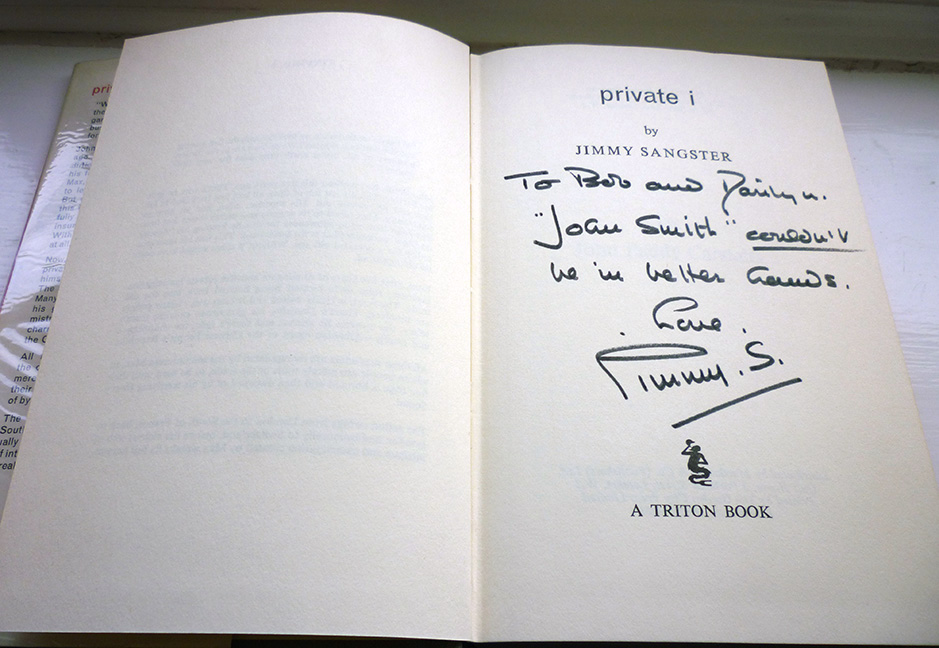
I've no idea who the poem was written for (although I'd dearly love to find out), but I do know who the other copy of the book, the association copy, was inscribed to, this time on the title page:


The inscription reads:

To Bob and Marilyn.

"John Smith" couldn't be in better hands.

Love

Jimmy S.

Bob and Marilyn are the American actor Robert Horton and his wife; Horton starred in Wagon Train from 1957–1962 and featured in numerous other television series, films and TV movies, one of which being the 1969 television film The Spy Killer, directed by Roy Ward Baker, produced by Jimmy Sangster and with a teleplay by Sangster based on his own novel... private i.


I've not seen The Spy Killer – although there is a clip on YouTube of the opening five minutes, featuring Horton as John Smith walking through Berwick Street Market to the baritone strains of what sounds like Scott Walker (although actually the rather less-well-known John Rowles), and the reviews on IMDB are positive – but I have read private i, and can report that it's a cracking piece of spy fiction – kind of early le Carré crossed with Len Deighton's unnamed working class secret agent and with a dash of Adam Hall's Quiller mixed in for good measure. Narrated by Smith, one-time operative with the Service – i.e. British Intelligence – turned down-at-heel private investigator, it starts out in a cut-price seedy gumshoe vein, with Smith employed by his ex-wife to obtain evidence of her new husband's gay affair, before taking a sharp left turn into the dangerous world of international espionage, as Smith is press-ganged back into service by his former boss, the ruthless and manipulative Max.

The plot is suitably murky and twisty, involving murder, coded secrets and both the Chinese and Russian security services, but it's Smith's sardonic narration which really lifts the thing. When three pages into a spy novel the lead states that he's "nearly two stone overweight, that my digestive system plays up constantly, that my teeth aren't particularly good, and that I have suffered periodically from halitosis, B.O., prickly heat and dandruff", you know you're not in the realm of Bond, and Smith spends the remainder of the novel boozing, leching, failing to get it up with his indifferent girlfriend and crashing around like the low rent – and yet, on occasion, lowly cunning – loser that he is. The only real downside is a regrettable streak of homophobia which runs through the narrative, but even that can be put down to Smith's boorish nature and the prevailing attitudes of the time rather than to whatever prejudices Sangster might or might not have held. And anyway, I can forgive a multitude of sins in any example of the spy fiction form which contains an irreverent passage like this one:

I poured myself a large drink, and read the evening paper. I washed up some dirty dishes and rinsed out a couple of pairs of socks. I washed a nylon shirt and hung it up to dry. I had another drink which I took with me to the bath. I trimmed my toenails, had a crap, read the evening paper again, and then had a shave. After that there seemed to be nothing left to do but to phone Berat's contact and tell him about the rendezvous.


The second and final John Smith spy thriller, Foreign Exchange, was published by Triton in 1968 (and filmed for television in 1970, again with Robert Horton in the lead role), and it's almost as good as private i, sending Smith to Russia as part of a complicated Cold War spy swap plot. A full review will have to wait for another time, however; this post is quite long enough as it is. For now, I invite anyone interested in learning more about the novel – and in reading contemporaneous reviews of private i – to click on the above images of the dust jacket of the Triton edition (designed by Alison Storey).