Thursday, 30 January 2014

Eric Ambler on The Mask of Dimitrios, Journey into Fear and Judgment on Deltchev: Introduction to Intrigue (Hodder, 1965)

NB: Linked in this week's Friday's Forgotten Books.

The Eric Ambler introduction in this anthology of three of the author's novels isn't quite as expansive as that in the 1964 short story (both Ambler's and others') anthology To Catch a Spy, but it's still worth a look, I feel, if only for the amusing way in which Ambler persistently undermines the reasoning for the inclusion of the introduction. And in any case, this little-seen edition of the book is itself quite intriguing – literally, in fact.


Published in hardback in the UK by Hodder & Stoughton in 1965, Intrigue collects three of Ambler's novels: The Mask of Dimitrios (1939), Journey into Fear (1940) and Judgment on Deltchev (1951). As such, it should not be confused with Intrigue, published in hardback in the US by Alfred A. Knopf in 1943 – and reissued in 1960 – which collects four of Ambler's novels: Journey into Fear, A Coffin for Dimitrios – the American title for The Mask of Dimitrios Cause for Alarm (1938) and Background to Danger – the American title for Uncommon Danger (1937).

Now, on balance, one might suppose that an anthology containing four early Eric Ambler spy thrillers would be a more attractive proposition than one containing three early(ish) Eric Ambler spy thrillers. But in this case, to my mind, matters are not so clear cut. For one thing, the Hodder version of Intrigue is much scarcer than the Knopf one, of which there are, presently, getting on for forty copies of the 1943 or (more commonly) 1960 edition on AbeBooks, as opposed to just two copies of the Hodder Intrigue. (My copy, incidentally, came from the basement of Camilla's secondhand bookshop in Eastbourne, bought for a fiver.) More importantly, however, there's the introduction. In the Knopf edition(s) it's by Alfred Hitchcock, whereas in the Hodder edition it's by Ambler himself. I haven't read Hitchcock's introduction in the Knopf Intrigue, but having read his typically glib one for his own Sinister Spies anthology, I can't imagine it's terribly insightful. Ambler's, on the other hand, though only four pages long, is revealing about the origins of each novel, agreeably anecdotal, and winningly self-deprecating about the business of writing introductions.


Having stated that "no writer of popular fiction should ever attempt to discuss or explain his own books; he should let them speak for themselves", Ambler then presents his excuse for ignoring his own advice: "It is – and already it begins to sound feeble – the fact that these books were written under three entirely different sets of circumstances, and that they seem now – as if it mattered – to reflect their times of origin." Of The Mask of Dimitrios he notes that it "was written during the nominal peace that followed the Munich agreement of 1938" and "was, inauspiciously, the Daily Mail Book-Of-The-Month for August 1939". He recalls how he "thought of the whole shape and plan... in a third-class compartment of the night train from Paris to Marseille" – the seat being "too hard for sleep" – and "made notes on a scrap of paper. They consisted of a rough sketch of Europe with a squiggly line drawn across it, and the words, 'begin Turkey – end Paris – Demetrius? Dimitrios'."

After musing that "[m]ost writers are familiar with the letter from the complete stranger who claims to recognise in a fictional character a thinly disguised (and, usually, libellous) portrait of himself", Ambler reveals that "The Mask of Dimitrios produced a considerable correspondence". There was the "Greek living in Wichita, Kansas who declared furiously, and with notable lack of filial consideration, that the odious Dimitrios was an obvious portrait of his father"; the French journalist who was convinced Dimitrios was based on a living Greek criminal (of whom Ambler had never heard); and the man in Argentina who sent "ten closely-written pages... in an awkward mixture of bad English and German" claiming that he had found in the novel "clear evidence of the manner of his father's death in the early thirties".

"Unfortunately," Ambler adds, "he neglected to mention which of the book's characters he had identified as his father."


Like The Mask of Dimitrios, Journey into Fear "was also evolved in a train" – this time "[s]tanding in the packed corridor of an express which stopped at every station between Lyon and Paris", although Ambler "made no notes on that occasion. As everyone seemed certain at that point that we were all going to be bombed or gassed at any moment, note-making scarcely seemed worthwhile." The book "was written while I was waiting to go into the army during the 'phony' War. It was the Evening Standard book choice for the month of Dunkirk." In a footnote Ambler muses: "An earlier book of mine, Cause for Alarm, had been published in the week of Hitler's invasion of Austria. The recurrent international crises of the pre-War period seemed to follow the Spring-Autumn publishing pattern relentlessly, and the book casualties were always heavy. Few persons are in the mood for thrillers when the sky is falling." He further expresses surprise that "I, who had an original (1917) drawing of Will Dyson's [Merchant of Death] monster hanging on the wall by my desk, should so readily have decided that the object of the reader's sympathy and concern in Journey into Fear could be an arms salesman."

Judgment on Deltchev was written ten years after Journey into Fear, "after six years in the army and an embroilment with the film industry". For Ambler, "novel-writing had been a laboriously-acquired habit. In the army I lost the habit, and the process of recovery was slow." That process took place at a house in St. Margaret's Bay in Kent, leased from Noel Coward on the condition "that I should use the house in which to write another book". "Forget all this film nonsense," Coward told Ambler: "You think you will always be able to go back to the well. That may be so, but remember this; if you stay away too long, one day you will go back and find the well dry!" The house's previous tenant had been Ian Fleming, "then about to embark upon his series of James Bond adventures. Obviously the house and its landlord were together conducive to work in the genre."

Ambler rewrote Judgment on Deltchev "at least five times" and "started and discarded three other books during those years": not only did he have to reacquire "the writing habit" but "the internal world which had confidently produced the earlier books had been so extensively modified that it had to be re-explored".

He continues:

If this sounds unduly solemn from a thriller-writer with the sole and avowed object of providing entertainment, then perhaps I may quote Ian Fleming on the subject: 'While thrillers may not be Literature, it is possible to write what I can best describe as "thrillers designed to be read as literature".' Such an aim would surely excuse a measure of solemnity and some critical self-examination.

"On reflection, however," Ambler offers in closing, "I think that perhaps I was right in the first place. It really is better to let the books speak for themselves."


Before I move on from Eric Ambler – whose work, by the way, Ethan Iverson will also shortly be exploring over at Do the Math – I thought I might showcase a couple of Ambler first editions, both of which I acquired on London's Cecil Court.

Thursday, 23 January 2014

The History of Spies, Spying and Spy Fiction: John Buchan, Somerset Maugham, Compton Mackenzie, Graham Greene, Ian Fleming and Michael Gilbert in Eric Ambler's To Catch a Spy (Bodley Head, 1964)

NB: Linked in this week's Friday's Forgotten Books.

Like Alfred Hitchcock's Sinister Spies (Max Reindhart, 1967), the second short spy story anthology I'm reviewing this week also boasts a Calder and Behrens story by Michael Gilbert, an Ashenden story by W. Somerset Maugham and a story by Eric Ambler. In this instance, however, the anthology was also compiled by Ambler, who provides a much more thorough introduction than Hitchcock's genially superficial one for Sinister Spies, as well as introductions to each individual tale.


To Catch a Spy was published by The Bodley Head in 1964 under a terrific typographical dust jacket designed by Michael Harvey (which I've added to the Existential Ennui Beautiful British Book Jacket Design of the 1950s and 1960s page). I bought this copy a year or two ago for £7.50 – not a bad price for a first edition, the only real defects being some light wear on the wrapper and foxing on the page edges. I must admit that as with Alfred Hitchcock's Sinister Spies it was the wrapper that initially attracted me, and I was only prompted to read the book more recently when, in the wake of returning to Michael Gilbert's Calder and Behrens spy stories, I took a closer look at Sinister Spies and found myself unexpectedly moved by the Maugham story therein: "The Traitor", taken from Maugham's 1928 collection of linked stories Ashenden, or, The British Agent. Realising that there was another Ashenden tale in To Catch a Spy, I headed directly for it.

That "Giulia Lazzari" is every bit as remarkable as "The Traitor" will, I'm sure, come as no surprise to anyone familiar with Maugham's original book. I don't number myself among them – not yet; I'll be rectifying that soon – but the elegance and clarity of the prose is plain for all to see, and the story is at least as affecting as that of "The Traitor", perhaps more so.

We learn a little more about cultured World War I master spy Ashenden in "Giulia Lazzari" than in "The Traitor": that he is a popular and successful novelist and playwright, a useful cover for his covert career working for Britain's secret service; that he runs a network of spies in Germany, paying their wages and forwarding on to R., his British Intelligence boss, whatever information they obtain. R. himself also features more prominently: there's a long scene set in a Parisian hotel where R. briefs Ashenden on his latest mission, during which R.'s imperialist, colonialist, even racist views become clear – views which are hard to stomach not only for the modern reader but seemingly for Ashenden as well.

Of course, whatever admiration Ashenden might have for his intended target – anti-British rule agitator Chandra Lal, an Indian who has allied himself with Germany – is of no consequence; as he tells R.: "He's declared war and he must take his chance." To that end Ashenden attempts to lure Chandra to the French side of Lake Geneva – and thus his doom – using Chandra's Italian lover, dancer and occasional prostitute Giulia Lazzari, as bait. How he does so is a vivid illustration of the heartless nature of the spymaster, who must ride roughshod over the emotions and feelings of those caught in his firing line in order to achieve his aims. As the story unfolds you remind yourself that there is a point to this cruelty, that a war is raging across Europe; but even so, one wonders whether the ends really justify the means.


In his introduction to "Giulia Lazzari", Eric Ambler notes that though the most popular Ashenden stories are probably "The Hairless Mexican", "The Traitor" and "Mr Harrington's Washing", "Giulia Lazzari" "...is the episode that I most enjoy re-reading. The preliminary scenes with R. are a perennial delight, and Madame Lazzari is so vividly presented that you can almost see the pores of her skin. It is an ugly story, but a highly satisfying one." In his introduction to To Catch a Spy as a whole, Ambler readily admits that his own early books were strongly influenced by Ashenden – "the first fictional work on the subject [espionage] by a writer of stature with first-hand knowledge of what he is writing about" – and "that there has been no body of work in the field of the same quality written since Ashenden" – high praise indeed from such an aficionado, not to mention the author of such notable spy novels himself as Epitaph for a Spy, The Mask of Dimitrios, Passage of Arms and others.

Ambler's To Catch a Spy introduction is fascinating for the way it details not merely the history of espionage writing but the history of espionage itself. He notes: "There seems to have been no period in recorded history when secret agents have not played a part... in political and military affairs. And yet, it is impossible to find any spy story of note written before the twentieth century." (As a reason for this he points to "the Dreyfus case (1894–99)... not so much on its having created a new public appetite or whetted an unfamiliar curiosity, as on the fact that it re-opened a discussion which had been firmly closed for nearly a hundred years.") Drawing a line from Erskine Childers's The Riddle of the Sands (1903) – "the first spy novel" – to Joseph Conrad's The Secret Agent (1907) – "the first attempt by a major novelist to deal realistically with the secret war, with the sub-world of conspiracy, sabotage, double-dealing and betrayal" – to William Le Quex and E. Phillips Oppenheim, Ambler arrives at John Buchan (The Thirty-Nine Steps, 1915) and the other authors he has selected for his anthology.


And what a selection: Buchan, Somerset Maugham, Compton Mackenzie, Graham Greene, Ian Fleming, Michael Gilbert and Ambler himself – that's one hell of a dinner party guest-list – all represented by some of their best work. Buchan's "The Loathly Opposite" is a fine tale of two cryptographers on opposing sides in World War I, while Ian Fleming steps up with "From a View to a Kill" (Taken from For Your Eyes Only, 1960), in which James Bond untangles a deadly plot to intercept British Secret Service communiques in France. Ambler makes note of Fleming/Bond's "shrewd and constructive... account of the difficulties of deciding what to drink in a Paris cafe" (Bond settles on "an Americano—bitter Campari, Cinzano, a large slice of lemon peel, and soda"), but adds: "Critics rarely remark on how well written the James Bond stories are. I suppose that with a man as civilized and amusing as Mr Fleming, good writing is taken for granted."

Ashenden aside, Ambler reserves special praise for Compton Mackenzie's long-out-of-print The Three Couriers (1929), from which he extracts "The First Courier". Personally I couldn't get on with it; perhaps I simply wasn't in the mood for Mackenzie's brand of, as Ambler puts it "light-hearted... absurdity and farce". Much more to my liking was Graham Greene's succinct "I Spy", which I'd read once before in Greene and his brother Hugh's The Spy's Bedside Book (1957) but which was well worth revisiting – as indeed was Michael Gilbert's excellent "On Slay Down", which I originally read in the Calder and Behrens collection Game Without Rules.


From his own fiction Ambler picks an episode from The Mask of Dimitrios (1939), declaring that "I have never written any short spy stories". I'm afraid I only skimmed over this, for the simple reason that I have every intention of reading the full novel at some point, probably in the edition I'll be blogging about next – another anthology, this time of Ambler's own work, again boasting an Ambler introduction.

Tuesday, 21 January 2014

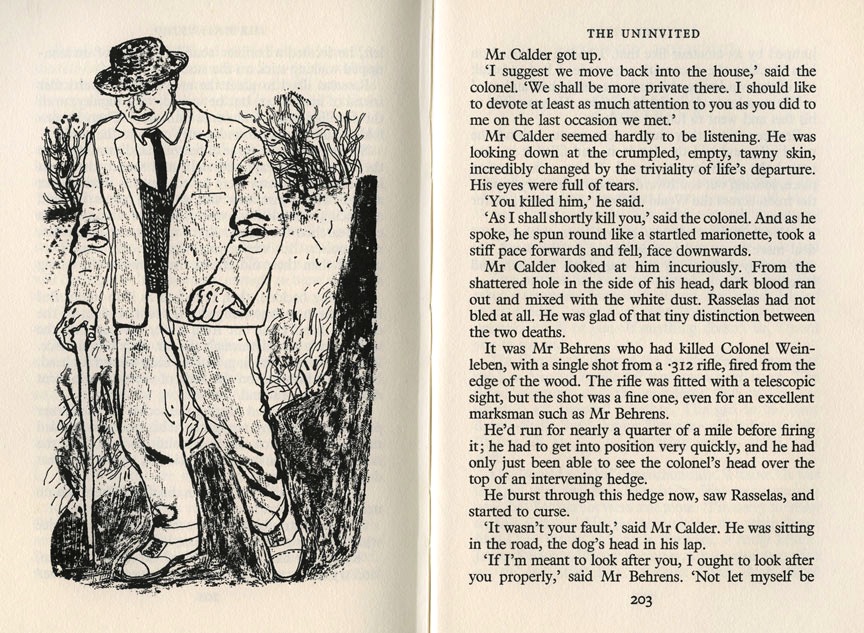
Michael Gilbert's Calder and Behrens and W. Somerset Maugham's Ashenden in Alfred Hitchcock's Sinister Spies (Max Reindhart, 1967)

Anyone who's taken a gander at the Existential Ennui Beautiful British Book Jacket Design of the 1950s and 1960s gallery should recognise this dust jacket:


Or at least the front of it; I added it to Beautiful British Book Jacket Design in the gallery's very early days, in the second batch of book covers, I believe. Designed by Jim Russell, it wraps the British first edition of the short story collection Alfred Hitchcock's Sinister Spies, published by Max Reindhart in 1967. I bought this copy in Colin Page Antiquarian Books in Brighton (I think) a few years ago, took a picture of the cover for Beautiful British Book Jacket Design, and then didn't really look at the book again properly until late last year, when I noticed that the Michael Gilbert short story within, "The Uninvited", starring Gilbert's quietly lethal middle-aged secret agents Daniel Calder and Samuel Behrens, didn't appear to be in either of the two Calder and Behrens collections – Game Without Rules (1967) and Mr. Calder and Mr. Behrens (1982). Accordingly I got quite excited, thinking I'd found a "lost" Calder and Behrens tale (and emailed fellow enthusiast Book Glutton to that effect)... until I realised that it was merely one of the stories in Game Without Rules, "A Price of Abyssinia", under another title.


Except not quite: having compared the two – which is the kind of stupendously dreary thing I do when left to my own devices – I've found that there are differences between them, or at least between "The Uninvited" and the version of "A Price of Abyssinia" in my copy of Game Without Rules, which is the British first edition, published in 1968, the year after the US Harper and Row edition of Game Without Rules, and indeed the year after Alfred Hitchcock's Sinister Spies. Evidently someone – either Gilbert or his editor – did some minor rewriting of the story, presumably for (the British edition of) Game Without Rules, although I guess it's conceivable the rewriting was done for "The Uninvited" and "A Price of Abyssinia" is presented as it originally appeared (in Ellery Queen's Mystery Magazine most likely). In any case: largely it's things like serial commas – used much more sparingly in British publications than American ones – which have been altered, but there are more noticeable changes too. Take the opening paragraph or so. Here's how it appears in Alfred Hitchcock's Sinister Spies:

Mr Calder was silent, solitary and generous with everything, from a basket of cherries or mushrooms, to efficient first aid to a child who had tumbled. The children liked him. But their admiration was reserved for his dog.

The great, solemn, sagacious Rasselas was a deerhound. He had been born in the sunlight.

Now here's how it appears in Game Without Rules (the emphasis is mine):

Mr Calder was silent, solitary and generous with everything, from a basket of cherries or mushrooms to efficient first aid to a child who had tumbled. The children liked him. But their admiration was reserved for his deerhound.

Rasselas had been born in the sunlight.

To pick another example, here's a description of Colonel Weinleben, Calder and Behrens' opponent in the story, from Sinister Spies:

He was greatly inferior to the dog, both in birth and breeding.

And the same description in Game Without Rules:

He was the illegitimate son of a cobbler from Mainz and greatly inferior to the dog, both in birth and breeding.


I suppose it's a matter of personal taste as to which you prefer – my preference is for the Game Without Rules version – but it does shed light on how stories can change from publication to publication. However, I do have an additional point which I'm edging towards here, which is that as a result of noticing these differences I was minded to take a closer look at Sinister Spies and read some of the other stories within (each of which is accompanied by a Jim Russell illustration). There's a perfunctory introduction by Hitchcock, a very good Eric Ambler story – more on him anon – and a handful of other stories that are worth a look, but the one that proved a real revelation for me was "The Traitor" by W. Somerset Maugham.


This, I discovered, is one of the loosely linked stories which make up the book Ashenden, or, The British Agent (Heinemann, 1928), which together detail the World War I exploits of Ashenden, novelist turned spy, based on Maugham's own experiences. Not that much of that can be gleaned from "The Traitor": there's no introduction to the story in Sinister Spies, and Ashenden's parallel career as a man of letters isn't mentioned. Regardless, even read in isolation "The Traitor" stands as one of the best pieces of spy fiction I've ever come across – almost languorous in pace and yet packing an emotional punch that's uncommon in the field of espionage writing (John le Carré's Karla Trilogy comes to mind as a useful comparison).

Sent to Lucerne in Switzerland by his boss at British Intelligence, R., in order to convince Grantley Caypor, an Englishman who's been spying for the Germans, to return to Britain, Ashenden spends much of the story seemingly making very little headway in his mission, becoming mildly friendly with Caypor but otherwise idling the days away, taking pleasant naps and latterly fretting over his lack of progress. Unregistered by Ashenden, however, R. has already laid the foundations for Caypor's extraction, and Caypor's fate, even given his betrayal – and though that fate is only guessed at by Ashenden and Caypor's German wife – is vividly brought home in all its awful finality.


It's a beautifully judged, wonderfully written tale, and it left me eager to read further Ashenden stories – which, luckily for me, was as simple a matter as plucking another book from my shelves. Because I own another, slightly earlier anthology of short spy stories which also contains a (different) Ashenden tale – an anthology compiled by the aforementioned Eric Ambler.

Thursday, 16 January 2014

Mr. Calder and Mr. Behrens by Michael Gilbert (Hodder, 1982): Book Review


NB: Linked in this week's Friday's Forgotten Books. Thank you, Patti!

Michael Gilbert published two collections of short stories featuring middle-aged British Intelligence operatives Daniel Calder and Samuel Behrens (and their boss, Mr. Fortescue, who divides his time between dealing with threats to the state and managing the Westminster branch of the London and Home Counties Bank). The first, the brilliant Game Without Rules (Hodder & Stoughton, 1968), I read and reviewed early in 2012, rating it so highly that I eventually placed it at number two in my top ten for that year (and would have happily placed it at number one were it not for another Michael). As a consequence, despite owning a first edition of the second collection, Mr. Calder and Mr. Behrens (Hodder & Stoughton, 1982), for almost as long as I have Game Without Rules, I've sort of been saving it – some form of delayed gratification, I suppose. But the arrival of Edie in May of last year brought with it the realisation that there are only so many hours in the day, and there's little sense in my looking forward to reading something if I ultimately end up never getting round to reading it.


So: Mr. Calder and Mr. Behrens. As I anticipated (not entirely unaided: Olman has a review of the book at his blog), the stories in this second collection are just as good as those in the first: clipped, economical, elegantly written and drily witty. Though a fair number hew to the established format – Calder and Behrens are tasked with investigating and bringing down some traitorous type and typically approach the problem from opposite ends, meeting in the middle – there are still those that buck that trend. The opening tale, "The Twilight of the Gods", which takes us back to World War II and Behrens' role in an attempt on Hitler's life, is like a condensed forerunner of Valkyrie, although the scene where Behrens inadvertently encounters the Fuhrer could more accurately be said to prefigure the bit in Indiana Jones and the Last Crusade where Indy comes face-to-face with Hitler. The closing story, "The Last Reunion", is also Hitler themed, involving as it does Neo-Nazis and a hunt for a recording of Hitler's final message to the people of the Reich, buried at the former site of a prisoner-of-war camp.


The tale I enjoyed the most is "The Decline and Fall of Mr. Behrens" – also fairly atypical, in that no one loses their life or, to any great extent, their liberty, and that Behrens, normally an (occasionally blunt) instrument of the state, turns agent provocateur, assisting a firebrand student in her struggle against the oppressive forces of the University of Middlesex (it also has an excellent payoff which turns on Behrens' Jewish heritage). It's an indication that although Calder and Behrens are very much of the Establishment, middle age has brought with it a more nuanced outlook, one which perhaps reflects Gilbert's own.

I wonder too if Gilbert's opinions can be detected in "Emergency Exit", when Mr. Fortescue informs the Under-Secretary of State that the wife of a Navy Admiral is a Communist agent, to be met by the disbelieving exclamation, "This sounds like something Security Executive has dreamed up" – Security Executive being the fictional intelligence department in the Colonel Charles Russell series of spy novels by the avowedly right-wing William Haggard.

Also in "Emergency Exit" is the hitherto secret origin of Rasselas, Calder's Persian deerhound, whose presence in a number of other stories in Mr. Calder and Mr. Behrens suggests that those stories must be set prior to "A Prince of Abyssinia" in Game Without Rules; as Book Glutton noted in an email to me, the chronology of the tales between the two collections does throw one a tad. Book Glutton also pointed out to me, when I lamented on Twitter after finishing Mr. Calder and Mr. Behrens that there were no more Calder and Behrens stories for me to read, that there are two Calder and Behrens radio plays in the 2009 Michael Gilbert collection The Murder of Diana Devon and Other Mysteries, so I shall have to keep an eye out for that.*


And I did for a while think that I might have found one further story featuring Calder and Behrens, in an anthology of espionage short stories – except as it turned out it was a story already in Game Without Rules under an alternate title. There are some minor differences between the two, however, and the anthology did prove revelatory to me in one other respect, so I'll be exploring all of that in the next post – unless, of course, this Saturday's Lewes Book Fair turns up anything interesting.


* There is also. I later learned, one further Calder and Behrens short story that doesn't appear in either Game Without Rules or Mr. Calder & Mr. Behrens; see this post for more.

Tuesday, 14 January 2014

Michael Gilbert Joins British Thriller Book Cover Design of the 1970s and 1980s

When last I left my British Thriller Book Cover Design of the 1970s and 1980s gallery, the number of dust jackets and paperback covers therein stood at an impressive 120. But I've still not exhausted my supply of '70s and '80s thrillers, and at the head of the queue to join the gallery is Michael Gilbert.

I've written about Gilbert in any depth just twice before, when I reviewed his 1956 spy thriller Be Shot for Sixpence last year, and his 1968 collection of espionage short stories featuring middle-aged spies Mr. Calder and Mr. Behrens, Game Without Rules, the year before. But though he's only cropped up a handful of times on Existential Ennui in total, behind the scenes I've quietly been collecting all manner of Michael Gilbert first editions, the selection in this post merely representing those that fit the remit of British Thriller Book Cover Design of the 1970s and 1980s (i.e. they were published in the '70s and '80s). The remainder of those books – some of which are highly intriguing – will have to wait for another time; for now, here are the Michael Gilbert jackets – all of which wrap the British firsts of the novels – which have joined the British thriller cover design gallery.


The Body of a Girl (Hodder & Stoughton, 1972); jacket design by Rene Brown
An impulse online purchase this one, bought for a few quid from an Amazon Marketplace seller after a first edition I was watching on eBay sold for more than I was prepared to pay. Gilbert also wrote a 1958 television play with the same title, although whether the novel is based on the play I've not been able to determine. The novel's lead, DCI Mercer, would go on to feature in three short stories in the 1997 collection The Man Who Hated Banks and Other Mysteries (that info gleaned from Martin Edwards's fine overview of Michael Gilbert's life and work).


The Empty House (Hodder, 1978); dust jacket uncredited
I believe I bought this one off the legend that is Jamie Sturgeon, at the Midhurst Book Fair. Like most of the books in this post, I've yet to read The Empty House, but should you wish to learn more about it (other than reading the jacket flap copy above), there's a brief but illuminating review by author Dana Stabenow on her website.


Death of a Favourite Girl (Hodder, 1980); jacket design by Melvyn Gill
A holiday purchase, as featured in the Framlingham leg of the Jones-Day 2013 Suffolk vacation. Death of a Favourite Girl was published in the States (the same year as the Hodder edition, by Harper & Row) under the title The Killing of Katie Steelstock, a title which was subsequently adopted for the British paperback edition, published by Penguin in 1981.


Mr. Calder and Mr. Behrens (Hodder, 1982); dust jacket uncredited
Gilbert's second collection of Calder and Gilbert espionage short stories, following Game Without Rules. I shall be coming back to this one...


Trouble (Hodder, 1987); jacket by McNab Design
A Lewes Book Bargain, no less, purchased in Lewes' A&Y Cumming secondhand bookshop a good few years ago now.


Young Petrella (Hodder, 1988); dust jacket uncredited
Another short story collection, this one focusing Sergeant Patrick Petrella's adventures – the second such collection, in fact, the first being 1977's Petrella at Q. The jacket photograph uses a similar device to that on the Mr. Calder and Mr. Behrens wrapper, with the titles of the stories within shown as, respectively, notes on a pad and filing cabinet dividers. I wouldn't be at all surprised if both were the work of the same photographer – and possibly Death of a Favourite Girl, too, which would make all three the work of Melvyn Gill.

I'll be staying with Michael Gilbert for the next post, which will be on the aforementioned Calder and Behrens...

Friday, 10 January 2014

Notes from the Small Press 16: Sky in Stereo #2 by Mardou (Yam Books, 2013)

I'm briefly reviving my Notes from the Small Press series (the last instalment was over a year ago; whether the series will continue beyond this point remains to be seen) because this popped through my letterbox on New Year's Eve:


The second issue of Mardou's semi-autobiographical comic Sky in Stereo, kindly sent by Mardou herself. I reviewed the first issue, which Mardou self-published, in 2012, but since then the series has been picked up by a US small press publisher, Yam Books, who issued #2 mid-last year. It received positive reviews from Chris Mautner at Robot 6 and Andy Oliver at Broken Frontier and others, so there's little point in my reviewing it as well, especially since I'm so late to the party; but I like Mardou's work a lot – I've been following it (and her) for getting on for ten years now – and Sky in Stereo is developing into the best thing she's done, and so here, for what they're worth, are a few notes and thoughts on this second issue.


I was struck by individual panels this time round, and found myself dwelling on some of them – partly because of the confidence of the line and how they work as lovely little pieces of art and text, but also the truth of them, or what seemed to me to be the truth of them.


These small moments, almost narrative asides, are, I think, a big part of why Sky in Stereo is so good. In a formal or structural sense they're not intrinsic to the story, and yet they make the story. They add depth to the character of Iris – Mardou's fictional stand-in – but not in a conscious or overly considered way; they simply speak to the truth of being seventeen and awkward and uncertain in Manchester in 1993.


I did wonder if that specific milieu was why the comic worked for me; I'm older than Mardou – or should I say Iris – but only by about five years or so, and I was at college in Manchester close to when Sky in Stereo is set. But there were jolts of recognition for me even beyond those similarities of background: watching telly during an acid trip and seeing actors "leave holes in the scenery behind them"; a mention of the rotating lands atop Enid Blyton's Magic Faraway Tree and how you could get stuck in them if you weren't careful; a glimpse of a Teenage Fanclub Bandwagonesque poster on a bedroom wall. Those points of reference and scenes, plus positive response from American reviewers (and publishers), suggests to me a resonance far beyond those of us who happened to be in Manchester in the early 1990s.


Something I was chuffed to see was that my review of #1 has been excerpted on the back cover of #2, although that particular bit of my review does make me sound insufferably pompous.


(Then again, you could probably pick numerous other parts of numerous other reviews of mine and reach the same conclusion.)


Lastly, in a meeting of minds between two of my favourite comics creators (and people), my friend Martin Eden – he of Spandex and The O Men fame – did a nice piece of Sky in Stereo fan art, which Mardou posted on her LiveJournal at the end of last year, and which I'm reposting above.


Previous Notes from the Small Press:

Notes from the Small Press 1: Fast Fiction Presents the Elephant of Surprise

Notes from the Small Press 2: Monitor's Human Reward by Chris Reynolds

Notes from the Small Press 3: Small Pets

Notes from the Small Press 4: Anais in Paris by Mardou

Notes from the Small Press 5: The Curiously Parochial Comics of John Bagnall

Notes from the Small Press 6: Ed Pinsent's Illegal Batman and Jeffrey Brown's Wolverine: Dying Time

Notes from the Small Press 7: The Comix Reader #1

Notes from the Small Press 8: A Help! Shark Comics Gallery

Notes from the Small Press 9: Some Gristavision Comics by Merv Grist

Notes from the Small Press 10: Some Sav Sadness Comics by Bob Lynch

Notes from the Small Press 11: a Review of Illegal Batman in the Moon

Notes from the Small Press 12: The Sky in Stereo by Mardou

Notes from the Small Press 13: First by Tom Gauld and Simone Lia

Notes from the Small Press 14: Planet 4, a Monitor Story by Chris Reynolds

Notes from the Small Press 15: Spandex #7 by Martin Eden