Thursday, 20 November 2025

A History of Hot Toys Prelude: George Lucas's Head

Besides collecting books and comics and records (and, along with those, dust), I also collect action figures – on and off. This occasional diversion dates back to my time working at Titan in the early 2000s, when I edited Star Trek Magazine and tie-in souvenir magazines to movies like Hulk and X2, and launched and edited late lamented (by me) toy and comic collector magazine Memorabilia (a kind of British version of Wizard but with better jokes). Back then it was American companies like Marvel/Toy Biz and their early super-posable 6-inch action figures – Spider-Man, Daredevil, the 2002 Spider-Man movie range – or DC Direct and their superhero figures that I tended to gravitate to, but I also nurtured a fascination for Japanese companies like Sega and their 7-inch Real Model Neon Genesis Evangelion range or Medicom's Lego-like Kubrick figures (some of which I might blog about at some point).

My interest in action figures has waxed and waned over the years, but whenever my curiosity has been piqued in the past two decades it's tended to be by Japanese and Hong Kongese figures: Kaiyodo's Revoltech and Yamaguchi ranges (Evangelion again, but other anime/mecha too, plus sci-fi and Iron Man figures); Bandai and Medicom's 6-inch S.H. Figuarts and Mafex lines (mostly Marvel and DC movie figures); and the 1/6th-scale (i.e. 12-inch) high-end figures produced by Medicom in their Real Action Heroes range and Hot Toys in their Movie Masterpiece Series and Deluxe DX line. While Medicom were the trailblazers as regards 1/6th-scale movie and TV tie-in action figures, producing Judge Dredd and Alien figures as far back as 1995, since the early 2000s Hong Kong-based Hot Toys have risen to become leaders in the field, innovating in everything from articulation and artistry to craftsmanship and tailoring.

Naturally there have been numerous sites and YouTube channels which have charted Hot Toys' development and wares over the years: Michael Crawford's excellent Captain Toy site springs to mind, as do YouTubers like Dean Knight, Sean Long, Shartimus Prime and the seemingly surname-less Justin and his Collection. What there hasn't been so much of is historical exploration and appreciation of Hot Toys' extraordinary toys, and so that's what I thought I'd do in this series of posts, taking an idiosyncratic look at Hot Toys-gone-by in the form of figures from my own collection. Starting with this:

This is George Lucas's head. More specifically, it's a head – and neck – belonging to one of Hot Toys' first forays into 1/6th figures, the Famous Type Figure. Produced circa 2000, there were three of these, all unlicensed (i.e. unofficial): one clearly modelled on George Lucas, director of such films as THX 1138 (1971), American Graffiti (1973) and a long-forgotten space fantasy by the name of Star Wars (1977); one based on Tom Cruise as Ethan Hunt in Mission: Impossible 2 (2000), and one modelled on Keanu Reeves as Neo in The Matrix (1999). 

I don't have George's body or box as I bought his head as part of a job lot of 1/6th bits and pieces, but even disembodied it's notable how even at this very early juncture, 25 years ago, the ability of Hot Toys' sculptors and painters to capture a likeness was in evidence. 

Within the space of a few years Hot Toys' artisans would start to achieve uncannily lifelike head sculpts, in concert with cleverly engineered TrueType bodies that replicated the way the human body moves and outfits boasting finely detailed tailoring. But before we get to any of that, for my first post proper in this series I want to take a look at the two Famous Type Figures I own in full – these guys:

Wednesday, 16 July 2025

Signed Patricia Highsmith Books: Edith's Diary, People Who Knock on the Door and Found in the Street

As I mentioned in my post the other week on a significant (to me, if no one else) piece of signed Patriciaphernalia relating to Ripley's Game, I also have several signed Patricia Highsmith first and other editions I've been meaning to blog about for bloody ages – which, in order of publication, are as follows:


A 1977 Heinemann first edition of Edith's Diary, Highsmith's seventeenth novel. I've blogged in brief before about a previous copy of this edition, bought in 2010 in the Chichester branch of Kim's Bookshop (which, I've only just learned, closed down last year, though the Arundel branch still seemingly prospers) and subsequently sold to, I think, my friend Ric, co-proprietor of Lewes's fine (and pretty much only these days) secondhand and antiquarian bookshop Bow Windows. (And in a pleasing instance of serendipity, just the other day Ric drew my attention to Elena Gosalvez Blanca's piece about her time as Highsmith's assistant, in which Blanca highlights Edith's Diary as her favourite Highsmith.) This copy, however, is signed on the title page:


And dated 21 November 1988, a good decade on from publication. What Highsmith was up to on that particular day I couldn't say – while I own Edith's Diary, I don't own Highsmith's Her Diaries and Notebooks, if that day is even mentioned in there – but Andrew Wilson's 2003 biography Beautiful Shadow suggests she might have been in America, where this copy came from. Evidently whatever she was doing included signing a book, and three years earlier, around summer 1985, Highsmith was also signing books:


Namely the first American edition of her nineteenth novel, People Who Knock on the Door, published by Penzler Books in a numbered, limited, signed edition in September 1985:


One of half a dozen of Highsmith's works published by Penzler in signed limited editions, this is another book I've blogged about before (again back in 2010) in its 1983 Heinemann first edition, when I was in the process of securing firsts of as many Highsmiths as I could. And would you believe it I've blogged about the final book I'm showcasing before too, although not this particular edition:


An uncorrected advance proof of Found in the Street, Highsmith's twenty-first novel, published in the US in 1987 (the year after the UK Heinemann first edition) by Atlantic Monthly Press, with whom Highsmith signed after Otto Penzler dropped her dedication to "the Palestinian people and their leaders" from the above-showcased US edition of People Who Knock on the Door. This one I can state with reasonable certainty when and where it was signed, as it's an association copy originally belonging to Greg Gatenby, founding artistic director of the Toronto International Festival of Authors; his ownership signature can be seen on the half-title page above Highsmith's signature:


In October 1987 Highsmith was a guest at the festival, where she was interviewed for Sight & Sound magazine by film critic Gerald Peary, who noted what a coup her appearance was. According to Andrew Wilson, on 20 October, as part of her festival duties, Highsmith read from Found in the Street at Toronto's Harbourfront – and that locale, I would hazard, is where this proof of the US edition was signed.

Friday, 4 July 2025

Patriciaphernalia: A Signed Patricia Highsmith Letter Regarding Ripley's Game

I've a number of Patricia Highsmith signed books I've been meaning to blog about for bloody ages – years in fact – but the demands of work and life have meant that my blogging activity has largely been restricted to whichever books I've written or edited myself. However, I'm hoping to make more time for Existential Ennui besides simply blogging about whichever project I'm working on – case in point being my post the other day on Patrick Gierth – and have every intention of getting to those signed Highsmiths soon (and adding them to my dedicated Patricia Highsmith page). First, though, I want to showcase something even more remarkable:

A note Highsmith wrote on 9 February, 1975, regarding her "third Tom Ripley" as she puts it – in other words, 1974's Ripley's Game. The third in Highsmith's five-book Ripliad, Ripley's Game is, as I've noted many, many times, my favourite novel, not just of hers but full stop. I've never managed to secure a signed edition – though I do own a 1974 US Knopf first with an owner inscription by James Bond/Ian Fleming biographer John Pearson – so when I saw this note offered for sale I knew I had to have it so I could pair it with my 1974 Heinemann first edition of Ripley's Game (the book which began my book-collecting odyssey).

Addressed from Highsmith's then-residence in the village of Moncourt, France, where she wrote both Ripley's Game and the next book in the Ripliad, 1980's The Boy Who Followed Ripley (a signed US edition of which I blogged about back in 2017), the note is penned in response to a missive from one Peter Ladkin. An inveterate letter writer judging by the number of other examples of his author letters offered for sale at the same time (he also corresponded with the philosopher and LSE Professor John Watkins), Mr. Ladkin had evidently written approvingly of Ripley's Game, eliciting the following response from Highsmith:

Dear Mr Ladkin,

Don't worry about sending me the cost of return postage. I thank you very much for your remarks about my work and am glad you enjoyed my third Tom Ripley.

Yours sincerely

Patricia Highsmith

As the mention of "return postage" suggests, Mr. Ladkin had also seemingly requested Highsmith's signature and an accompanying inscription, which she duly supplied on a separate piece of paper, presumably so it could be used as a bookplate:

So there we have it: two notes regarding Ripley's Game, written from the house where Patricia Highsmith wrote that novel. Quite the pair of pieces of Patriciaphernalia for a Highsmith/Ripley's Game obsessive like myself.

Wednesday, 2 July 2025

Painter, Illustrator and Book Jacket Designer Patrick Gierth and the West Sussex Village of Wisborough Green

Among the dust jackets collated in my Beautiful British Book Jacket Design of the 1950s and 1960s gallery is an evocative one belonging to a 1951 Michael Joseph first edition of Rogue Male author Geoffrey Household's terrific rural thriller A Rough Shoot (a novel wherein, as I noted in my review back in 2012, the unsuspecting reader will find such bucolic details as badger ham). The dust jacket's designer, Patrick Gierth, also designed the wrapper for the 1951 Joseph first edition of John Wyndham's The Day of the Triffids (among other jackets), but he had a broader artistic life stretching far beyond the bounds of book cover art. His 1943 painting Guard Relaxing, the Stables, Wynnstay is held in the Government Art Collection, while his poster for Shell/BP is held by the British Council, and his name pops up in the Imperial War Museum collection. Yet he found artistic expression in the parochial as well as the national, as I learned after I bought this:

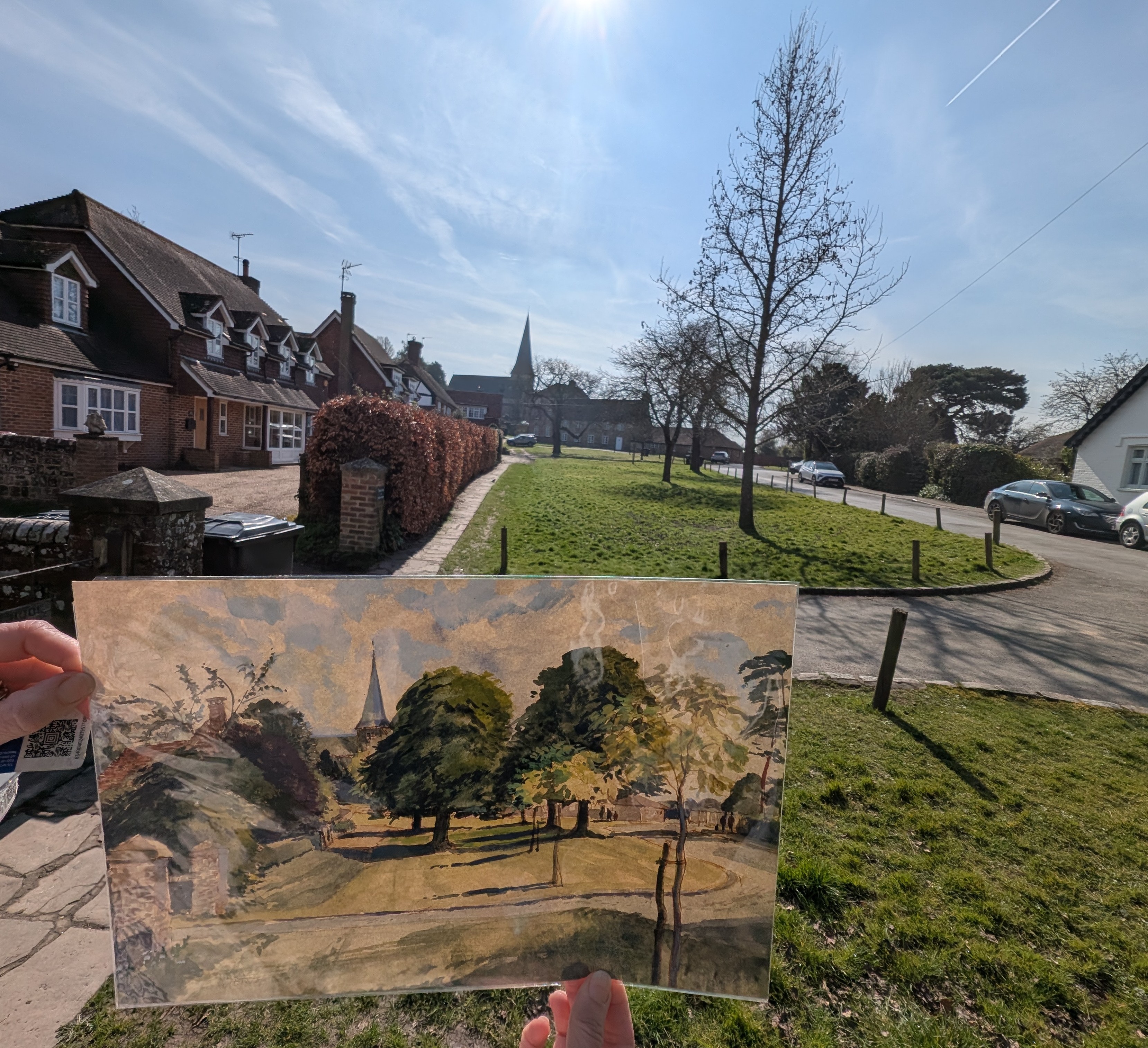
This is a 9.7 by 14.6-inch watercolour painting I came across whilst googling Patrick Gierth. It was listed by the seller under the surname Gierth – it's signed, but only with a surname – dated 1986 and described as "A charming watercolour with gouache highlights." I had no idea whether it was actually by Patrick Gierth, but his was an unusual surname, and stylistically it looked like it could be, plus it was only thirty quid, so after some deliberation I decided to go for it. 

With the painting in hand I did some further digging and determined that until his death in November 1994 Gierth lived in the West Sussex village of Wisborough Green, about an hour's drive from where I live in Lewes. While I was pretty sure I'd driven through the place, I'd never visited it, so although I suspected the scene depicted in the painting might be somewhere in the village, it wasn't anywhere I recognised. Gierth's given address upon his death was School Lane; could the painting depict the road where he lived, I wondered? 

Google Street View gave me a sense that I might be on the right track, but while I thought the church glimpsed in the picture could well be the Wisborough Green parish church (alias St Peter Ad Vincula), I wasn't able to pinpoint precisely the vantage point. I did, however, discover that Gierth was instrumental in the creation of the Wisborough Tapestry which hangs in the church, and that he designed the village green sign.

There was only one thing for it: I was going to have to go to Wisborough Green. And so earlier this year, on my birthday, that's precisely what Rachel and I did, painting in hand(s). It didn't take long to find the place where the picture was painted, round the corner from the village hall and pond, just down from where Gierth lived in High Barn. You can see the view in the photos in this post, along with other photos I took of the village sign, the tapestry, and as it turns out several other pieces Gierth produced for the church.


Confirmation, then, that this rather lovely painting is indeed by the designer of the dust jacket of one of my favourite thrillers, and moreover depicts the road in Wisborough Green where he lived.

Friday, 4 April 2025

Testing, Testing: Build the Guardians of the Galaxy Ship!

Currently swooping into view in newsagents and supermarkets... somewhere in the country (I have no idea where – if you've seen it out in the wild, please do leave a comment!) is this:


Hachette Partworks' Marvel Guardians of the Galaxy Ship! It's something I've been working on for the past couple of years: a step-by-step build of the Guardians' – and Avengers' – ship from Avengers: Infinity War, Avengers: Endgame, Thor: Love and Thunder and indeed I Am Groot, accompanied by a magazine delving into all aspects of the Guardians and cosmic Marvel both on screen and in comics. I wrote and edited the magazine – which was designed by the amazing Amazing15 – and in my capacity as author of Guardians of the Galaxy Ultimate Guide, Marvel Arms and Armour and other Guardians and Marvel books have been advising on the ship, the build, the Guardians, Marvel and multifarious other aspects of the project.

What's appearing in shops right now... somewhere in the UK (again, I really don't know where – I wish I did) is a four-issue test comprising the first four magazines and sets of parts. If the test goes well, then the partwork will launch nationally. So if you want the chance of building a huge model of the Guardians' ship (or the Infinity Saga ship as I like to call it) with working lights and engines, movable wings and tail, and even the auxiliary pod that Thor, Rocket and Groot use in Infinity War and War Machine and Nebula use in Endgame, and you want to know what else I have planned for the magazine, grab yourself an issue or three if it appears in shops near you, or head to the website and subscribe. Believe me, the ship truly is a thing of beauty – and the magazine's a damn good read too!

Thursday, 5 December 2024

The DC Heroes & Villains Collection Extension Issues 101 to 110

I've blogged about the 20-volume extension to the DC Heroes & Villains Collection a couple of times now, and posted repeatedly in the DC Heroes & Villains Collection Facebook group, but those posts have been somewhat piecemeal in nature, and not everyone has the time, patience or, frankly, interest in putting the various pieces together. So I thought a straightforward rundown of the first ten releases in the extension might be of more use, along with a little additional background.

First out of the blocks, and already in some readers' clammy hands, are issues 101 and 102, namely Batman: Universe and Justice League vs. Suicide Squad, both of which I wrote about in this post, along with issues 103 and 104:

The Joker: The Series and Batman: Ten Nights of the Beast, which will be published later this month and early in the new year. Having already blogged about all four of the initial volumes in the extension, I shan't dwell on them here... except to say that as magnificent as Batman: Universe and Justice League vs. Suicide Squad are – and as huge a book as the latter of those two is, at nearly 300 pages – The Joker: The Series and Batman: Ten Nights of the Beast are even more special because they're unique to the DC Heroes & Villains Collection: bespoke volumes collecting, respectively, all of the mid-1970s The Joker series – including the 'lost' 10th issue – plus two key Denny O'Neil, Neal Adams and Irv Novick issues of Batman, and the first half of Jim Starlin's late-1980s Batman run, including the classic Ten Nights of the Beast. On top of which, both books are chock-full of bonus features.

Speaking of the Joker and bespoke volumes – and indeed big extents – later in January there's issue 106, The Joker: Vengeance. Collecting all 21 chapters of the lead storyline from James Tynion IV, Guillem March and co.'s 2021–2022 15-issue The Joker series – for my money one of the best extended comics storylines of the last five years – it's one long twisty-turny suspense thriller in one unique 328-page graphic novel. Just ahead of that book there's issue 105, the visually spectacular The Man of Steel, featuring showstopping art by, among others, Jim Lee, Jason Fabok, Steve Rude, Ryan Sook, Kevin Maguire and Adam Hughes, and then in February we have releases 107 and 108:

Batman: The Cult and Justice Society Returns! I vividly recall reading both of these on original publication, in 1988 and 1999 respectively, which is true of a good many of the comics in the DC Heroes & Villains Collection, and an indication of how personal the collection is to me (although personal preference obviously wasn't the only criteria for the selection of the stories). Published a couple of years after Frank Miller's Batman: The Dark Knight Returns, Jim Starlin and Bernie Wrightson's The Cult was only the second Batman miniseries to be published in the then-relatively new upmarket Prestige Format, and thus felt like a very different kind of Batman comic when I picked it up off the shelves of Forbidden Planet on Denmark Street: one seemingly set in current continuity, but bearing the influence of the dystopian Dark Knight Returns, as Starlin readily admitted. 

The Cult was a high-profile project for DC at the time, whereas the Justice Society Returns! event flew very much under the radar in 1999, yet was a revelation for me: a terrific introduction to the Justice Society of America (with whom I was only passingly familiar at the time) ahead of the JSA series which launched in its wake, by the architects of that series, James Robinson and David S. Goyer, plus the likes of Mark Waid, Geoff Johns, Ron Marz, Chuck Dixon, Michael Lark, Eduardo Barreto, Peter Snejbjerg, Stephen Sadowski, Chris Weston and Russ Heath. Moreover, the format of the event – two issues of a revived All Star Comics bookending seven resurrected Golden Age titles, with the story reflecting the way JSA stories of the past saw the team splitting up into smaller units – was a really nice idea.

With both Batman: The Cult and Batman: Ten Nights of the Beast in the extension, it's only fitting that the remainder of Jim Starlin's stint as Batman writer be included too, which it will be in March, in the shape of issue 109, Batman: A Death in the Family. Collecting not just that notorious storyline but the issues either side of it, it's another bespoke volume and boasts some terrific bonus content, including Jim Aparo's original art pages for the alternate outcome of Batman #428 alongside their coloured and lettered counterparts, which were only belatedly published this year. A 400-page follow-up volume, Batman: Under the Red Hood, will be published later next year – I'll blog about that book nearer the time – but before then, and rounding out the initial ten releases in the extension, we have issue 110, Supergirl: Woman of Tomorrow. Originally published from 2021–2022 as an eight-issue miniseries, Tom King and Bilquis Evely's celebrated sci-fi fable is a story that I suspect a lot of people will be interested in reading, due to the Craig Gillespie/Milly Alcock movie currently in pre-production.