This next novel I'm featuring in this series of posts on books wot begat perhaps more famous films didn't just inspire a movie: it inspired an entire franchise, comprising film sequels, a TV series, action figures, games and so forth. Moreover, its protagonist's name eventually wound up in the Oxford English Dictionary, coming to denote "an exceptionally tough, aggressive man"...
David Morrell's First Blood was first published in hardback in the UK by Barrie & Jenkins in 1972, the same year as the US M. Evans edition. The dust jacket on the British edition differs from the American one, and was painted by Michael Codd, who, as well as illustrating a variety of jackets and paperback covers, also illustrated a number of articles in top shelf men's magazine Mayfair. As the eagle-eyed among you may have noticed, unusually for a novel, there's no text on the front of the wrapper: no title, no author name, no nothing. But if we take a look at the whole jacket:
There's the title and author credit on the back.
As with one or two others of the books I've featured in this novels-into-movies series, I think I must have borrowed First Blood from Beckenham Library sometime in the 1980s, possibly even in this edition. I bought this copy of the Jenkins first – on Amazon Marketplace – much more recently, specifically because I wanted to include it in this run of posts, but dipping into it again after all these years, I was reminded how brilliantly gripping it is. For those who've been living in a cave for the past forty years, First Blood is the story of Rambo – I don't believe he's ever given another name in the novel, although he was christened "John" for Ted Kotcheff's Sylvester Stallone-starring 1982 film adaptation – a young man hitchhiking in Kentucky who lands himself in trouble with a local Sheriff and winds up killing a cop. Thereafter he escapes into the mountains and becomes the subject of a manhunt, leading to further deaths and a bloody climax.
The first line of the novel is still one of the best I've ever read – "His name was Rambo, and he was just some nothing kid for all anybody knew, standing by the pump of a gas station at the outskirts of Madison, Kentucky" – which is all the more remarkable in that First Blood was David Morrell's debut novel. He's since penned another twenty-five-plus – a handful of which I've also read and enjoyed – including novelisations of Rambo: First Blood Part II and Rambo III – this despite Rambo – and look away now if you want to avoid a major spoiler – dying at the end of the first book.
I've only ever caught parts of the two Rambo film sequels – and I've definitely not seen 2008's Stallone-directed Rambo – but I have seen First Blood the movie, and though it's neither especially faithful nor the equal of the book, it's still a decent enough adaptation. As ever with these things, though, there's more to Morrell's novel than there is to the movie – an unexpected depth which belies the book's ostensible nature as a thriller. Because of course what First Blood is really about is the Vietnam War – of which Rambo is a veteran – which, by the early 1970s, had become highly unpopular in the States, reflected in the extreme violence Rambo metes out to his pursuers (see Olman's 2010 review of the novel for more). But it also displays a visceral feel for the mountainous wilderness that Rambo flees into, informed by a novel which Morrell cites as a major influence on First Blood: Geoffrey Household's superlative manhunt classic, Rogue Male (1939).
First Blood is set in the American south, but we'll be heading even deeper south for the next book and film in this series of posts: a 1970 novel about a canoe trip that turns into a test of endurance, which begat a 1972 movie that, to my mind, is even better than the source text...
Friday, 6 July 2012
Wednesday, 4 July 2012
Fletch by Gregory Mcdonald (Gollancz, 1976): the Original Novel, Basis for the 1985 Movie
NB: Featured as one of this week's Friday's Forgotten Books.
Next in this run of posts on books which begat perhaps more famous films, we move from an obscure '60s crime novel – in a Gollancz first edition – and its '70s movie adaptation to a rather less obscure '70s crime novel – also in a Gollancz first edition – and its '80s movie adaptation:
First published in hardback in the UK by Gollancz in 1976 – two years after the US Bobbs-Merrill edition – Fletch was American journalist-turned-author Gregory Mcdonald's second novel, following 1964's Running Scared. It was also the first in what would become an eleven-book mystery series, one which would hop back and forth across the life of both its title character, investigative reporter I. M. Fletcher, and latterly his son, and would also spin off another four-book series featuring police inspector Flynn. But more pertinently from the perspective of this 'ere series of posts, in 1985 Fletch was turned into a film, starring Chevy Chase as the eponymous lead.
Now, let me just state for the record here that I'm a huge fan of Michael Ritchie's movie (which was scripted by Andrew Bergman, who also wrote Blazing Saddles). I rarely miss an opportunity to respond to a "thank you" or, even better, a "muchas gracias" with "Tierra del Fuego", or reply to enquiries as to what I do for a living with "I'm a shepherd". But as eminently quotable and gloriously silly as Fletch the movie is – and even though it was my gateway to Mcdonald's series (which, courtesy of Beckenham Library, I made my way through during the 1980s, although I don't believe I ever read the "son of Fletch" books) – the original novel still, I think, stands as the superior work.
A big part of the reason for that is Mcdonald's narrative approach. Fletch – all the Fletch novels, in fact – is very dialogue-heavy, with little in the way of description. Chapters typically begin with a conversation and progress from there, Mcdonald filling in the gaps where necessary. But where, say, George V. Higgins's similarly dialogue-heavy prose, with its long speeches posing as conversations, can become wearying (or at least, can for me), Mcdonald keeps it light and snappy, the back-and-forth banter between Fletch and the various players a joy to read.
Of course, Chevy Chase brought his own unique voice to Fletch – the character and film – dropping in ad-libs and generally arsing about. Even here, though, many of his quips and one-liners have their basis in the book – Fletch introducing himself to someone as "John Zalumarinero", or engaging with a police chief thus:
"What's your name?"
"Fletch."
"What's your full name?"
"Fletch Fletch Fletch."
Alone in the chief's bare, utilitarian office, they sat on either side of a gray aluminum desk.
"By any chance, could Fletch be short for Fletcher?"
"It could be."
"Is Fletcher your first name or your last?"
"My first name."
"What's your last name?"
"Smith."
"Fletcher Smith," the Chief said. "Seems I've heard that name somewhere before."
"Fletcher Smith?"
"No. Just Smith. Where do you live, Smith?"
"I forget the address. Where your goons picked me up this morning."
"You live there?"
"Weekends I spend in Hawaii."
"Do you live alone?"
"Except for a pet roach."
"And what do you do for a living, Mr. Smith?"
"I"m a shoeshine boy."
Meanwhile the screenplay progresses along essentially the same lines as the book – Fletch is hired by wealthy businessman Alan Stanwyk to murder Stanwyk, a proposition which eventually becomes entwined with Fletch's investigation into the LA beach drugs scene – which is more than can be said for the 1989 sequel to the movie, Fletch Lives, again directed by Ritchie, but bearing little relation to Mcdonald's novels. Mind you, Fletch Lives, while nowhere near as good as the first film – and certainly not the equal of the books – has its own share of daffy dialogue. ("Take your pants off." "I don't even know your name." "Bend over." "Ben? Nice to meet you, Victor Hugo.")
The Gollancz edition of Fletch has become fairly uncommon in first: AbeBooks has just two copies listed at present, one of them ex-library (ignore the listings for Confess, Fletch, the first sequel, which has been mistakenly listed as being published in 1976 by a few sellers; it was actually published by Gollancz in 1977) – rather less than the Bobbs-Merrill first, of which there are over twenty copies currently available.
I'm planning on returning to Mcdonald and his Fletch series down the line – when I'll probably get into what a minefield collecting the novels in Gollancz first editions is – but next in this series of posts: a terrific 1972 thriller in the Geoffrey Household mould, one which begat an incredibly successful film franchise, and whose (anti-)hero would wind up as an entry in the Oxford English Dictionary...
Next in this run of posts on books which begat perhaps more famous films, we move from an obscure '60s crime novel – in a Gollancz first edition – and its '70s movie adaptation to a rather less obscure '70s crime novel – also in a Gollancz first edition – and its '80s movie adaptation:
First published in hardback in the UK by Gollancz in 1976 – two years after the US Bobbs-Merrill edition – Fletch was American journalist-turned-author Gregory Mcdonald's second novel, following 1964's Running Scared. It was also the first in what would become an eleven-book mystery series, one which would hop back and forth across the life of both its title character, investigative reporter I. M. Fletcher, and latterly his son, and would also spin off another four-book series featuring police inspector Flynn. But more pertinently from the perspective of this 'ere series of posts, in 1985 Fletch was turned into a film, starring Chevy Chase as the eponymous lead.
Now, let me just state for the record here that I'm a huge fan of Michael Ritchie's movie (which was scripted by Andrew Bergman, who also wrote Blazing Saddles). I rarely miss an opportunity to respond to a "thank you" or, even better, a "muchas gracias" with "Tierra del Fuego", or reply to enquiries as to what I do for a living with "I'm a shepherd". But as eminently quotable and gloriously silly as Fletch the movie is – and even though it was my gateway to Mcdonald's series (which, courtesy of Beckenham Library, I made my way through during the 1980s, although I don't believe I ever read the "son of Fletch" books) – the original novel still, I think, stands as the superior work.
A big part of the reason for that is Mcdonald's narrative approach. Fletch – all the Fletch novels, in fact – is very dialogue-heavy, with little in the way of description. Chapters typically begin with a conversation and progress from there, Mcdonald filling in the gaps where necessary. But where, say, George V. Higgins's similarly dialogue-heavy prose, with its long speeches posing as conversations, can become wearying (or at least, can for me), Mcdonald keeps it light and snappy, the back-and-forth banter between Fletch and the various players a joy to read.
Of course, Chevy Chase brought his own unique voice to Fletch – the character and film – dropping in ad-libs and generally arsing about. Even here, though, many of his quips and one-liners have their basis in the book – Fletch introducing himself to someone as "John Zalumarinero", or engaging with a police chief thus:
"What's your name?"
"Fletch."
"What's your full name?"
"Fletch Fletch Fletch."
Alone in the chief's bare, utilitarian office, they sat on either side of a gray aluminum desk.
"By any chance, could Fletch be short for Fletcher?"
"It could be."
"Is Fletcher your first name or your last?"
"My first name."
"What's your last name?"
"Smith."
"Fletcher Smith," the Chief said. "Seems I've heard that name somewhere before."
"Fletcher Smith?"
"No. Just Smith. Where do you live, Smith?"
"I forget the address. Where your goons picked me up this morning."
"You live there?"
"Weekends I spend in Hawaii."
"Do you live alone?"
"Except for a pet roach."
"And what do you do for a living, Mr. Smith?"
"I"m a shoeshine boy."
Meanwhile the screenplay progresses along essentially the same lines as the book – Fletch is hired by wealthy businessman Alan Stanwyk to murder Stanwyk, a proposition which eventually becomes entwined with Fletch's investigation into the LA beach drugs scene – which is more than can be said for the 1989 sequel to the movie, Fletch Lives, again directed by Ritchie, but bearing little relation to Mcdonald's novels. Mind you, Fletch Lives, while nowhere near as good as the first film – and certainly not the equal of the books – has its own share of daffy dialogue. ("Take your pants off." "I don't even know your name." "Bend over." "Ben? Nice to meet you, Victor Hugo.")
The Gollancz edition of Fletch has become fairly uncommon in first: AbeBooks has just two copies listed at present, one of them ex-library (ignore the listings for Confess, Fletch, the first sequel, which has been mistakenly listed as being published in 1976 by a few sellers; it was actually published by Gollancz in 1977) – rather less than the Bobbs-Merrill first, of which there are over twenty copies currently available.
I'm planning on returning to Mcdonald and his Fletch series down the line – when I'll probably get into what a minefield collecting the novels in Gollancz first editions is – but next in this series of posts: a terrific 1972 thriller in the Geoffrey Household mould, one which begat an incredibly successful film franchise, and whose (anti-)hero would wind up as an entry in the Oxford English Dictionary...
Monday, 2 July 2012
The Chase (a.k.a. Pursuit) by Richard Unekis (Gollancz, 1963): the Original Novel (a Lewes Book Bargain), Basis for the 1974 Movie Dirty Mary, Crazy Larry
NB: Featured as one of this week's Friday's Forgotten Books.
Into the second week of posts on books which begat perhaps more famous films we go. And this next novel is an obscure crime fiction work originally published in 1962 and adapted for the screen in 1974 – although not especially faithfully...
This is the UK hardback first edition of Richard Unekis's The Chase, published by Gollancz in 1963, originally published in the States by Walker in 1962, and subsequently published under the title Pursuit by Signet in 1964. I bought this copy in the Lewes Antiques Centre a couple of years ago, with no real notion of what it was, other than what I could glean from the dust jacket flap blurb. It was only later I realised it was the basis for the 1974 cult road movie Dirty Mary, Crazy Larry, directed by John Hough and starring Peter Fonda, Susan George, Adam Roarke and Vic Morrow.
There are, however, significant differences twixt book and film, not the least of which being that in the original novel, there's no "Dirty Mary". The film begins much as the novel does, with NASCAR hopefuls Larry Rayder (Fonda) and Deke Sommers (Roarke) enacting a daring daylight supermarket heist by holding the store manager's wife and child hostage – although in the book Rayder's first name is Floyd while Sommers is simply called Grozzo, and both are ex-cons rather than prospective racing drivers. But a major change comes with the addition of Mary Coombs (Susan George), Rayder's one-night-stand, who hitches a ride with the heisters: Mary is an invention of the movie, and doesn't appear in the novel. Moreover, the approaches and aims of the book and the film are quite different, as Richard Unekis had a very specific concept in mind with The Chase.
The Wikipedia page for the adaptation of Dirty Mary, Crazy Larry boasts a pretty detailed account of how the various changes came about, so I shan't dwell on them here. But it's also unfairly dismissive of Unekis's novel, calling it "an out of date book with little literary value except for a car chase". In fact The Chase has more going for it than that. Admittedly there's not much in the way of character development, but then neither is there in the movie; Unekis is more interested in exploring applied mathematics and probabilities, in particular how to "maximise or minimize the chances for interception" – in other words, Game Theory.
In making their escape, Rayder and Grozzo utilise the gravel roads "running straight by the compass in all four directions" to the south of Chicago. "From the air," Unekis notes at the novel's outset, these roads "make the countryside look like a giant checkerboard, running perfectly flat all the way to the horizon. There are so many roads that, in any manhunt, it is impossible to block them all. The state police do not even try. They just block the major highways—and hope." Enter Superintendant Franklin, the man heading up the hunt for Rayder and Grozzo. Instead of following the standard protocol, Franklin draws on his naval background plotting positions of submarines in order to work out where Rayder and Grozzo are heading, and what their most likely route will be. The result is a tense, clammily exciting game of cat-and-mouse, as Franklin deducts that the pair are headed for Chicago and directs the police cars at his disposal to cut them off, and Rayder and Grozzo barrel along at terrifying speeds on the dangerous gravel roads, a couple of times escaping seemingly certain death by the skin of their teeth.
Aside from a 2009 obituary, there's little in the way of information about Richard Unekis available online; The Chase was his only published novel, and fell out of print decades ago – there are only around twenty copies of the book in any edition available on AbeBooks (among them a single Gollancz first). But the Edgar Awards committee for 1962 thought highly enough of The Chase to shortlist it for the Best First Mystery Novel prize, and to my mind it deserves rescuing from obscurity: it's not perfect by any means, but in its intriguing deployment of mathematics in a high speed pursuit scenario, it displays enough ambition to make it worth a second look.
And I've another Gollancz first edition for the next post in this run, this time a hip, dialogue-heavy '70s crime fiction novel which begat a gloriously daft '80s action comedy...
Into the second week of posts on books which begat perhaps more famous films we go. And this next novel is an obscure crime fiction work originally published in 1962 and adapted for the screen in 1974 – although not especially faithfully...
This is the UK hardback first edition of Richard Unekis's The Chase, published by Gollancz in 1963, originally published in the States by Walker in 1962, and subsequently published under the title Pursuit by Signet in 1964. I bought this copy in the Lewes Antiques Centre a couple of years ago, with no real notion of what it was, other than what I could glean from the dust jacket flap blurb. It was only later I realised it was the basis for the 1974 cult road movie Dirty Mary, Crazy Larry, directed by John Hough and starring Peter Fonda, Susan George, Adam Roarke and Vic Morrow.
There are, however, significant differences twixt book and film, not the least of which being that in the original novel, there's no "Dirty Mary". The film begins much as the novel does, with NASCAR hopefuls Larry Rayder (Fonda) and Deke Sommers (Roarke) enacting a daring daylight supermarket heist by holding the store manager's wife and child hostage – although in the book Rayder's first name is Floyd while Sommers is simply called Grozzo, and both are ex-cons rather than prospective racing drivers. But a major change comes with the addition of Mary Coombs (Susan George), Rayder's one-night-stand, who hitches a ride with the heisters: Mary is an invention of the movie, and doesn't appear in the novel. Moreover, the approaches and aims of the book and the film are quite different, as Richard Unekis had a very specific concept in mind with The Chase.
The Wikipedia page for the adaptation of Dirty Mary, Crazy Larry boasts a pretty detailed account of how the various changes came about, so I shan't dwell on them here. But it's also unfairly dismissive of Unekis's novel, calling it "an out of date book with little literary value except for a car chase". In fact The Chase has more going for it than that. Admittedly there's not much in the way of character development, but then neither is there in the movie; Unekis is more interested in exploring applied mathematics and probabilities, in particular how to "maximise or minimize the chances for interception" – in other words, Game Theory.
In making their escape, Rayder and Grozzo utilise the gravel roads "running straight by the compass in all four directions" to the south of Chicago. "From the air," Unekis notes at the novel's outset, these roads "make the countryside look like a giant checkerboard, running perfectly flat all the way to the horizon. There are so many roads that, in any manhunt, it is impossible to block them all. The state police do not even try. They just block the major highways—and hope." Enter Superintendant Franklin, the man heading up the hunt for Rayder and Grozzo. Instead of following the standard protocol, Franklin draws on his naval background plotting positions of submarines in order to work out where Rayder and Grozzo are heading, and what their most likely route will be. The result is a tense, clammily exciting game of cat-and-mouse, as Franklin deducts that the pair are headed for Chicago and directs the police cars at his disposal to cut them off, and Rayder and Grozzo barrel along at terrifying speeds on the dangerous gravel roads, a couple of times escaping seemingly certain death by the skin of their teeth.
Aside from a 2009 obituary, there's little in the way of information about Richard Unekis available online; The Chase was his only published novel, and fell out of print decades ago – there are only around twenty copies of the book in any edition available on AbeBooks (among them a single Gollancz first). But the Edgar Awards committee for 1962 thought highly enough of The Chase to shortlist it for the Best First Mystery Novel prize, and to my mind it deserves rescuing from obscurity: it's not perfect by any means, but in its intriguing deployment of mathematics in a high speed pursuit scenario, it displays enough ambition to make it worth a second look.
And I've another Gollancz first edition for the next post in this run, this time a hip, dialogue-heavy '70s crime fiction novel which begat a gloriously daft '80s action comedy...
Friday, 29 June 2012
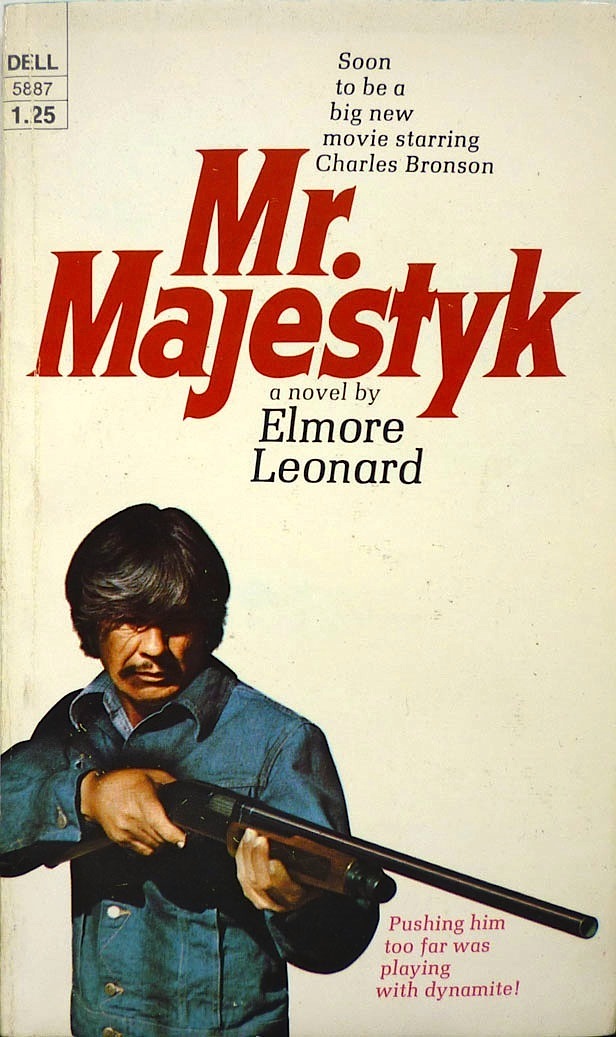
Mr. Majestyk by Elmore Leonard (Dell, 1974); Book Review, Original Novel, Basis for the 1974 Movie
NB: Featured as one of this week's Friday's Forgotten Books.
From one 1974 Charles Bronson-starring movie and its original novel, next in this series of posts on books which begat perhaps more famous films we turn to another 1974 Charles Bronson-starring movie and its original novel – or, perhaps more accurately, novelization...
First published as a paperback original in the US by Dell in 1974, Mr. Majestyk is Elmore Leonard's adaptation of his own screenplay for the same year's Bronson-headlining, Richard Fleischer-directed Mr. Majestyk movie. I found this copy of the Dell edition in the basement of the fine Cecil Court secondhand bookshop Tindley & Chapman, along with another, earlier Elmore Leonard paperback original, one which I'll be blogging about down the line, and which shares with Mr. Majestyk a similarly monikered – but unrelated – character.
Though it's true that Mr. Majestyk (the novel) is, in effect, a novelization, it's also true that it's one of Elmore Leonard's best books. It's a long time since I've seen the movie, but I don't remember it being anything other than a pretty decent action flick – an estimation borne out by this contemporaneous New York Times review (although that review strikes me as being a little too dismissive). Leonard's novel, on the other hand, is short, taut, lean, and moves like a well-oiled machine.
The story centres on Vincent Majestyk, a melon farmer eking out a meagre living in the dusty midwest. Vincent is confronted by a hood named Bobby Kopas, who tries to foist a crew of inexperienced melon-pickers on Majestyk instead of the more skilled migrant workers Vincent usually uses. Rather than capitulate, Majestyk thumps him and sends him and his men on their way, and is promptly arrested. In jail awaiting a bail hearing, Majestyk meets mob hitman Frank Renda, and gets caught up in Renda's escape attempt; after unsuccessfully trying to turn Renda over to the cops, Majestyk finds himself beset by both Kopas and Renda – along with Renda's right-hand man, Eugene Lundy, and assorted hired thugs – leading to a violent climax.
Mr. Majestyk was only Elmore Leonard's third crime novel – prior to 1969's The Big Bounce he'd concentrated exclusively on westerns – but even by this stage his distinctive tone and style was firmly established. I've written before about his seemingly effortless storytelling – see, for example, this review of his most recent novel, Raylan (2012), or, more appositely, this post on Pronto (1993) – and that sublime and unique sense of a tale being told is present and correct in Mr. Majestyk. But Leonard's genius also resides in his handling of characters, and in the way he can elicit sympathy for even the most unsympathetic of players.
Of course, the "good guys" are compelling too, simply and deftly defined with just the merest hint of background (brief recollections from Majestyk of his time fighting in the jungles of Asia; Vincent's foreman, Larry Mendoza's loving family; Nancy Chavez, with whom Vincent becomes involved, and her hard life as a drifter and union organiser); but Leonard spends just as much time, if not more, on the "bad guys". Frank Renda in particular is a fascinating creation – cold, calculating, and yet troubled by doubts over his effectiveness as a killer, driven to pursue Majestyk even though common sense (not to mention his lawyer and mob bosses) dictates that he should leave well alone – but even Kopas and Lundy (who, curiously, share in common with Renda five-letter surnames) are given space to live and breathe, so that when their ultimate fates unfold, it's oddly touching.
I've been asked a couple of times recently where the best place to start is with Elmore Leonard; I've duly directed said interested parties to to his 1990 masterpiece, Get Shorty. Actually, though, on reflection, I reckon Mr. Majestyk is just as good a place to dive in: if you don't "get" Leonard after reading this one, you probably never will.
Next in this series of posts: another film from 1974, this time a cult car chase flick inspired by – but in fact markedly different from – an obscure early-1960s crime novel...
From one 1974 Charles Bronson-starring movie and its original novel, next in this series of posts on books which begat perhaps more famous films we turn to another 1974 Charles Bronson-starring movie and its original novel – or, perhaps more accurately, novelization...
First published as a paperback original in the US by Dell in 1974, Mr. Majestyk is Elmore Leonard's adaptation of his own screenplay for the same year's Bronson-headlining, Richard Fleischer-directed Mr. Majestyk movie. I found this copy of the Dell edition in the basement of the fine Cecil Court secondhand bookshop Tindley & Chapman, along with another, earlier Elmore Leonard paperback original, one which I'll be blogging about down the line, and which shares with Mr. Majestyk a similarly monikered – but unrelated – character.
Though it's true that Mr. Majestyk (the novel) is, in effect, a novelization, it's also true that it's one of Elmore Leonard's best books. It's a long time since I've seen the movie, but I don't remember it being anything other than a pretty decent action flick – an estimation borne out by this contemporaneous New York Times review (although that review strikes me as being a little too dismissive). Leonard's novel, on the other hand, is short, taut, lean, and moves like a well-oiled machine.
Mr. Majestyk was only Elmore Leonard's third crime novel – prior to 1969's The Big Bounce he'd concentrated exclusively on westerns – but even by this stage his distinctive tone and style was firmly established. I've written before about his seemingly effortless storytelling – see, for example, this review of his most recent novel, Raylan (2012), or, more appositely, this post on Pronto (1993) – and that sublime and unique sense of a tale being told is present and correct in Mr. Majestyk. But Leonard's genius also resides in his handling of characters, and in the way he can elicit sympathy for even the most unsympathetic of players.
Of course, the "good guys" are compelling too, simply and deftly defined with just the merest hint of background (brief recollections from Majestyk of his time fighting in the jungles of Asia; Vincent's foreman, Larry Mendoza's loving family; Nancy Chavez, with whom Vincent becomes involved, and her hard life as a drifter and union organiser); but Leonard spends just as much time, if not more, on the "bad guys". Frank Renda in particular is a fascinating creation – cold, calculating, and yet troubled by doubts over his effectiveness as a killer, driven to pursue Majestyk even though common sense (not to mention his lawyer and mob bosses) dictates that he should leave well alone – but even Kopas and Lundy (who, curiously, share in common with Renda five-letter surnames) are given space to live and breathe, so that when their ultimate fates unfold, it's oddly touching.
I've been asked a couple of times recently where the best place to start is with Elmore Leonard; I've duly directed said interested parties to to his 1990 masterpiece, Get Shorty. Actually, though, on reflection, I reckon Mr. Majestyk is just as good a place to dive in: if you don't "get" Leonard after reading this one, you probably never will.
Next in this series of posts: another film from 1974, this time a cult car chase flick inspired by – but in fact markedly different from – an obscure early-1960s crime novel...
Thursday, 28 June 2012
Death Wish by Brian Garfield (Hodder & Stoughton, 1973); the Original Novel, Basis for the 1974 Movie
NB: A version of this post also appears on The Violent World of Parker blog.
The two movies I've spotlighted thus far in this series of posts on books which begat perhaps more famous films – Where Eagles Dare and Jaws – are at least the equal of their source texts, and arguably better. But of course, that's not always the case with book-to-film adaptations – rarely the case, even – as this next novel amply demonstrates:
This is the British first edition of Brian Garfield's Death Wish, published in hardback by Hodder & Stoughton in 1973 – the year after the US David McKay edition – with a dust jacket designed by Jefferson Godwin. I nabbed this copy at last year's London Paperback & Pulp Bookfair, for the princely sum of nine quid – which, considering the cheapest Hodder first on AbeBooks at present is twenty quid, with the remaining five copies ranging from £95 to well over £200, was quite the bargain.
Death Wish wasn't Brian Garfield's first novel – he'd had over a dozen published prior to Death Wish, a mixture of crime works and westerns (a number of them pseudonymous) – but it was the first of his books to be filmed. That film, directed by Michael Winner and starring Charles Bronson as Paul Kersey (Paul Benjamin in the book), was released in 1974, and would become notorious for its perceived glorification of vigilantism, with a quartet of sequels appearing in its wake. It's a long time since I've seen the movie, but I don't remember it being terribly good, and I certainly don't recall it possessing any of the depth of the original novel, which is a powerful, pacy meditation on loss, bereavement and revenge.
Unlike the comparatively toned and svelte Bronson of the film, the Paul Benjamin of the book is a middle-aged, overweight New York accountant (Bronson is an architect in the movie), and where Winner visualizes the opening assault on Paul's wife and daughter – throwing in a rape for good measure – in the book the attack happens "off-page". The first Paul hears of it is via a phone call from his son-in-law, and when he eventually learns of his wife's death at the hospital, he plunges into a spiral of rage and depression, frustrated at the police's inability to find the attackers, reduced to drifting about his apartment or aimlessly walking the streets of Manhattan.
It's not until halfway through the book that he starts to actively seek out trouble, fending off a knife-wielding kid using a kosh made of coins and then, in the closing stages of the novel – and having acquired a gun during a business trip to Arizona – embarking on a murderous spree. But there's no sensationalizing here: Garfield doesn't shy away from depicting these shootings as the squalid, sordid affairs they are, and leaves us in no doubt as to how damaged and increasingly unhinged Paul has become. Though there are glimpses of approval from the press, the public and the police, Paul's taking the law into his own hands is self-evidently a symptom of his grief and madness, thrown into stark relief by Garfield's extensive detailing of Paul's ordinary, humdrum day job.
Garfield went on to pen a further twenty-five or so novels after Death Wish, including Gangway! (1973), a collaboration with his friend and poker buddy, Donald E. Westlake – hence why I'm cross-posting this review on The Violent World of Parker blog (although Death Wish will be of interest to VWoP regulars in its own right) – and the Edgar Award-winning Hopscotch (1975). He also wrote a sequel to Death Wish, Death Sentence (1975, itself adapted for the screen – even more loosely than Death Wish, although more to Garfield's liking – in 2007), in which Paul continues his one-man war on crime in Chicago – where, oddly enough, Charles Bronson winds up at the end of the movie Death Wish. I haven't read the sequel yet, but this Pulp Serenade review got me interested enough to order a copy, so I'll be reviewing it myself at some point. And while we're on the subject of other folks' reviews, Olman turned his beady eye on Death Wish (the novel) earlier this year, noting Garfield's vivid and unnerving portrayal of 1970s New York, so go read his review for an alternative take on the book.
As for the Charles Bronson movie sequels to Death Wish, well, probably the less said about them the better – and who the hell knows what the mooted Joe "The Grey" Carnahan remake – set to star either Sylvester Stallone or Liam Neeson, depending on who you believe – will be like. But Bronson did star in a number of other interesting movies in the 1970s, including one in the same year as Death Wish – and it's to that film, and its attendant novel, that I'll be turning next...
The two movies I've spotlighted thus far in this series of posts on books which begat perhaps more famous films – Where Eagles Dare and Jaws – are at least the equal of their source texts, and arguably better. But of course, that's not always the case with book-to-film adaptations – rarely the case, even – as this next novel amply demonstrates:
This is the British first edition of Brian Garfield's Death Wish, published in hardback by Hodder & Stoughton in 1973 – the year after the US David McKay edition – with a dust jacket designed by Jefferson Godwin. I nabbed this copy at last year's London Paperback & Pulp Bookfair, for the princely sum of nine quid – which, considering the cheapest Hodder first on AbeBooks at present is twenty quid, with the remaining five copies ranging from £95 to well over £200, was quite the bargain.
Death Wish wasn't Brian Garfield's first novel – he'd had over a dozen published prior to Death Wish, a mixture of crime works and westerns (a number of them pseudonymous) – but it was the first of his books to be filmed. That film, directed by Michael Winner and starring Charles Bronson as Paul Kersey (Paul Benjamin in the book), was released in 1974, and would become notorious for its perceived glorification of vigilantism, with a quartet of sequels appearing in its wake. It's a long time since I've seen the movie, but I don't remember it being terribly good, and I certainly don't recall it possessing any of the depth of the original novel, which is a powerful, pacy meditation on loss, bereavement and revenge.
Unlike the comparatively toned and svelte Bronson of the film, the Paul Benjamin of the book is a middle-aged, overweight New York accountant (Bronson is an architect in the movie), and where Winner visualizes the opening assault on Paul's wife and daughter – throwing in a rape for good measure – in the book the attack happens "off-page". The first Paul hears of it is via a phone call from his son-in-law, and when he eventually learns of his wife's death at the hospital, he plunges into a spiral of rage and depression, frustrated at the police's inability to find the attackers, reduced to drifting about his apartment or aimlessly walking the streets of Manhattan.
It's not until halfway through the book that he starts to actively seek out trouble, fending off a knife-wielding kid using a kosh made of coins and then, in the closing stages of the novel – and having acquired a gun during a business trip to Arizona – embarking on a murderous spree. But there's no sensationalizing here: Garfield doesn't shy away from depicting these shootings as the squalid, sordid affairs they are, and leaves us in no doubt as to how damaged and increasingly unhinged Paul has become. Though there are glimpses of approval from the press, the public and the police, Paul's taking the law into his own hands is self-evidently a symptom of his grief and madness, thrown into stark relief by Garfield's extensive detailing of Paul's ordinary, humdrum day job.
Garfield went on to pen a further twenty-five or so novels after Death Wish, including Gangway! (1973), a collaboration with his friend and poker buddy, Donald E. Westlake – hence why I'm cross-posting this review on The Violent World of Parker blog (although Death Wish will be of interest to VWoP regulars in its own right) – and the Edgar Award-winning Hopscotch (1975). He also wrote a sequel to Death Wish, Death Sentence (1975, itself adapted for the screen – even more loosely than Death Wish, although more to Garfield's liking – in 2007), in which Paul continues his one-man war on crime in Chicago – where, oddly enough, Charles Bronson winds up at the end of the movie Death Wish. I haven't read the sequel yet, but this Pulp Serenade review got me interested enough to order a copy, so I'll be reviewing it myself at some point. And while we're on the subject of other folks' reviews, Olman turned his beady eye on Death Wish (the novel) earlier this year, noting Garfield's vivid and unnerving portrayal of 1970s New York, so go read his review for an alternative take on the book.
As for the Charles Bronson movie sequels to Death Wish, well, probably the less said about them the better – and who the hell knows what the mooted Joe "The Grey" Carnahan remake – set to star either Sylvester Stallone or Liam Neeson, depending on who you believe – will be like. But Bronson did star in a number of other interesting movies in the 1970s, including one in the same year as Death Wish – and it's to that film, and its attendant novel, that I'll be turning next...
Wednesday, 27 June 2012
Jaws by Peter Benchley: the Original Novel (Andre Deutsch, 1974), Basis for the 1975 Movie
Next in this series of posts on books which begat perhaps more famous films, we turn to a 1974 thriller, the 1975 movie adaptation of which has taken on a near-mythic status over the years – not least due to its problematic production – and is currently once again showing on cinema screens here in the UK:
First published in Britain by Andre Deutsch in 1974 – the same year as the US Doubleday first edition – Jaws was American author Peter Benchley's debut novel – although not his first book; he'd already had a couple of non-fiction works published by the time Jaws arrived. I found this Deutsch first edition/first printing at the Midhurst Book Fair a few months back, a snip at £9.50; copies of the Deutsch first edition/first impression (it went through multiple printings) can go for anything up to £100 – depending on condition – so I was rather pleased with this score.
It's worth taking a look at Tom Simmonds's full design for the dust jacket – which differs to the American edition – as it stretches round to the back cover:
As for the book itself, I must admit it's bloody ages since I read it – I probably borrowed it from Beckenham Library decades ago, maybe even in this edition – and so I recall more about Steven Spielberg's film than I do the original novel. Certainly the memorable opening scene of Jaws the movie, with the shark savaging the hapless female swimmer, is lifted straight from the book, and the novel ends much as the film does, with Brody paddling
towards the shore after his close encounter (ahem) with the Great White (although with one significant change). But I do remember it being a darker affair than the adaptation – for one thing, Brody and his wife, Ellen, don't get on terribly well in the book – and there being a subplot concerning an extramarrital affair which didn't make it into the movie. Handily, IMDB has a list of differences twixt novel and film, although be warned that by its very nature the list is somewhat spoilery.
Thankfully, my memories of the next book I'll be blogging about are rather better, because I read it only recently; it's the movie adaptation I can't recall terribly well, although given its standing in the cinematic pantheon, that might not be such a bad thing...
First published in Britain by Andre Deutsch in 1974 – the same year as the US Doubleday first edition – Jaws was American author Peter Benchley's debut novel – although not his first book; he'd already had a couple of non-fiction works published by the time Jaws arrived. I found this Deutsch first edition/first printing at the Midhurst Book Fair a few months back, a snip at £9.50; copies of the Deutsch first edition/first impression (it went through multiple printings) can go for anything up to £100 – depending on condition – so I was rather pleased with this score.
It's worth taking a look at Tom Simmonds's full design for the dust jacket – which differs to the American edition – as it stretches round to the back cover:
Thankfully, my memories of the next book I'll be blogging about are rather better, because I read it only recently; it's the movie adaptation I can't recall terribly well, although given its standing in the cinematic pantheon, that might not be such a bad thing...
Subscribe to:
Posts (Atom)