Thursday, 15 October 2015

Jimmy Sangster's John Smith Spy Novels: private i (Triton, 1967); Signed Inscribed First Editions

NB: Linked in Friday's Forgotten Books, 16/10/15.

When Jimmy Sangster died four years ago, his obituaries naturally concentrated largely on his film and TV work (see The Guardian, The Independent, The Telegraph and The New York Times). Sangster was a key figure in the revival of Hammer Films in the late 1950s and through the 1960s; he wrote The Curse of Frankenstein (1957), Dracula (1958), The Mummy (1959) and two dozen other Hammer horrors before moving to America, where he wrote for The Six Million Dollar Man, Kolchak: The Night Stalker, Ironside, Wonder Woman and a bunch more US TV shows.

But Sangster also penned eight novels (plus a couple of novelisations of his own screenplays) besides his film and television work: three murder mysteries published from 1986–88 (1989–90 in the UK) starring expat former Scotland Yard investigator James Reed; one standalone thriller-cum-farce published in 1971 starring gun-running adventurer Anthony Bridges; two spy thrillers published from 1968–70 starring British Intelligence agent Katy Touchfeather; and two half-spy/half-mystery novels published from 1967–68 starring ex-British Intelligence operative turned private investigator John Smith, the first of which is this:


Or rather, these: private i, published by Triton in 1967, dust jacket design by Collis Clements. Now, I suppose the immediate question here is, why do I have two copies of the same book? Answer being, having learned about Sangster's parallel career as a writer of spy fiction (from screenwriter and novelist Stephen Gallagher, no less), I went in search of a first edition of his debut novel – private i – and came across two copies, both of which boasted intriguing inscriptions (written by Sangster, as far as I can determine; the handwriting is a little different in each book, but there are enough similarities – the same black maker pen used, corresponding letterforms – that I'm fairly confident they're from the same hand), one of which being an association copy. And since both books were relatively inexpensive – and being the hopeless case that I am – I bought both of them. (Whether or not I'll keep both of them remains to be seen – I'm planning on doing some eBaying soon.)

The copy on the left has a poem inscribed on the front free endpaper:


It reads:

Roses are Red.
Violets are Blue.
I'll lay odds
I'm higher than you.

Violets are Blue
Roses are Red
If I could find the strength
I'd drag you to bed

Drifting around in a Pale Velvet haze
What a wonderfull way to pass all our days.

Love, Jim xxxx

I've no idea who the poem was written for (although I'd dearly love to find out), but I do know who the other copy of the book, the association copy, was inscribed to, this time on the title page:
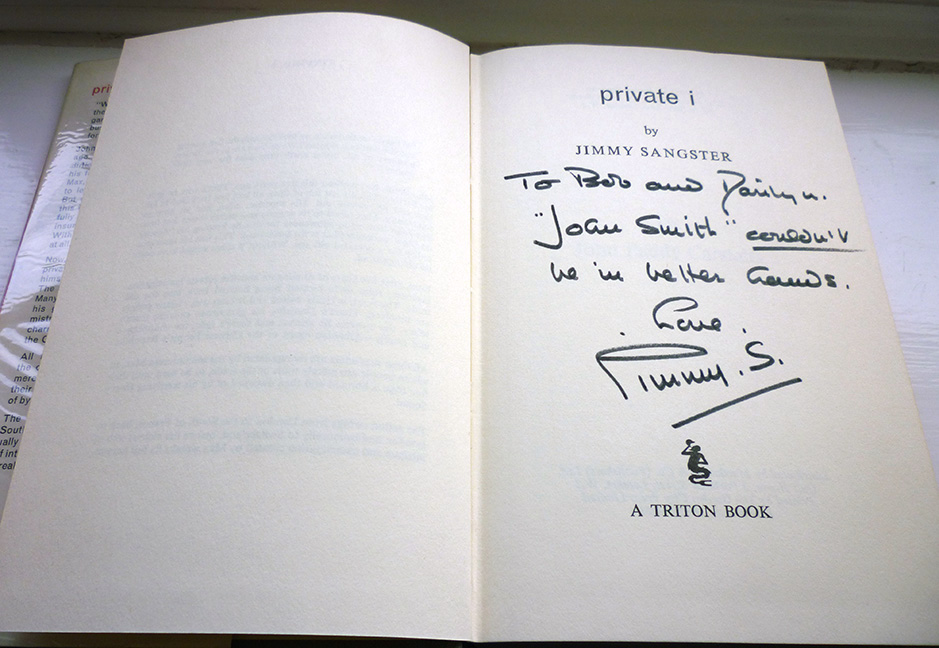

The inscription reads:

To Bob and Marilyn.

"John Smith" couldn't be in better hands.

Love

Jimmy S.

Bob and Marilyn are the American actor Robert Horton and his wife; Horton starred in Wagon Train from 1957–1962 and featured in numerous other television series, films and TV movies, one of which being the 1969 television film The Spy Killer, directed by Roy Ward Baker, produced by Jimmy Sangster and with a teleplay by Sangster based on his own novel... private i.


I've not seen The Spy Killer – although there is a clip on YouTube of the opening five minutes, featuring Horton as John Smith walking through Berwick Street Market to the baritone strains of what sounds like Scott Walker (although actually the rather less-well-known John Rowles), and the reviews on IMDB are positive – but I have read private i, and can report that it's a cracking piece of spy fiction – kind of early le Carré crossed with Len Deighton's unnamed working class secret agent and with a dash of Adam Hall's Quiller mixed in for good measure. Narrated by Smith, one-time operative with the Service – i.e. British Intelligence – turned down-at-heel private investigator, it starts out in a cut-price seedy gumshoe vein, with Smith employed by his ex-wife to obtain evidence of her new husband's gay affair, before taking a sharp left turn into the dangerous world of international espionage, as Smith is press-ganged back into service by his former boss, the ruthless and manipulative Max.

The plot is suitably murky and twisty, involving murder, coded secrets and both the Chinese and Russian security services, but it's Smith's sardonic narration which really lifts the thing. When three pages into a spy novel the lead states that he's "nearly two stone overweight, that my digestive system plays up constantly, that my teeth aren't particularly good, and that I have suffered periodically from halitosis, B.O., prickly heat and dandruff", you know you're not in the realm of Bond, and Smith spends the remainder of the novel boozing, leching, failing to get it up with his indifferent girlfriend and crashing around like the low rent – and yet, on occasion, lowly cunning – loser that he is. The only real downside is a regrettable streak of homophobia which runs through the narrative, but even that can be put down to Smith's boorish nature and the prevailing attitudes of the time rather than to whatever prejudices Sangster might or might not have held. And anyway, I can forgive a multitude of sins in any example of the spy fiction form which contains an irreverent passage like this one:

I poured myself a large drink, and read the evening paper. I washed up some dirty dishes and rinsed out a couple of pairs of socks. I washed a nylon shirt and hung it up to dry. I had another drink which I took with me to the bath. I trimmed my toenails, had a crap, read the evening paper again, and then had a shave. After that there seemed to be nothing left to do but to phone Berat's contact and tell him about the rendezvous.


The second and final John Smith spy thriller, Foreign Exchange, was published by Triton in 1968 (and filmed for television in 1970, again with Robert Horton in the lead role), and it's almost as good as private i, sending Smith to Russia as part of a complicated Cold War spy swap plot. A full review will have to wait for another time, however; this post is quite long enough as it is. For now, I invite anyone interested in learning more about the novel – and in reading contemporaneous reviews of private i – to click on the above images of the dust jacket of the Triton edition (designed by Alison Storey).

Monday, 12 October 2015

Big Morning Blues by Gordon Williams (Hodder, 1974): Signed and Inscribed First Edition

Authors inscribe books to all sorts of people and for all sorts of reasons. Sometimes they inscribe them for fans, to add a personal touch; sometimes they inscribe them to friends or confidants, to associates, acquaintances or correspondents, to family or loved ones. Sometimes they inscribe them to fellow writers and their spouses, to journalists, interviewers, filmmakers and, yes, bloggers. They might inscribe them to folk who've helped them in some way with that book or with their career – to their publisher or editor, their translator or again some friends – or who they've worked with in film or TV – a co-writer maybe, or an actress. Or they might inscribe a book with the express intention of seeing that book turned into a television series, as is the case with this one:


Big Morning Blues by Gordon Williams, published by Hodder & Stoughton in 1974, dust jacket design by Jeff Godwin, who I'm guessing is Jefferson Godwin, designer of the jacket for the 1973 Hodder edition of Brian Garfield's Death Wish; in any case, I've added Godwin's jacket for Big Morning Blues to British Thriller Book Cover Design of the 1970s and 1980s, even though the novel's not so much a thriller as an evocation of London's hard-drinking underworld, or "The Rookery", as the story has it (reviews here and here).

Williams is probably best known these days as the writer of The Siege of Trencher's Farm (1969), filmed by Sam Peckinpah in 1971 as Straw Dogs, but he has well over a dozen other novels to his credit, including The Man Who Had Power Over Women (1967), which was filmed in 1970, and four novels co-written with football manager Terry Venables, three of them a series (published by Macmillan from 1974–76 under Williams and Venables' joint pen name, P. B. Yuill) starring cockney private eye James Hazell which begat an ITV show, Hazell, in 1978.


Evidently Williams imagined Big Morning Blues had telly potential too, because this copy of the book – which I acquired from book dealer Jamie Sturgeon – has the following inscription on the half-title page:


The inscription reads:

Dear Jacky,

Could you read this quickly with a view to making an offer for network dramatisation?

Best wishes,

Gordon

I've not been able to work out who "Jacky" is – Williams's agent? A television producer? – but I don't believe the novel ever did make it onto the telly (at least not according to IMDB). Unlike the next inscribed book I'll be blogging about: a 1967 spy thriller by a writer who was instrumental in the rebirth of Hammer Films.

Thursday, 8 October 2015

Hong Kong Kill by Bryan Peters, Alias Peter George: Signed Inscribed First Edition (T. V. Boardman, 1958)

NB: Linked in Friday's Forgotten Books, 9/10/15.

I've been on the hunt for a copy of the 1958 T. V. Boardman edition of Bryan Peters's Hong Kong Kill – the first in the author's very short series (in fact just two books) of Cold War spy thrillers starring British secret agent Anthony Brandon and American CIA operative Jess Lundstrum – ever since I got my hands on a copy of the Boardman edition of the second one, 1961's The Big H, three years ago. It wasn't merely the desire to complete a series which drove me to seek out Hong Kong Kill, nor the fact that like The Big H – and indeed almost all the crime and spy novels published under Boardman's Bloodhound Mystery banner – it boasted a dust jacket designed by Denis McLoughlin (although that was admittedly a major factor in my desire to obtain that particular edition); it was also my abiding interest in the man behind the "Bryan Peters" alias: Peter George.

Best known as the co-writer of Stanley Kubrick's Dr. Strangelove or: How I Learned to Stop Worrying and Love the Bomb (1964), George published nine novels from 1952 to 1965 (including in 1963 a novelisation of Dr. Strangelove, which was itself based on George's 1958 novel Two Hours to Doom, alias Red Alert), both under his own name and the pen names Bryan Peters and Peter Bryant. It's a fascinating body of work, comprising on the one hand a handful of straightforward crime thrillers, largely published in the 1950s, and on the other a succession of books from 1958 onwards all preoccupied to a greater or lesser degree with nuclear annihilation – an obsession which in 1966 drove George to take his own life. Somewhere in the middle are the two Bryan Peters spy novels – both of which touch on the threat of obliteration by intercontinental nuclear weapons (The Big H more so than Hong Kong Kill); and spy fiction being a particular passion of mine, and having already acquired (and read, and liked) The Big H, I was keen to get hold of Hong Kong Kill too.


In the end I managed not only to find a fairly inexpensive, fairly decent copy of the uncommon Boardman edition – not ex-library and with a dust jacket that, while edge-worn and chipped, is still bright and presentable (now added to the Denis McLoughlin section in Beautiful British Book Jacket Design of the 1950s and 1960s) – but one which, unusually, is inscribed by George. Signed or inscribed Peter George books really aren't too common; I own an inscribed copy (on an author bookplate) of George's final and perhaps finest novel, Commander-1 (1965), and there are two other signed George books that I can see for sale online at present – one an inscribed copy of his 1958 crime novel Cool Murder priced at £70, the other an inscribed copy of Two Hours to Doom priced at £1,250 – but that's about it.


This copy of Hong Kong Kill is inscribed on the front free endpaper. The simple inscription reads:

Johnny – with best of good wishes – and hopes for a happy new life.

Pete

"Bryan Peters"


As to the novel itself, it's a good but uneven affair – a trifle flat in places, melodramatic in others, with a very dry first third ("The Briefing"; the novel is split into three parts, the other two being "The Kill" and "The Prize") which establishes the background to British Intelligence agent Brandon's mission – to travel to Hong Kong in order to thwart the nefarious activities of the Chinese "Extermination Section" Yellowknife, which is poised to foment trouble and assassinate key individuals – in a little too painstaking detail, and a colonial bias which is a little hard to take nearly sixty years hence. But there are some classic bits of Fleming/Bondesque spy business in the thing: a doomed love affair; a high stakes game of seven-card stud; coded messages conveyed via books (namely, amusingly, Conrad's The Secret Agent and Waugh's Decline and Fall). And it explodes into vivid, evocative life in the final part, as the 1956 Kowloon Riots erupt and Brandon and CIA agent Lundstrum go on the hunt for Yellowknife leader Lily Wang, with some shocking bursts of violence and corpses piling up in the streets around the two leads.


Intriguingly, there's an Author's Note at the start of the book which suggests that there's an element of truth to the novel beyond the (fictionalised) real life riots it features. The note reads:

This story is fiction. Unfortunately, most of the incidents in it are not. Brandon exists, though not under the name I have given him. Lily Wang exists too, though that was not the name under which she operated either. But Brandon still lives. While he does, and all those other nameless people who voluntarily walk in that savage other world, we can feel reasonably content that the other world will not encroach on our carefully balanced, peaceful lives. That was not the reason this story was written, but it is its justification.

Tuesday, 6 October 2015

The 100 Kilo Club by Simon Gandolfi: Signed Inscribed First Edition (Wildwood House, 1975)

Following on from that signed and inscribed association copy of Patricia Highsmith's Ripley Under Water I blogged about last week, I thought I'd post a bunch more inscribed books, all of them relatively recently acquired. Some are books by authors I've been well into for a while and have written about on Existential Ennui before; some are by authors I've discovered in the last year or so and who consequently will be making their Existential Ennui debuts; one or two are association copies, i.e. inscribed to notable folk associated with the author or to fellow writers; and some simply sport inscriptions which are in some way intriguing. Like this book:


The 100 Kilo Club by Simon Gandolfi, published by Wildwood House in 1975, dust jacket design by Richard Ward – said dust jacket now added to the British Thriller Book Cover Design of the 1970s and 1980s gallery, being, as it is, a classic of the form (briefcase, banknotes – rolled into spliffs in this instance – and a small stack of cannabis resin, no less). The story of an international game of cat-and-mouse between FBI agent Patrick Nolan and a dope dealer named Pleasure, it was Gandolfi's second novel, following 1965's Even with the Shutters Closed. He went on to pen five spy thrillers in collaboration with Alistair MacLean – the Trent series, published from 1992 to 2000 – and more recently a travelogue, Old Man on a Bike, detailing his own exploits as a septuagenarian motorcyclist making his way across South America. Indeed it's his peripatetic inclinations which seem to have inspired the inscription in this copy of The 100 Kilo Club.


It reads: "For Nick and Sue in loving memory of eight hundred fleas, one couch, one dog and a French au pere [sic]." As tantalising as that is, though, just as curious is what's written on the rear endpaper, possibly even in the same hand:


A telephone number for La Fonda on the Plaza hotel in Santa Fe. Make of all that what you will.*


I bought this copy of The 100 Kilo Club off book dealer Jamie Sturgeon, one of a handful of inscribed books I've acquired from Jamie over the past six months (typically at the Lewes Book Fair), some of which I'll be showcasing down the line. Whether or not I'll ever get round to reading this one is a moot point, but I have read the next inscribed book I'll be blogging about: a 1958 spy thriller written under a pen name by Peter George.

* Or simply read the comments to this post.

Wednesday, 30 September 2015

Patricia Highsmith's Ripley Under Water: Signed Inscribed Association Copy (Bloomsbury, 1991)


NB: Linked in Friday's Forgotten Books, 2/10/15.

In September 1991, Patricia Highsmith travelled from her home in Tegna, Switzerland, to London in order to publicise her latest book, Ripley Under Water – her third for Bloomsbury (following 1987's Tales of Natural and Unnatural Catastrophes and 1990's Carol) and the last to be published in her lifetime (a final novel, Small G: A Summer Idyll, was published shortly after her death in 1995). One of her publicity engagements was an interview before an audience at the ICA on 27 September, conducted by the crime writer Michael Dibdin – since made available on the British Library website (archiver, incidentally, of Existential Ennui). Later that evening Highsmith signed copies of the Bloomsbury first edition of Ripley Under Water at the late lamented Murder One on Charing Cross Road (and again the following day at Waterstones in Earls Court); but at some point on the day before, 26 September, she inscribed, signed and dated a copy of the book to her publisher, Liz Calder. This copy:


Which I acquired from Suffolk bookseller Claude Cox, and which came with an accompanying letter of provenance, signed by Liz Calder, on Full Circle Editions headed paper – Full Circle being the Suffolk publishing house Calder established in 2009 – the year after she left Bloomsbury – with her husband, Louis Baum, and Genevieve and John Christie.


I wrote about Ripley Under Water, the final novel in the Ripliad, back in 2013 as part of the Great Tom Ripley Reread, when I got my hands on a 1991 London Limited Edition of the book, flat signed by Highsmith. I mentioned then how as a Highsmith and Ripley enthusiast – okay, fanatic – "owning a signed Ripley novel is quite something"; so to have now come into possession of a signed association copy of a Ripley novel – even though it be the same Ripley novel, albeit in a (slightly) different edition – inscribed to such a key figure in Highsmith's life, is properly thrilling. (The book wasn't too expensive either, certainly in comparison to another association copy of Ripley Under Water currently listed on AbeBooks, a 1992 US Knopf edition inscribed to a literary agent and priced at around £250.)

In her accompanying letter, Liz Calder states that she "met Patricia Highsmith during the last years of her life and published several of her books", making note of the time "Highsmith came to London for publication" of Ripley Under Water and how Highsmith "was a gravel-voiced, quite shy but darkly funny woman who loved whisky and cats". Writing in The Oldie the month after Highsmith's death (March 1995 issue, as quoted in Andrew Wilson's 2003 biography of Highsmith, Beautiful Shadow), Calder recalled that publicity trip to London, when Highsmith stayed at Hazlitt's Hotel on Frith Street, Soho:

I collected her there for an evening on the town, and she had discovered that so crooked were the floors that her whisky bottle slid of its own accord down the top of her chest of drawers and she was catching it with glee as it flew off the edge. She kept repeating this trick a bit like Pooh and his balloon. She had a childlike pleasure in simple things.


Ripley Under Water is not the best Tom Ripley novel, nor my favourite (that would be 1974's Ripley's Game, in both cases), but I love the Ripliad as a body of work and Ripley Under Water is an intrinsic part of that series – a sequel of sorts to the second Ripley novel, Ripley Under Ground (1970), with a handful of excellent and memorable sequences which are the equal of anything else in the Ripliad (Tom luring his nemesis, David Pritchard, to a secluded seaside Tangier cafe and then losing his rag with Pritchard and beating him up; Tom and Ed Banbury's gruesome disposal of the remains of the art dealer Murchison; the final fate of David and Janice Pritchard). So I'm delighted to add to my Highsmith collection a unique signed copy of the novel, and especially one with so firm – and firmly dated, not to mention located – a provenance.


I'll be showcasing some more inscribed books over the coming weeks – not by Highsmith, although I do have a couple of other signed books by her I'll be unveiling at some point – but by other authors, some of whom have appeared on Existential Ennui before, and some who have not.

Monday, 28 September 2015

Patricia Highsmith on Writing, in Whodunit? A Guide to Crime, Suspense & Spy Fiction and Crime & Mystery: The 100 Best Books by H. R. F. Keating


By far the most sustained piece of writing by Patricia Highsmith on the subject of fiction – her own and others' – can be found in her 160-page (in its 1981 revised edition) guidebook Plotting and Writing Suspense Fiction (orig. 1966). But Highsmith did pen the occasional piece for other publications too, both magazines (Plotting itself grew out of an article Highsmith wrote for The Writer magazine, and in 1989 she wrote an article for Granta magazine on the subject of Tom Ripley) and books (the 1990 Bloomsbury edition of Carol includes an afterword on the genesis of that novel). In the 1980s she twice contributed to books edited and written by the crime writer and critic H. R. F. KeatingWhodunit? A Guide to Crime, Suspense & Spy Fiction (Windward, 1982) and Crime & Mystery: The 100 Best Books (Xanadu, 1987) – and both pieces are well worth a look.


Her piece for Whodunit, "Not-Thinking with the Dishes" in the "How I Write My Books" chapter, isn't very long – barely a page in length – but it's still revealing as regards her methods. Noting that she had "no set of rules for writing a book" and that she "never think[s] about who my readers may be", she states: "My book ideas begin with a situation of surprise or coincidence, some unusual circumstance, and around this, and forward and backward, I create a narrative with a beginning and an end." She continues:

I like to write three or four hours a day, taking a break frequently to do something such as finishing the last dishes in the sink, during which I am not-thinking about my work in progress. It is important that nobody else be in the house. Then my thoughts take a creative jump. Hard thought never did me very much good. I believe in letting one's mind alone. The only price I pay is having to rewrite, but not always a lot and mostly it is polishing, and having to cut a fair amount.

To illustrate this last point, Whodunit? reproduces a manuscript page from People Who Knock on the Door, which at that juncture hadn't been published (it was published by Heinemann the following year). Highsmith additionally reveals that she could write up to two thousand words a day, worked seven days a week ("In principle... something always happens to prevent work one or two days a week") and that she was unable to "adopt the method of a famous writer who said he writes the action parts first and fills in the gaps later" but instead had to "write all the in-between material as I go". She reasons: "Maybe this is inevitable because of the subjective attitude I generally take: I describe what is in the head of the protagonist, psychopath or not, because what is in his or her head must explain as well as advance the story."


Whodunit? itself is a thoroughly worthwhile book – there are essays by, among others, Michael Gilbert, John Gardner ("The Espionage Novel"), Gregory Mcdonald, Len Deighton and Eric Ambler, as well as writer-by-writer and character-by-character guides to crime fiction and thrillers – as is Crime & Mystery: The 100 Best Books, in which H. R. F. Keating offers a hundred two-page essays on key crime novels and their authors (the list can be found at Classic Crime Fiction). Highsmith penned the foreword to the book, in which she appears to demonstrate more of a working knowledge of the field than she suggested she had in Plotting and Writing Suspense Fiction (she maintained in that book that she "seldom read" other people's crime novels). She singles out, among others, Wilkie Collins, Raymond Chandler, P. D. James, Cornell Woolrich, Georges Simenon and, especially gratifyingly for me, P. M. Hubbard (albeit only in passing), and picks over Keating's musings on these and other authors.

"One can open The 100 Best anywhere," Highsmith writes at the close of her foreword, "and be entertained by its contents, learn something new, or reinforce what is already in one's head." Not least in regard to Highsmith herself: Keating includes both The Tremor of Forgery (1969) – highlighting the "uneasiness" and "Fuzziness, ambiguity" of Highsmith's writing and "the to-and-fro indecisiveness of real life" she captures – and The Talented Mr. Ripley (1955), where he details the traits which make Tom Ripley such a compelling and, yes, charming character – "his genuine love of art and his true appreciation of the fruits of the earth... the simple affection he feels for his friends... his real interest in the earth-loving pursuit of gardening" and our "awed admiration" at "his willingness to take risks". He also recalls "a meeting of the Crime Writers' Association's Gold Dagger award where one of our number announced that if we chose Ripley's Game for the prize she would resign".

Both Whodunit? and Crime & Mystery: The 100 Best Books are fairly readily – and cheaply – available (I found both for a few quid each in Colin Page Antiquarian Books in Brighton – where there is also, at time of writing, an expanded selection of secondhand crime fiction – a recently acquired collection, one which, needless to say, I've already raided). Not so the next Patricia Highsmith book I'll be blogging about: a signed association copy of the final novel in the Ripliad.