Monday, 2 November 2015

Existential Ennui on eBay: Tinker Tailor Soldier Spy, Point Blank and Pity Him Afterwards

At long last I've finally gone and done something I've been promising to do for bloody ages: I've listed some books for sale on eBay. All three books have featured on Existential Ennui at various points, and two of them have even featured on The Violent World of Parker too – not that either of those facts are especially salient or will make a blind bit of difference as regards determining whether or not the books sell or, if they do sell, how much they sell for, I'm sure – I mean, why should whether a book has made an appearance on a little-read blog collecting blog – and a better-read crime fiction website – and indeed sat on the shelves of the proprietor of the little-read book collecting blog for, ooh, a good few years, in any way impact its relative desirability? – but I just thought I'd mention it. Er, at length.

The books are as follows:


A first edition/impression of John le Carré's Tinker, Tailor, Solider, Spy, published in hardback by Hodder & Stoughton in 1974, as seen on Existential Ennui here, here and here (among other posts), eBay auction here;


A British hardback first edition/impression of Richard Stark's Point Blank, alias The Hunter, published by Allison & Busby in 1984, as seen on Existential Ennui – and, no doubt, The Violent World of Parker – all over the bloody place (I can't be fagged to find all the posts) but certainly on the British Thriller Book Cover Design of the 1970s and 1980s page, eBay auction here;


An American first edition/impression of Donald E. Westlake's Pity Him Afterwards, published in hardback by Random House in 1964, as seen on Existential Ennui here and here and The Violent World of Parker here, eBay auction here.

I suppose they're all quite obvious books in a way: better known titles (although less so in the case of Pity Him Afterwards) by authors who are firm favourites on Existential Ennui. But they're all collectable first editions of a sort, and they all have low starting prices – £4.99 in each case – so they're a good way for me to test the waters, to see if it's going to be worth my while to persist with selling on eBay. If they do well, I have other, more obscure delights waiting to be listed (not least some more Westlake books).

All three auctions finish on Sunday 8 November around 7pm, and all three are UK only affairs, I'm afraid; I may offer international shipping on future auctions (if there are future auctions), but for these initial ones I wanted to keep it simple. There's information about the condition of each book in each respective listing, but anyone looking for more details can either ask me questions on eBay itself, or post a comment below, or drop me a line on the usual Existential Ennui email address (see the contact details in the sidebar on the right) and I'll respond as swiftly as I'm able.

Wednesday, 28 October 2015

Author Donald MacKenzie's Crime and Spy Thrillers, 1956–1993, Feat. the Raven Series, The Kyle Contract and a Bibliography


Donald MacKenzie (1918–1993) is one of those authors who, if you're into classic and vintage crime fiction and you frequent secondhand bookshops, chances are you'll have come across at some point, and yet about whom there is scant information online – this despite, in MacKenzie's case, having published three dozen novels and two volumes of autobiography over the course of a four-decade career. (The Canadian-born MacKenzie does have a Wikipedia page, but it's in French.) So far, so unremarkable: there are scores of crime writers who, like MacKenzie, have largely slipped from the collective consciousness.

What makes MacKenzie unusual among his crime-writing brethren is that he genuinely knew of what he wrote. Those aforementioned two volumes of autobiography, Fugitives (1955, US title Occupation: Thief) and Gentlemen at Crime (1956), published at the start of his literary career, detail his prior career: as a convicted criminal – initially a confidence trickster, then a share-pusher and finally a robber.


The back of the dust jacket of the British first edition of MacKenzie's debut novel, Nowhere to Go (Elek, 1956) – which, incidentally, was made into a film by Ealing Studios in 1958 (the novel, not the dust jacket) – offers synopses of both of MacKenzie's non-fiction titles (click on the image above left to read them), while the back of the dust jacket of the British first edition of his third novel, The Scent of Danger (Collins, 1958) – the first of two books to star burglar Macbeth Bain – features an amusing potted biography (widely quoted online, invariably unattributed):

Born in Ontario, Canada, in 1908 and educated in England, Canada and Switzerland, for twenty-five years MacKenzie lived by crime in many countries. "I went to jail," he writes, "if not with depressing regularity – too often for my liking." His last sentences were five years in the United States and three years in England – and they ran concurrently. He began writing and selling stories when in an American jail and says, "I like writing and hope to keep at it till I die. I like travel, kippers, American cars, Spanish suits, ice hockey, prize fights, walking, flowers, sun, dogs, Brahms, horseback riding, settling old scores, people who like me. I don't like meat, cocktail parties, Spanish gin, policemen, most judges, talk about things I don't understand, pompous people, good losers, or writers who 'spell it out' for you.

"I try to do exactly as I like as often as possible and I don't think I'm either psychopathic, a wayward boy, a problem of our time, a charming rogue, or ever was."


MacKenzie's canon can be divided roughly into two strands: those novels which feature as their leads criminals or former criminals, including two short series (the Macbeth Bain series and the Henry Chalice/Crying Eddie series, which comprises three books); and an extended series of crime/spy thrillers starring ex-copper turned international troubleshooter John Raven. MacKenzie's writing is characterised by a noirish sensibility, an economical style and clipped, deadpan sentences.


I guess you could call him a stylist, except that he's not (in my opinion) quite up there with the likes of, say, Richard Stark or Elmore Leonard. From the little I've read of him and the contemporaneous review excerpts I've seen – where comments range from "One of the few British crime writers who investigates the psychological make-up of his characters in a convincing way... smacks not a little of Graham Greene in its mild pessimism and pathos" (Books and Bookmen on The Scent of Danger) to "The action is splendidly developed... and the climax breathless" (the Oxford Mail – probably Anthony Price then – on Night Boat to Puerto Vedra) to "A craftsman's job" (The Sun on Dead Straight) – I'd say MacKenzie was a sharp, stylish writer, but not an easy one to warm to, his novels as likely to be penned from the perspective of an unsympathetic recidivist as from that of a policeman.

For me that makes him a more interesting writer – that and his colourful background – but I suppose it might be one reason why he's less celebrated than some other classic crime writers; certainly he merits more coverage online than has heretofore been the case – hence this post and its bibliography, the most detailed and accurate yet assembled for the web (to my knowledge). Still, MacKenzie can at least claim to be currently in print, courtesy of Orion's Murder Room imprint, although the dust jackets illustrating this post are actually taken from first editions of the novels, a stack of which I acquired from book dealer Jamie Sturgeon and some of which boast handsome jacket designs by, variously, Ionicus (alias Joshua Charles Armitage; The Lonely Side of the River, Hodder, 1965), William Randell (The Scent of Danger, Collins, 1958) and Edward Pagram (Nowhere to Go and The Juryman, Elek, 1956/57; some more of his work can be seen here). I've added all three of those artists' MacKenzie wrappers to Beautiful British Book Jacket Design of the 1950s and 1960s, which marks the debut of Ionicus and Pagram on that page. (I've also added Pagram's wrapper for the 1965 Hodder edition of Patricia Carlon's Crime of Silence, which I suddenly remembered whilst writing this post that I had sitting on my shelves.)


I also took off Jamie's hands three signed and inscribed copies of MacKenzie first editions:


Two Raven novels – Raven and the Paperhangers, published by Macmillan in 1980, dust jacket photograph by Bill Richmond (whose work also appears on the covers of books by Victor Canning, Elmore Leonard and Patricia Highsmith), and Nobody Here by That Name, published by Macmillan in 1986, dust jacket illustration by Martin White – both of which may well have been inscribed to the same two people (I can't quite make out the names; suggestions in the comments please), and:


The Kyle Contract, published by Hodder in 1971, dust jacket design uncredited but which may well be by Gordon King. A solid, compelling but sober (and sobering) standalone novel, set in California, about two ex-cons, one a failing screenwriter, attempting to put the screws on a wealthy Hollywood director who framed the screenwriter for the murder of the director's wife, the inscription in this one is rather intriguing:


It reads: "I loved her but she never knew it – Donald May '71". I wonder who the recipient of that one was...? Anyway, I've added the jackets of all three of those signed books to British Thriller Book Cover Design of the 1970s and 1980s.

NB: This post linked in the 30/10/11 Friday's Forgotten Books round-up.

Donald MacKenzie Bibliography


Standalone Novels
Nowhere to Go (Elek, 1956); US title Manhunt
The Juryman (Elek, 1957)
Dangerous Silence (Collins, 1960)
Knife Edge (Collins, 1961)
The Genial Stranger (Collins, 1962)
Double Exposure (Collins, 1963); US title I, Spy
Cool Sleeps Balaban (Collins, 1964)
The Lonely Side of the River (Hodder & Stoughton, 1965)
Three Minus Two (Hodder & Stoughton, 1968); US title The Quiet Killer
Night Boat from Puerto Vedra (Hodder & Stoughton, 1969)
The Kyle Contract (Hodder & Stoughton, 1971)
Postscript to a Dead Letter (Macmillan, 1973)
The Spreewald Collection (Macmillan, 1975)
Deep, Dark and Dead (Macmillan, 1978)
The Last of the Boatriders (Macmillan, 1981)

Macbeth Bain Series
The Scent of Danger (Collins, 1958); US title Moment of Danger
Dead Straight (Hodder & Stoughton, 1968)

Henry Chalice and Crying Eddie Series
Salute from a Dead Man (Hodder & Stoughton, 1966)
Death Is a Friend (Hodder & Stoughton, 1967)
Sleep Is for the Rich (Macmillan, 1971); paperback title The Chalice Caper

John Raven Series
Zaleski's Percentage (Macmillan, 1974)
Raven in Flight (Macmillan, 1976)
Raven and the Ratcatcher (Macmillan, 1977)
Raven and the Kamikaze (Macmillan, 1977)
Raven Feathers His Nest (Macmillan, 1980); US title Raven After Dark
Raven Settles a Score (Macmillan, 1979)
Raven and the Paperhangers (Macmillan, 1980)
Raven's Revenge (Macmillan, 1982)
Raven's Longest Night (Macmillan, 1984)
Raven's Shadow (Macmillan, 1984)
Nobody Here by That Name (Macmillan, 1986)
A Savage State of Grace (Macmillan, 1988)
By Any Illegal Means (Macmillan, 1989)
Loose Cannon (Macmillan, 1991)
The Eyes of the Goat (Macmillan, 1992)
The Sixth Deadly Sin (Macmillan, 1993)

Non-fiction
Fugitives (Elek, 1955); US title Occupation: Thief
Gentlemen at Crime (Elek, 1956)

NB: Some sources credit MacKenzie with another two novels: Harrier! (Granada, 1983) and Thunderbolt! (Panther, 1984); however, according to Steve Holland those were actually penned pseudonymously by Christopher Priest.

Friday, 23 October 2015

Author Brian Cleeve, Vote X for Treason (alias Counterspy) and the Sean Ryan Spy Series, 1964–67

NB: One of this Friday's Forgotten Books.

Google the Irish (British-born) writer and broadcaster Brian Cleeve (1921–2003) and one of the first links you'll come across, aside from his Wikipedia page, is a website called SevenMansions. Subtitled, slightly misleadingly, "The Works of Brian Cleeve", it's a collection of Cleeve's writings about spirituality and God, incorporating a handful of books on those subjects which Cleeve published in the early 1980s shortly after he experienced a religious epiphany. What the site neglects to mention, however – hence the "slightly misleadingly" – are the twenty novels Cleeve published from the early 1950s to the mid-1970s (plus one final one, A Woman of Fortune, published in 1993), a run of eight of which, beginning with 1961's Assignment to Vengeance through to 1968's You Must Never Go Back, are suspense and spy thrillers. And half of those eight comprise an espionage series starring Irish terrorist-turned-British Intelligence agent Sean Ryan, as follows:

Vote X for Treason (Collins, 1964; US title Counterspy)
Dark Blood, Dark Terror (Hammond, 1966)
The Judas Goat (Hammond, 1966; US title Vice Isn't Private)
Violent Death of a Bitter Englishman (Random House, 1967)


The first book in the series, Vote X for Treason (Collins edition dust jacket design by Barbara Walton), is a grim but compelling affair – a grubby, street-level take on spy fiction informed, Cleeve himself admitted (according to Donald McCormick in Spy Fiction: A Connoisseur's Guide), by the author's experiences working for British Counterintelligence during the war. (Cleeve led an eventful life, to say the least.) The story sees Sean Ryan released early from a fifteen-year prison sentence on the orders of intelligence chief Major Courtenay, who presents Ryan with a choice: either infiltrate the New Party – a political organisation with fascistic leanings and violently revolutionary aims, with its base in a string of gyms and youth clubs and tendrils extending far into Westminster – or go back to jail. Ryan accepts the mission and soon finds himself sucked into a thuggishly brutal world, the mindless camaraderie of which holds a certain appeal for the former gunman – until his only friend comes a cropper.


Vote X for Treason is the only one of the Sean Ryan novels I've read thus far, but I plan on getting to the others at some point, and accordingly have collected British first editions of the second and third books in the series (I'm still on the hunt for an American hardback first edition of the fourth, Violent Death of a Bitter Englishman, which I don't believe was ever published in hardback in the UK – I think it went straight to Corgi paperback here):


Dark Blood, Dark Terror, published by Hammond, Hammond & Company in 1966, dust jacket design by Roger Harris, and:


The Judas Goat, again published by Hammond in 1966, again with a dust jacket designed by Roger Harris. I'm keener on Harris's jacket for this one than for Dark Blood, Dark Terror, but I've nevertheless added both wrappers to the Existential Ennui Beautiful British Book Jacket Design of the 1950s and 1960s page, along with Harris's wrapper for the 1965 Hammond edition of James Munro's Die Rich Die Happy, and they do look rather good grouped together like that. (I've updated the Vote X for Treason cover there too, as I now own two copies of the scarce Collins first edition; the first copy I bought has a Boots Library sticker firmly affixed to the front of its jacket.)

There's one other thing worth noting about this copy of The Judas Goat – and in keeping with my recent posts on signed and inscribed books – which is this:


It's been signed and inscribed by Cleeve on the front free endpaper (in festive fashion – "With love and wishes from Brian Cleeve Xmas 1966"). There are more than a dozen signed Brian Cleeve books on AbeBooks at present, but this is the only signed book in the Sean Ryan series I've come across. Evidently, in this matter at least, Cleeve's God was smiling on me.

Thursday, 15 October 2015

Jimmy Sangster's John Smith Spy Novels: private i (Triton, 1967); Signed Inscribed First Editions

NB: Linked in Friday's Forgotten Books, 16/10/15.

When Jimmy Sangster died four years ago, his obituaries naturally concentrated largely on his film and TV work (see The Guardian, The Independent, The Telegraph and The New York Times). Sangster was a key figure in the revival of Hammer Films in the late 1950s and through the 1960s; he wrote The Curse of Frankenstein (1957), Dracula (1958), The Mummy (1959) and two dozen other Hammer horrors before moving to America, where he wrote for The Six Million Dollar Man, Kolchak: The Night Stalker, Ironside, Wonder Woman and a bunch more US TV shows.

But Sangster also penned eight novels (plus a couple of novelisations of his own screenplays) besides his film and television work: three murder mysteries published from 1986–88 (1989–90 in the UK) starring expat former Scotland Yard investigator James Reed; one standalone thriller-cum-farce published in 1971 starring gun-running adventurer Anthony Bridges; two spy thrillers published from 1968–70 starring British Intelligence agent Katy Touchfeather; and two half-spy/half-mystery novels published from 1967–68 starring ex-British Intelligence operative turned private investigator John Smith, the first of which is this:


Or rather, these: private i, published by Triton in 1967, dust jacket design by Collis Clements. Now, I suppose the immediate question here is, why do I have two copies of the same book? Answer being, having learned about Sangster's parallel career as a writer of spy fiction (from screenwriter and novelist Stephen Gallagher, no less), I went in search of a first edition of his debut novel – private i – and came across two copies, both of which boasted intriguing inscriptions (written by Sangster, as far as I can determine; the handwriting is a little different in each book, but there are enough similarities – the same black maker pen used, corresponding letterforms – that I'm fairly confident they're from the same hand), one of which being an association copy. And since both books were relatively inexpensive – and being the hopeless case that I am – I bought both of them. (Whether or not I'll keep both of them remains to be seen – I'm planning on doing some eBaying soon.)

The copy on the left has a poem inscribed on the front free endpaper:


It reads:

Roses are Red.
Violets are Blue.
I'll lay odds
I'm higher than you.

Violets are Blue
Roses are Red
If I could find the strength
I'd drag you to bed

Drifting around in a Pale Velvet haze
What a wonderfull way to pass all our days.

Love, Jim xxxx

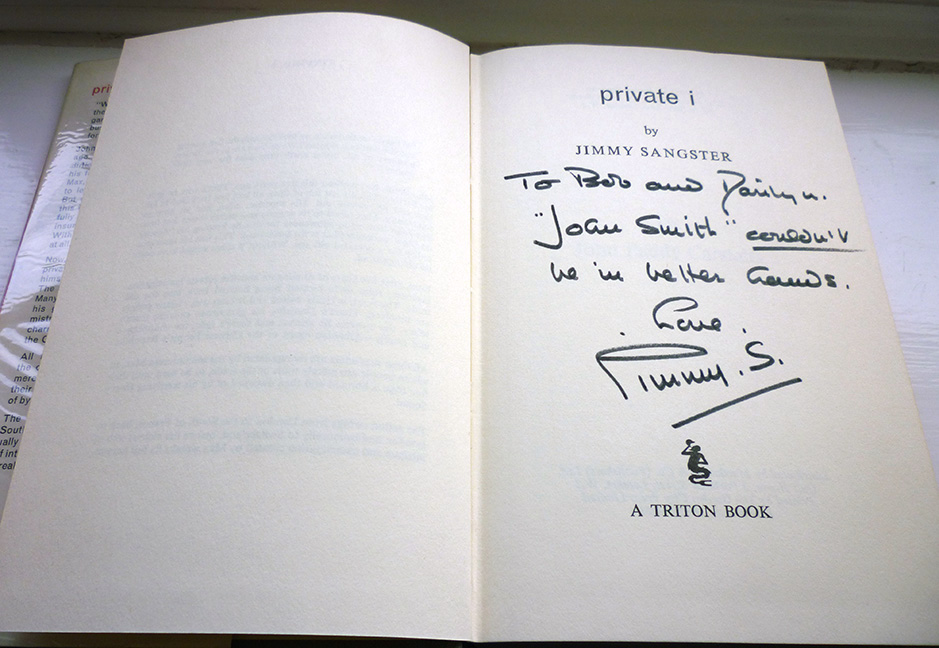
I've no idea who the poem was written for (although I'd dearly love to find out), but I do know who the other copy of the book, the association copy, was inscribed to, this time on the title page:


The inscription reads:

To Bob and Marilyn.

"John Smith" couldn't be in better hands.

Love

Jimmy S.

Bob and Marilyn are the American actor Robert Horton and his wife; Horton starred in Wagon Train from 1957–1962 and featured in numerous other television series, films and TV movies, one of which being the 1969 television film The Spy Killer, directed by Roy Ward Baker, produced by Jimmy Sangster and with a teleplay by Sangster based on his own novel... private i.


I've not seen The Spy Killer – although there is a clip on YouTube of the opening five minutes, featuring Horton as John Smith walking through Berwick Street Market to the baritone strains of what sounds like Scott Walker (although actually the rather less-well-known John Rowles), and the reviews on IMDB are positive – but I have read private i, and can report that it's a cracking piece of spy fiction – kind of early le Carré crossed with Len Deighton's unnamed working class secret agent and with a dash of Adam Hall's Quiller mixed in for good measure. Narrated by Smith, one-time operative with the Service – i.e. British Intelligence – turned down-at-heel private investigator, it starts out in a cut-price seedy gumshoe vein, with Smith employed by his ex-wife to obtain evidence of her new husband's gay affair, before taking a sharp left turn into the dangerous world of international espionage, as Smith is press-ganged back into service by his former boss, the ruthless and manipulative Max.

The plot is suitably murky and twisty, involving murder, coded secrets and both the Chinese and Russian security services, but it's Smith's sardonic narration which really lifts the thing. When three pages into a spy novel the lead states that he's "nearly two stone overweight, that my digestive system plays up constantly, that my teeth aren't particularly good, and that I have suffered periodically from halitosis, B.O., prickly heat and dandruff", you know you're not in the realm of Bond, and Smith spends the remainder of the novel boozing, leching, failing to get it up with his indifferent girlfriend and crashing around like the low rent – and yet, on occasion, lowly cunning – loser that he is. The only real downside is a regrettable streak of homophobia which runs through the narrative, but even that can be put down to Smith's boorish nature and the prevailing attitudes of the time rather than to whatever prejudices Sangster might or might not have held. And anyway, I can forgive a multitude of sins in any example of the spy fiction form which contains an irreverent passage like this one:

I poured myself a large drink, and read the evening paper. I washed up some dirty dishes and rinsed out a couple of pairs of socks. I washed a nylon shirt and hung it up to dry. I had another drink which I took with me to the bath. I trimmed my toenails, had a crap, read the evening paper again, and then had a shave. After that there seemed to be nothing left to do but to phone Berat's contact and tell him about the rendezvous.


The second and final John Smith spy thriller, Foreign Exchange, was published by Triton in 1968 (and filmed for television in 1970, again with Robert Horton in the lead role), and it's almost as good as private i, sending Smith to Russia as part of a complicated Cold War spy swap plot. A full review will have to wait for another time, however; this post is quite long enough as it is. For now, I invite anyone interested in learning more about the novel – and in reading contemporaneous reviews of private i – to click on the above images of the dust jacket of the Triton edition (designed by Alison Storey).

Monday, 12 October 2015

Big Morning Blues by Gordon Williams (Hodder, 1974): Signed and Inscribed First Edition

Authors inscribe books to all sorts of people and for all sorts of reasons. Sometimes they inscribe them for fans, to add a personal touch; sometimes they inscribe them to friends or confidants, to associates, acquaintances or correspondents, to family or loved ones. Sometimes they inscribe them to fellow writers and their spouses, to journalists, interviewers, filmmakers and, yes, bloggers. They might inscribe them to folk who've helped them in some way with that book or with their career – to their publisher or editor, their translator or again some friends – or who they've worked with in film or TV – a co-writer maybe, or an actress. Or they might inscribe a book with the express intention of seeing that book turned into a television series, as is the case with this one:


Big Morning Blues by Gordon Williams, published by Hodder & Stoughton in 1974, dust jacket design by Jeff Godwin, who I'm guessing is Jefferson Godwin, designer of the jacket for the 1973 Hodder edition of Brian Garfield's Death Wish; in any case, I've added Godwin's jacket for Big Morning Blues to British Thriller Book Cover Design of the 1970s and 1980s, even though the novel's not so much a thriller as an evocation of London's hard-drinking underworld, or "The Rookery", as the story has it (reviews here and here).

Williams is probably best known these days as the writer of The Siege of Trencher's Farm (1969), filmed by Sam Peckinpah in 1971 as Straw Dogs, but he has well over a dozen other novels to his credit, including The Man Who Had Power Over Women (1967), which was filmed in 1970, and four novels co-written with football manager Terry Venables, three of them a series (published by Macmillan from 1974–76 under Williams and Venables' joint pen name, P. B. Yuill) starring cockney private eye James Hazell which begat an ITV show, Hazell, in 1978.


Evidently Williams imagined Big Morning Blues had telly potential too, because this copy of the book – which I acquired from book dealer Jamie Sturgeon – has the following inscription on the half-title page:


The inscription reads:

Dear Jacky,

Could you read this quickly with a view to making an offer for network dramatisation?

Best wishes,

Gordon

I've not been able to work out who "Jacky" is – Williams's agent? A television producer? – but I don't believe the novel ever did make it onto the telly (at least not according to IMDB). Unlike the next inscribed book I'll be blogging about: a 1967 spy thriller by a writer who was instrumental in the rebirth of Hammer Films.

Thursday, 8 October 2015

Hong Kong Kill by Bryan Peters, Alias Peter George: Signed Inscribed First Edition (T. V. Boardman, 1958)

NB: Linked in Friday's Forgotten Books, 9/10/15.

I've been on the hunt for a copy of the 1958 T. V. Boardman edition of Bryan Peters's Hong Kong Kill – the first in the author's very short series (in fact just two books) of Cold War spy thrillers starring British secret agent Anthony Brandon and American CIA operative Jess Lundstrum – ever since I got my hands on a copy of the Boardman edition of the second one, 1961's The Big H, three years ago. It wasn't merely the desire to complete a series which drove me to seek out Hong Kong Kill, nor the fact that like The Big H – and indeed almost all the crime and spy novels published under Boardman's Bloodhound Mystery banner – it boasted a dust jacket designed by Denis McLoughlin (although that was admittedly a major factor in my desire to obtain that particular edition); it was also my abiding interest in the man behind the "Bryan Peters" alias: Peter George.

Best known as the co-writer of Stanley Kubrick's Dr. Strangelove or: How I Learned to Stop Worrying and Love the Bomb (1964), George published nine novels from 1952 to 1965 (including in 1963 a novelisation of Dr. Strangelove, which was itself based on George's 1958 novel Two Hours to Doom, alias Red Alert), both under his own name and the pen names Bryan Peters and Peter Bryant. It's a fascinating body of work, comprising on the one hand a handful of straightforward crime thrillers, largely published in the 1950s, and on the other a succession of books from 1958 onwards all preoccupied to a greater or lesser degree with nuclear annihilation – an obsession which in 1966 drove George to take his own life. Somewhere in the middle are the two Bryan Peters spy novels – both of which touch on the threat of obliteration by intercontinental nuclear weapons (The Big H more so than Hong Kong Kill); and spy fiction being a particular passion of mine, and having already acquired (and read, and liked) The Big H, I was keen to get hold of Hong Kong Kill too.


In the end I managed not only to find a fairly inexpensive, fairly decent copy of the uncommon Boardman edition – not ex-library and with a dust jacket that, while edge-worn and chipped, is still bright and presentable (now added to the Denis McLoughlin section in Beautiful British Book Jacket Design of the 1950s and 1960s) – but one which, unusually, is inscribed by George. Signed or inscribed Peter George books really aren't too common; I own an inscribed copy (on an author bookplate) of George's final and perhaps finest novel, Commander-1 (1965), and there are two other signed George books that I can see for sale online at present – one an inscribed copy of his 1958 crime novel Cool Murder priced at £70, the other an inscribed copy of Two Hours to Doom priced at £1,250 – but that's about it.


This copy of Hong Kong Kill is inscribed on the front free endpaper. The simple inscription reads:

Johnny – with best of good wishes – and hopes for a happy new life.

Pete

"Bryan Peters"


As to the novel itself, it's a good but uneven affair – a trifle flat in places, melodramatic in others, with a very dry first third ("The Briefing"; the novel is split into three parts, the other two being "The Kill" and "The Prize") which establishes the background to British Intelligence agent Brandon's mission – to travel to Hong Kong in order to thwart the nefarious activities of the Chinese "Extermination Section" Yellowknife, which is poised to foment trouble and assassinate key individuals – in a little too painstaking detail, and a colonial bias which is a little hard to take nearly sixty years hence. But there are some classic bits of Fleming/Bondesque spy business in the thing: a doomed love affair; a high stakes game of seven-card stud; coded messages conveyed via books (namely, amusingly, Conrad's The Secret Agent and Waugh's Decline and Fall). And it explodes into vivid, evocative life in the final part, as the 1956 Kowloon Riots erupt and Brandon and CIA agent Lundstrum go on the hunt for Yellowknife leader Lily Wang, with some shocking bursts of violence and corpses piling up in the streets around the two leads.


Intriguingly, there's an Author's Note at the start of the book which suggests that there's an element of truth to the novel beyond the (fictionalised) real life riots it features. The note reads:

This story is fiction. Unfortunately, most of the incidents in it are not. Brandon exists, though not under the name I have given him. Lily Wang exists too, though that was not the name under which she operated either. But Brandon still lives. While he does, and all those other nameless people who voluntarily walk in that savage other world, we can feel reasonably content that the other world will not encroach on our carefully balanced, peaceful lives. That was not the reason this story was written, but it is its justification.