Showing posts with label book collecting. Show all posts

Saturday, 30 May 2026

From the Lewes Book Fair (Slight Return): Gavin Lyall's The Secret Servant

I realise haven't done a Lewes Book Fair blog post in bloody ages – or indeed hardly any blogging at all – but I was just at the latest Lewes fair chatting to my friend, the book dealer Jamie Sturgeon, who asked me, as he usually does, whether I'll ever get back to blogging about books again. And having actually bought a book this time (not a guarantee these days), and taken a few pictures, I thought to myself, well, why the devil not? Hence this resurrection of the From the Lewes Book Fair format, which I have largely composed whilst sitting on the grass at Lewes Athletics track watching Edie (remember her...?) doing her pole vault training (don't ask).

The book wot I bought is in fact one I already own, in exactly the same edition (along with an uncorrected proof): a 1980 Hodder first of Gavin Lyall's excellent espionage novel The Secret Servant, the first in the author's short Harry Maxim spy thriller series:

I, ahem, spied it in amongst Mark Skipper of Cheltenham Rare Books' reduced-to-four-quid offerings and, as is my wont, and being a big fan of the book, decided to have a quick shufty inside, only to discover that, lo and behold, it was signed and inscribed, to a Tim Morris in thanks for "a marvellous lunch and occasion generally":

No idea who Tim Morris is or was – perhaps he's this one – but it was a nice find nonetheless. Also of interest at the fair, to me if nobody else, was this lovely signed photo I spotted hanging on the stand next to Jamie's table:

Yes, that's Ben Affleck in all his be-muscled glory (although not as buff as he would later be in 2016's Batman v. Superman: Dawn of Justice) as the eponymous lead of 2003's Daredevil film. I can't say I'm overly fond of the film (unlike the aforementioned Batman v. Superman, at least in its extended Ultimate Edition), but I'd be lying if I said I wasn't tempted. And to answer Jamie's question about which Morgan Freeman film the signed photo above it is taken from:

I can confirm that it's another Ben Affleck flick from the year before, 2002's The Sum of All Fears, based of course on a book hailing from Tom Clancy's imperial doorstopper period.

Wednesday, 16 July 2025

Signed Patricia Highsmith Books: Edith's Diary, People Who Knock on the Door and Found in the Street

As I mentioned in my post the other week on a significant (to me, if no one else) piece of signed Patriciaphernalia relating to Ripley's Game, I also have several signed Patricia Highsmith first and other editions I've been meaning to blog about for bloody ages – which, in order of publication, are as follows:


A 1977 Heinemann first edition of Edith's Diary, Highsmith's seventeenth novel. I've blogged in brief before about a previous copy of this edition, bought in 2010 in the Chichester branch of Kim's Bookshop (which, I've only just learned, closed down last year, though the Arundel branch still seemingly prospers) and subsequently sold to, I think, my friend Ric, co-proprietor of Lewes's fine (and pretty much only these days) secondhand and antiquarian bookshop Bow Windows. (And in a pleasing instance of serendipity, just the other day Ric drew my attention to Elena Gosalvez Blanca's piece about her time as Highsmith's assistant, in which Blanca highlights Edith's Diary as her favourite Highsmith.) This copy, however, is signed on the title page:


And dated 21 November 1988, a good decade on from publication. What Highsmith was up to on that particular day I couldn't say – while I own Edith's Diary, I don't own Highsmith's Her Diaries and Notebooks, if that day is even mentioned in there – but Andrew Wilson's 2003 biography Beautiful Shadow suggests she might have been in America, where this copy came from. Evidently whatever she was doing included signing a book, and three years earlier, around summer 1985, Highsmith was also signing books:


Namely the first American edition of her nineteenth novel, People Who Knock on the Door, published by Penzler Books in a numbered, limited, signed edition in September 1985:


One of half a dozen of Highsmith's works published by Penzler in signed limited editions, this is another book I've blogged about before (again back in 2010) in its 1983 Heinemann first edition, when I was in the process of securing firsts of as many Highsmiths as I could. And would you believe it I've blogged about the final book I'm showcasing before too, although not this particular edition:


An uncorrected advance proof of Found in the Street, Highsmith's twenty-first novel, published in the US in 1987 (the year after the UK Heinemann first edition) by Atlantic Monthly Press, with whom Highsmith signed after Otto Penzler dropped her dedication to "the Palestinian people and their leaders" from the above-showcased US edition of People Who Knock on the Door. This one I can state with reasonable certainty when and where it was signed, as it's an association copy originally belonging to Greg Gatenby, founding artistic director of the Toronto International Festival of Authors; his ownership signature can be seen on the half-title page above Highsmith's signature:


In October 1987 Highsmith was a guest at the festival, where she was interviewed for Sight & Sound magazine by film critic Gerald Peary, who noted what a coup her appearance was. According to Andrew Wilson, on 20 October, as part of her festival duties, Highsmith read from Found in the Street at Toronto's Harbourfront – and that locale, I would hazard, is where this proof of the US edition was signed.

Friday, 4 July 2025

Patriciaphernalia: A Signed Patricia Highsmith Letter Regarding Ripley's Game

I've a number of Patricia Highsmith signed books I've been meaning to blog about for bloody ages – years in fact – but the demands of work and life have meant that my blogging activity has largely been restricted to whichever books I've written or edited myself. However, I'm hoping to make more time for Existential Ennui besides simply blogging about whichever project I'm working on – case in point being my post the other day on Patrick Gierth – and have every intention of getting to those signed Highsmiths soon (and adding them to my dedicated Patricia Highsmith page). First, though, I want to showcase something even more remarkable:

A note Highsmith wrote on 9 February, 1975, regarding her "third Tom Ripley" as she puts it – in other words, 1974's Ripley's Game. The third in Highsmith's five-book Ripliad, Ripley's Game is, as I've noted many, many times, my favourite novel, not just of hers but full stop. I've never managed to secure a signed edition – though I do own a 1974 US Knopf first with an owner inscription by James Bond/Ian Fleming biographer John Pearson – so when I saw this note offered for sale I knew I had to have it so I could pair it with my 1974 Heinemann first edition of Ripley's Game (the book which began my book-collecting odyssey).

Addressed from Highsmith's then-residence in the village of Moncourt, France, where she wrote both Ripley's Game and the next book in the Ripliad, 1980's The Boy Who Followed Ripley (a signed US edition of which I blogged about back in 2017), the note is penned in response to a missive from one Peter Ladkin. An inveterate letter writer judging by the number of other examples of his author letters offered for sale at the same time (he also corresponded with the philosopher and LSE Professor John Watkins), Mr. Ladkin had evidently written approvingly of Ripley's Game, eliciting the following response from Highsmith:

Dear Mr Ladkin,

Don't worry about sending me the cost of return postage. I thank you very much for your remarks about my work and am glad you enjoyed my third Tom Ripley.

Yours sincerely

Patricia Highsmith

As the mention of "return postage" suggests, Mr. Ladkin had also seemingly requested Highsmith's signature and an accompanying inscription, which she duly supplied on a separate piece of paper, presumably so it could be used as a bookplate:

So there we have it: two notes regarding Ripley's Game, written from the house where Patricia Highsmith wrote that novel. Quite the pair of pieces of Patriciaphernalia for a Highsmith/Ripley's Game obsessive like myself.

Wednesday, 2 July 2025

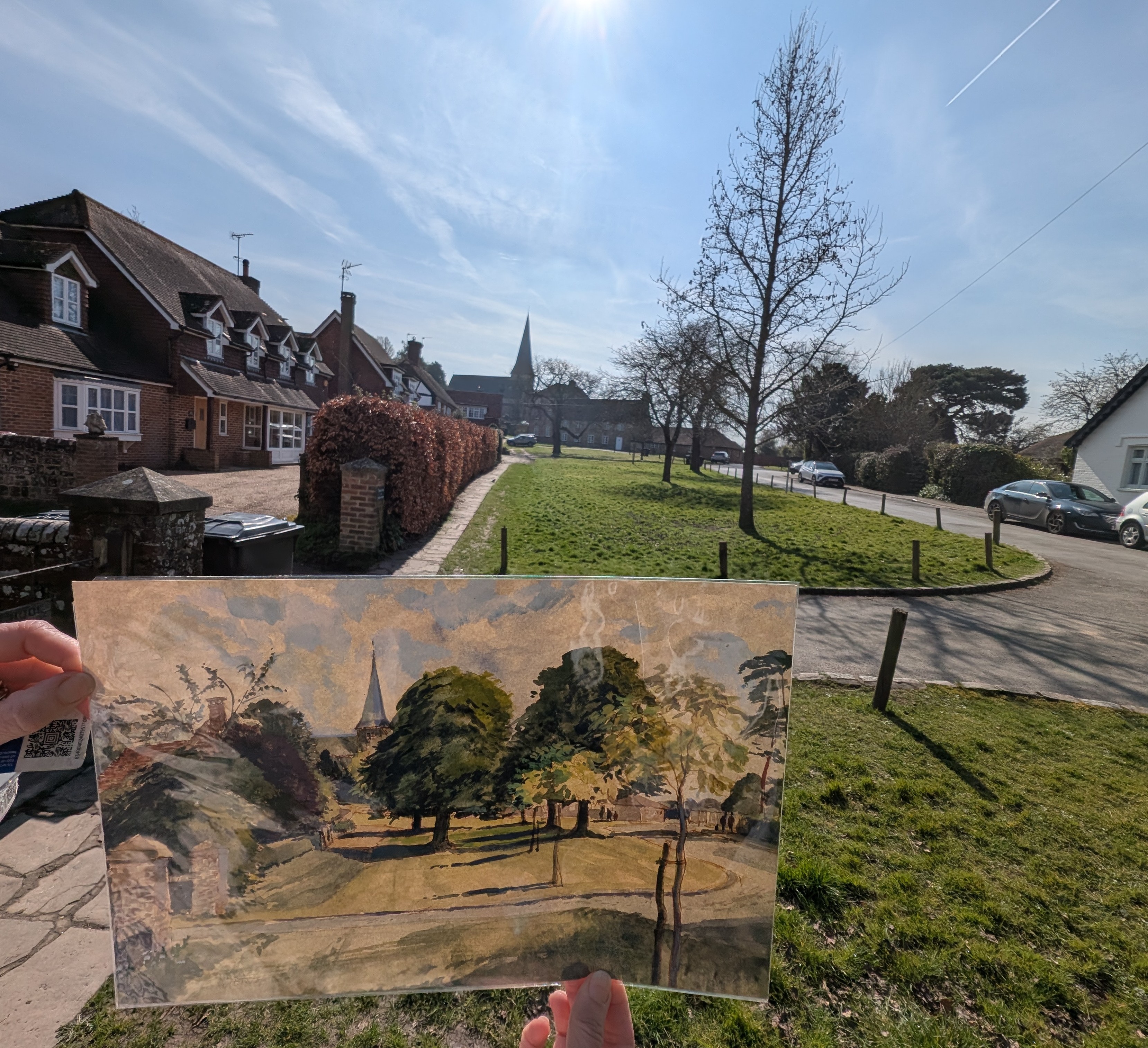
Painter, Illustrator and Book Jacket Designer Patrick Gierth and the West Sussex Village of Wisborough Green

Among the dust jackets collated in my Beautiful British Book Jacket Design of the 1950s and 1960s gallery is an evocative one belonging to a 1951 Michael Joseph first edition of Rogue Male author Geoffrey Household's terrific rural thriller A Rough Shoot (a novel wherein, as I noted in my review back in 2012, the unsuspecting reader will find such bucolic details as badger ham). The dust jacket's designer, Patrick Gierth, also designed the wrapper for the 1951 Joseph first edition of John Wyndham's The Day of the Triffids (among other jackets), but he had a broader artistic life stretching far beyond the bounds of book cover art. His 1943 painting Guard Relaxing, the Stables, Wynnstay is held in the Government Art Collection, while his poster for Shell/BP is held by the British Council, and his name pops up in the Imperial War Museum collection. Yet he found artistic expression in the parochial as well as the national, as I learned after I bought this:

This is a 9.7 by 14.6-inch watercolour painting I came across whilst googling Patrick Gierth. It was listed by the seller under the surname Gierth – it's signed, but only with a surname – dated 1986 and described as "A charming watercolour with gouache highlights." I had no idea whether it was actually by Patrick Gierth, but his was an unusual surname, and stylistically it looked like it could be, plus it was only thirty quid, so after some deliberation I decided to go for it. 

With the painting in hand I did some further digging and determined that until his death in November 1994 Gierth lived in the West Sussex village of Wisborough Green, about an hour's drive from where I live in Lewes. While I was pretty sure I'd driven through the place, I'd never visited it, so although I suspected the scene depicted in the painting might be somewhere in the village, it wasn't anywhere I recognised. Gierth's given address upon his death was School Lane; could the painting depict the road where he lived, I wondered? 

Google Street View gave me a sense that I might be on the right track, but while I thought the church glimpsed in the picture could well be the Wisborough Green parish church (alias St Peter Ad Vincula), I wasn't able to pinpoint precisely the vantage point. I did, however, discover that Gierth was instrumental in the creation of the Wisborough Tapestry which hangs in the church, and that he designed the village green sign.

There was only one thing for it: I was going to have to go to Wisborough Green. And so earlier this year, on my birthday, that's precisely what Rachel and I did, painting in hand(s). It didn't take long to find the place where the picture was painted, round the corner from the village hall and pond, just down from where Gierth lived in High Barn. You can see the view in the photos in this post, along with other photos I took of the village sign, the tapestry, and as it turns out several other pieces Gierth produced for the church.


Confirmation, then, that this rather lovely painting is indeed by the designer of the dust jacket of one of my favourite thrillers, and moreover depicts the road in Wisborough Green where he lived.

Thursday, 6 February 2020

A Ripley's Game Reprise: 1974 US Knopf First Edition of Patricia Highsmith's Third Tom Ripley Novel

What scant posts there have been on here of late have been to do with comics – those are, after all, what have been preoccupying me both personally and professionally over the past year or so – but I have been picking up the odd book here and there too, and among those have been a number by another perennial preoccupation of mine, Patricia Highsmith. Just the other day I came into possession of this:


An American first edition of Ripley's Game, published by Knopf in 1974, dust jacket design by Janet Halverson (whose other jackets include the 1970 and 1978 US firsts of Graham Greene's Travels with My Aunt and The Human Factor, and the 1981 US first of Ross Thomas's The Mordida Man). You may recall... actually at this point I doubt anyone recalls anything I've written on Existential Ennui, but anyway: Ripley's Game, the third book in the Ripliad (soon to become a TV show, with Andrew Scott as Tom Ripley – intriguing and encouraging casting there), is not only my favourite Highsmith novel, but my favourite novel full stop, and it was the acquisition of a 1974 Heinemann first a dozen years ago (in a long-since-vanished Cecil Court bookshop) that first got me into book collecting. As such, it's a totemic book for me.


I had my eye on a Knopf first six years ago, but it slipped through my fingers (as compensation I settled instead for a 1989 Heinemann Uniform Edition). The notion of getting my filthy mitts on a Knopf (ooer) has floated in and out of my head ever since then, but just the other day it seemed the fates had finally aligned when I was in Lewes's Bow Windows Bookshop and co-proprietor (and friend of mine) Ric mentioned he'd come into possession of one as part of a box of books – mostly crime fiction and spy fiction – he'd bought from a local. Or at least he thought he had: when we looked in said box, there was no sign of Ripley's Game. Bugger.

I'd pretty much resigned myself to the fact that once again the Knopf first had eluded my grasp when two days later Ric sent me a message saying he'd found it. And it turned out that not only was it a first edition (not a later printing – the Knopf edition went through a few), but it was once owned by local author John Pearson, he of James Bond: The Authorized Biography and The Life of Ian Fleming fame.


So I'm very happy with my copy (even though the dust jacket is a little battered: the sign of a well-read book, whether by Mr. Pearson or whoever it was Ric bought it off – and quite right too), not least because it affords me the opportunity to compare the US and UK first editions. The text in the Knopf edition, which was published in May of '74, a few months after the Heinemann edition, has been Americanised, or I suppose – depending on whether Highsmith, who was American, wrote the manuscript in American English – re-Americanised: within the first few sentences, there's a "parlor game" as opposed to "parlour game" in the Heinemann edition.


The Knopf has deckled edges, as is often the case with American editions, and a red-stained top block. I also rather like the jacket flap description of Tom Ripley as "energetic, amoral, overcivilized" and "undersensitized".


Now I suppose I'll have to write something abut the other Highsmith books I've picked up – especially as they're all signed.

Wednesday, 5 June 2019

Anthony Price, 1928–2019


I wasn't planning on commemorating Anthony Price, who died last Thursday, 30 May; I was content to let my 2011 two-part interview with the spy novelist stand as tribute (along with all my other Price posts). But Ethan Iverson – who has posted his own typically excellent tribute – encouraged me to do so, and so here are a few thoughts.

I still think fondly of the day I interviewed the author at his then-home in Oxfordshire: spotting red kites on the drive there; the warm welcome Rachel and I received from Price and his late wife, Ann, when we arrived, exemplified by the salmon lunch we were served; and Price's candour during the interview in his study, including the revelation – which I left out of the transcript at his request – that the reason he never wrote the 20th David Audley novel after 1989's The Memory Trap was because Ann had fallen seriously ill.

Something else I haven't since revealed is that following the interview, Price and I corresponded for a little while, exchanging the odd letter and Christmas card. When his wife died in 2012 he wrote of the funeral and his memories of Ann, and when Rachel and my daughter Edie was born in 2013, he commended the choice of her "lovely Anglo-Saxan name", and shared the news that he'd moved to Blackheath in London and had just been to a "wonderful, but terrifying!" Leonard Cohen concert at the 02. ("All those people!") I regret that I didn't keep up the correspondence past that point – I didn't want to pester him – but I shall always treasure my small stash of letters.

I'll also treasure the firsts of The Labyrinth Makers, The Alamut Ambush, and Our Man in Camelot he inscribed to me. And I'll continue to make my way through the David Audley series, which I'm ashamed to admit I'm still not even halfway through. Tomorrow's Ghost is next up for me, even though Price somewhat spoiled the fate of its protagonist during our interview. I wouldn't have it any other way though.

Addendum: There are now obituaries at The New York Times, The Guardian, The Washington Post, The Times, and The Telegraph, all of which refer to my 2011 interview.

Tuesday, 12 February 2019

First Editions of Raymond Chandler's The Little Sister, John Rowland's Calamity in Kent and Henry Kane's Trilogy in Jeopardy

It's perhaps a measure of the neglect Existential Ennui has suffered in recent times – on my part I mean; whatever commensurate neglect there's been on the part of the readership is neither here nor there – that I haven't updated my Beautiful British Book Jacket Design of the 1950s and 1960s page in well over a year. That's partly down to my gravitating more towards science fiction from the 1970s and later in my collecting and reading over the past few years, and as a consequence acquiring fewer books that fit with that 50s/60s theme; but it's not the whole story. As I mentioned last May, the blogging muse, such as it was, rather deserted me in 2018; so while I have still been picking up books here and there, the wrappers of which have been eminently suitable for Beautiful British Book Jacket Design, I haven't been able to summon the impetus or enthusiasm to blog about them.

This year, however, the muse has seemingly made a marginal return. I managed two posts in January – a nascent series called 80s Comics Cavalcade, which I hope to continue – and am keen to maintain that momentum, however faltering it may be. To that end, I thought I'd increase 2019's post tally by showcasing a few finds which I'm adding to the aforementioned Beautiful British Book Jackets page, starting with a small haul from one of Brighton's flea markets last year – small but, I feel, given the piddling prices paid, impressive, especially this book:


A British first edition/first impression of Raymond Chandler's The Little Sister. Published in hardback by Hamish Hamilton, strictly speaking its issue date of 1949 should disqualify it from inclusion in Beautiful British Book Jackets of the 1950s and 1960s; but I've made exceptions before, and its wrapper, by Cecil Walter Bacon, is too good not to include, especially as it makes a nice companion to the two other CWB jackets on the page.


The fifth of Chandler's Philip Marlowe novels, The Little Sister is quite a valuable book in British first (the true first of the book, as it preceded the American first by three months), especially in its original dust jacket, even a somewhat chipped and worn one as here. When I spied this copy on the shelves of the bijou book stall in the flea market, I couldn't quite credit what I was seeing, but on closer inspection I realised it was indeed a British 1st/1st, and with a ludicrously low price pencilled on its front free endpaper. I've come across some real bargains in my time collecting books, but this is by far my biggest find: the closest comparable copy I can see online is listed at £375 –  rather more than the £3 I paid.


The other two books from this haul aren't in quite the same league as the Chandler, but they are both pretty scarce and fairly valuable. Probably scarcest of the two, at least in first edition, is this one:


Calamity in Kent by John Rowland, published by Herbert Jenkins in 1950. One of two Rowland novels reissued by the British Library in 2016 under their Crime Classics imprint (the other being 1938's Murder in the Museum), Calamity in Kent is an entry in Rowland's series of novels featuring Inspector Shelley (and one of the last he published), and is set in the fictional Kentish coastal town of Broadgate, a name which Rowland presumably arrived at by shmooshing Broadstairs into Ramsgate. As a Kent man myself (originally – I suppose I'm more of a Sussex sort these days), I can only commend this act of geographical commingling.


John Norris of Pretty Sinister Books wrote about Rowland back in 2016, so head to that post if you want to learn more about the author. What concerns us here is the dust jacket of the first edition, which was designed by an H. T. Watts... although I've been able to find out very little about him, if indeed he is a him. I do know he also designed the wrappers for the 1950 Jenkins edition of Leonora Starr's Azaleas on the Hill and the 1950 Sampson Low, Marston & Co edition of Paul Townend's The Modern World Book of Wonders, but beyond that, I've drawn a blank. I did wonder if H. T. Watts might have been related to the publisher Charles Albert Watts, for whom I believe John Rowland worked at one time, but that's barely even conjecture on my part.


One note, however, before we move on to the final book in this haul: there was a John Rowland designing dust jackets in the 1950s and 1960s – I wrote about him here, and his work is featured on the Beautiful British Book Jackets page. Were Rowland the author and Rowland the illustrator and designer one and the same? As ever, if anyone can shed any light, do please leave a comment.

At present I can't see any jacketed firsts of Calamity in Kent for sale online, so the £2 I paid for mine, even with its torn wrapper, has to be considered something of a steal. As does the £3 I paid for this book:


A British first edition of Trilogy in Jeopardy by Henry Kane, published by T. V. Boardman in 1955 – #113 in the publisher's American Bloodhound Mystery series. I've written about Boardman, and the designer of most of their dust jackets and book covers, Denis McLoughlin, many times, so I shan't tarry here; follow the links for more on both. This particular book, a collection of three of Kane's Peter Chambers P.I. stories (namely "Slaughter on Sunday", "One Little Bullet" and "Skip a Beat"), is in very short supply online: I can see a couple of jacketed copies in the US priced at around £40, but that's it.


I've added all three of those wrappers to Beautiful British Book Jacket design of the 1950s and 1960s, but blogging about Trilogy in Jeopardy has reminded me that I have some other McLoughlin-wrapped Boardmans to add to the page. I shall endeavour to do that at the earliest opportunity.


Linked in Friday's Forgotten Books, 8/3/19.

Thursday, 20 December 2018

2018: Science Fiction Odyssey, Too


Oh good grief would you look at the time. I mean date. I mean... whatever: Christmas and New Year's are fast approaching, and I am seized by an inexplicable urge to blog about the books I bought and read in 2018 – this despite having barely posted anything all year and consequently squandered whatever remaining sliver of readership Existential Ennui yet retained. Still, when have I ever let widespread disinterest stop me from wittering on at extreme length?

2018, then. A year that, much like 2017 – which, you'll recall (or at least you would if there were anyone left to read this rubbish in order to recall anything) was characterised by an extended science fiction book-collecting-and-reading odyssey – has been characterised by an extended science fiction book-collecting-and-reading odyssey... albeit arguably a less frenzied one. Even so, there have been sizeable scores this year, not least a haul of paperbacks (plus one hardback – a first of Larry Niven and Steven Barnes' Dream Park) I secured over successive visits to Lewes' own Bow Windows Bookshop, who had bought in a huge collection of softcover SF – piles and piles of the bloody stuff – towards the end of the year. (There's still a fair bit left if you're passing.) My spoils mostly comprised space opera by Stephen Baxter, Frederik Pohl (including a couple of entries in the Heechee Saga), Larry Niven, Elizabeth Moon, Charles Stross, Orson Scott Card and others, plus some Philip K. Dick, Terry Pratchett, Bruce Sterling, Joe Haldeman and so on.


Other notable SF scores this year included a stack of Stephen Baxter, Alastair Reynolds and Peter F. Hamilton first editions (notably Reynolds' entire Poseidon's Children trilogy, and a signed first of Hamilton's Misspent Youth plus his ensuing Commonwealth Saga) from two of Brighton's charity bookshops on the same day:


A smaller pile of SF from one of the same shops (including Joe Haldeman's sequel to The Forever War, Forever Free, which I'd been wanting to read):


A return visit to Camilla's Bookshop in Eastbourne (which saw me completing my collection of firsts of Hamilton's Void Trilogy, the sequel to the aforementioned Commonwealth Saga):


And returns visits too to Leigh Gallery Books in Leigh-on-Sea (who had a half-price sale on) and the Stables Bookshop at Hylands House, plus closer to home a mooch round the charity shops of Uckfield:


There were also some (relatively slim) pickings from the Paperback & Pulp Book Fair:


And of course the Lewes Book Fair:


Then there was the stack of Analog science fiction magazines, secured in Brighton's Snooper's Paradise (including the first appearance of Orson Scott Card's Ender's Game):


And a smaller selection of SF magazines, bought in London's Quinto Bookshop, and containing P. M. Hubbard's three earliest short stories, a Joe Haldeman Forever War novella (not included in the first edition I own), and Jerry Pournelle's three-part A Spaceship for the King, alias King David's Spaceship (there was also an epic Westlake/Stark score on the same visit, but that's a story for another time):


Lastly, there were the signed paperbacks I picked up online for a song:


Besides all those, there were other books acquired here and there, but I think I've given the general gist of the year's collecting. What was that about 2018's odyssey being less frenzied than 2017's...?

As for actually reading any of the bloody things... allow me to present my traditional big long list of the books I read this year, in the order in which I read them. In previous years I've also tended to detail the comics I read, and sometimes even offered some commentary on my reading, but it's been a long year and I really can't be arsed. I have, however, deigned to include links to whatever I've previously written about some of the books (however brief). You're welcome. Merry Christmas.

Raft by Stephen Baxter
The Diary of a Bookseller by Shaun Bythell
Absolution Gap by Alastair Reynolds
An Entity Observes All Things by Box Brown
Tales from the Hyperverse by William Cardini
Across the Sea of Suns by Gregory Benford
Starship Troopers by Robert A. Heinlein
Forever Free by Joe Haldeman
The Forge of God by Greg Bear
Anvil of Stars by Greg Bear
A World Out of Time by Larry Niven
Tales of Known Space by Larry Niven
The Long ARM of Gil Hamilton by Larry Niven
Protector by Larry Niven
A Gift from Earth by Larry Niven
Neutron Star by Larry Niven
Spock Must Die! by James Blish (see Star Trek Magazine #69, out now, for my review)
Ringworld by Larry Niven
The Mercenary by Jerry Pournelle
He Fell into a Dark Hole (in Analog) by Jerry Pournelle
Planet of Judgment by Joe Haldeman (see Star Trek Magazine #70 for my review)
The Mote in God's Eye by Larry Niven and Jerry Pournelle, plus prologue in A Step Farther Out, and and missing first chapter in Infinite Stars.
Timelike Infinity by Stephen Baxter
The five Shaper/Mechanist stories in Ascendancies by Bruce Sterling
Es*Ef by Phil Elliott, Darryl Cunningham, Glenn Dakin, Paul Duncan and David Thorpe
Kingdom by Jon McNaught
XTC69 by Jessica Campbell
DC Nuclear Winter Special by various
Gateway by Frederik Pohl (still reading)