Showing posts with label thrillers. Show all posts
Wednesday, 5 June 2019
Anthony Price, 1928–2019
I wasn't planning on commemorating Anthony Price, who died last Thursday, 30 May; I was content to let my 2011 two-part interview with the spy novelist stand as tribute (along with all my other Price posts). But Ethan Iverson – who has posted his own typically excellent tribute – encouraged me to do so, and so here are a few thoughts.
I still think fondly of the day I interviewed the author at his then-home in Oxfordshire: spotting red kites on the drive there; the warm welcome Rachel and I received from Price and his late wife, Ann, when we arrived, exemplified by the salmon lunch we were served; and Price's candour during the interview in his study, including the revelation – which I left out of the transcript at his request – that the reason he never wrote the 20th David Audley novel after 1989's The Memory Trap was because Ann had fallen seriously ill.
Something else I haven't since revealed is that following the interview, Price and I corresponded for a little while, exchanging the odd letter and Christmas card. When his wife died in 2012 he wrote of the funeral and his memories of Ann, and when Rachel and my daughter Edie was born in 2013, he commended the choice of her "lovely Anglo-Saxan name", and shared the news that he'd moved to Blackheath in London and had just been to a "wonderful, but terrifying!" Leonard Cohen concert at the 02. ("All those people!") I regret that I didn't keep up the correspondence past that point – I didn't want to pester him – but I shall always treasure my small stash of letters.
I'll also treasure the firsts of The Labyrinth Makers, The Alamut Ambush, and Our Man in Camelot he inscribed to me. And I'll continue to make my way through the David Audley series, which I'm ashamed to admit I'm still not even halfway through. Tomorrow's Ghost is next up for me, even though Price somewhat spoiled the fate of its protagonist during our interview. I wouldn't have it any other way though.
Addendum: There are now obituaries at The New York Times, The Guardian, The Washington Post, The Times, and The Telegraph, all of which refer to my 2011 interview.
Monday, 9 October 2017
J.G. Ballard's The Drowned World and Other eBay Delights
I've got a bunch of new eBay auctions up and running, including something quite special:
Volume 4 No. 24 of Science Fiction Adventures, published in January 1962. What's so darn special about it? Well it features the first appearance of J.G. Ballard's dystopian classic The Drowned World, which debuted in this issue of Science Fiction Adventures months before it was published in hardback by Gollancz – making this effectively the true first edition. (See this post for more.) It's a pretty scarce publication, with lovely Brian Lewis cover art illustrating Ballard's tale, and it's got a low starting price, so someone could potentially nab a bargain.
All of my latest eBay offerings can be found here:
Existential Ennui on eBay
Or by clicking on each picture for the individual auctions...
Among them a 1964 first edition (later printing) of The Man Who Sold Death by James Munro (alias Callan creator James Mitchell)...
....a 1989 first edition of Quiller KGB by Adam Hall...
and a 2016 omnibus of Avengers: Time Runs Out, which collects the climax to Jonathan Hickman's brilliant Avengers run. Quite a mix of books, then, plus there are some others I've offered before – some of them signed – but which now have lower starting prices. Have at it.


Volume 4 No. 24 of Science Fiction Adventures, published in January 1962. What's so darn special about it? Well it features the first appearance of J.G. Ballard's dystopian classic The Drowned World, which debuted in this issue of Science Fiction Adventures months before it was published in hardback by Gollancz – making this effectively the true first edition. (See this post for more.) It's a pretty scarce publication, with lovely Brian Lewis cover art illustrating Ballard's tale, and it's got a low starting price, so someone could potentially nab a bargain.
All of my latest eBay offerings can be found here:
Existential Ennui on eBay
Or by clicking on each picture for the individual auctions...
Thursday, 1 December 2016
Mike Ripley's Not Single Spies, a Readers' History of Thrillers, Published 2017
Now this is rather exciting. Crime writer and thriller aficionado Mike Ripley has announced the publication next year of "a readers' history", as Mike himself puts it, of "the boom in British thrillers" from 1953–1975. Titled Not Single Spies, the book takes as its starting point Ian Fleming's debut Bond novel Casino Royale (1953) and its end point Jack Higgins' The Eagle Has Landed (1975), featuring along the way the likes of Alistair MacLean, Desmond Bagley, John le Carre and Frederick Forsyth, and drawing on discussions Mike has had over the years with such luminaries as Len Deighton, Anthony Price, Alan Williams and Gavin Lyall.
Set to be published by Harper Collins on 18 May 2017, Not Single Spies also boasts a foreword by Lee Child, who, when approached to write the foreword, apparently noted that he knew: "It would be a book I would want to read – maybe even pay for!" I couldn't agree more.
Friday, 12 August 2016
Manning O'Brine: Mills, Crambo, and No Earth for Foxes (1969–1974)
To read the author bios on the covers of the trilogy of spy novels Manning O'Brine (1919–1974) published from 1969–1974 is to get a glimpse of a quite remarkable life. The dust jacket flap of the first edition of Mills (Herbert Jenkins, 1969) states: "During the War he served in France with the Resistance, then in North Africa as a secret agent. In 1943 he was parachuted into Montenegro to join the partisans and finished the War with the Garibaldi partisans in Italy. After the War he fought for Israel in the Arab Wars, managed an opera company, and wrote several thrillers. Still a believer in authentic background, he recently smuggled himself in and out of Albania to get material for Crambo."
The author bio on the first edition of Crambo (Michael Joseph, 1970) notes that O'Brine was an opera director, a film producer and a writer for film and television "with more than a hundred scripts to his credit". The third book, No Earth for Foxes (Barrie & Jenkins, 1974), adds to his CV a stint as a scenic designer and reveals that he "turned to writing when he decided he could write better than the 'bloody scripts that appeared on his drawing board'". It also gives additional details of his wartime exploits – that "he was with Special Services and parachuted into France on a number of occasions", was "Caught and tortured by the Gestapo... escaped on the way to Belsen", and finally reached Gibraltar.
His was, by any measure – and if those jacket flap bios are to be believed – an extraordinary life, aspects of which he channelled into Mills, Crambo and No Earth for Foxes. O'Brine had published novels before these three – he wrote a string of spy thrillers in the 1950s starring ex-Secret Service agent Mike O'Kelly – but his later espionage novels were clearly closer to his heart. (In the bio on the jacket flap of Crambo he describes his earlier novels as "desperately bad".)
Mills is the best of the three, a cat-and-mouse thriller in which the eponymous British agent decides to retire but then becomes quarry for agents from the Russian and America secret services – as well as his own – all of whom believe he is carrying the formula for a new form of LSD. But Crambo and No Earth for Foxes are almost as good, the former an account of the titular agent's extraction of a Soviet State Security man and his family (although there's more to it than that), the latter a tale of a faked defection (although again...). Characters cross over from one novel to another – Mills and his fellow agents Crambo and Pavane appear to greater or lesser degrees in each story – and there are manhunts (the one in Crambo through the coastal swamps of Albania is particularly good; O'Brine's research paid off there) and double-crosses aplenty.
What's really extraordinary about the books, though – especially Mills and No Earth for Foxes – are the frequent flashbacks to World War II, and how those shape the narrative. These brief interludes sketch in the wartime backgrounds of some of the protagonists – Mills', but also the Nazis he fought in the war and hunted down and killed afterwards for their war crimes. There are gut-wrenching glimpses of the atrocities carried out by German SS troops. Clearly informed by O'Brine's own wartime experiences, these passage burn with a righteous fury and give the novels their character of unfinished business being dealt with. Take this passage from Mills:
The old and infirm had been locked indoors and flamethrowers put to their houses. Babies had been tossed, screaming, into cement-mixers. Women had been cut down by machine-guns as they fled to the chestnut groves.
Or this one from No Earth for Foxes:
He smashed her teeth with the barrel of the machine-pistol and thrust it into her mouth. He fired a burst of 9m bullets that exploded her skull. As she fell backwards, he blew down the barrel of the pistol, lay the weapon on the wall.
And those aren't even the worst of it. O'Brine's hatred of Nazis and, yes, Germans, is channelled through Mills, who in No Earth for Foxes refers to Germans "as dog-turds, fouling the footpath of mankind, filth to be swept away every so often". But it's also made explicit in the Author's Foreword at the start of that book. Noting that the wartime horrors he details in the novel – the horrendous SS 'rastrellamento' (which O'Brine translates as "a scoring, a raking over, a cleansing") in Italy in 1944 – are based in fact, he writes:
Today, all too few really care, one way or the other. It is so much blood under the bridge, forgive and forget, Germans and Austrians are a new generation now. Indeed they are, fathered and mothered by the Hitler Jugend and Bund-Deutsche-Madel of 1945, men and women whose memories are of defeat, of being uprooted from a domain they cherished, and still cherish, as a divine right... a viscid bile that seeks by way of reunification to rise again.
Fools and politicians (all too often one and the same) can believe that the seed of such malignancy withered and died in the flames of a Berlin bunker. Facts, alas, prove otherwise.
A bleak summation of the German character, for sure. But then, given that in an afterword to the novel, O'Brine writes of having seen in Italy in 1944 "a well choked with the bodies of babies and tiny children, most of them drowned or suffocated under the weight of those above", perhaps understandable.
Thursday, 5 May 2016
Sarah Gainham, Time Right Deadly (Arthur Barker, 1956 / 1957)
No. 10 in a series of posts on books I've bought but haven't got round to blogging about properly – indeed may never get round to blogging about properly – so this will have to do. NB: linked in Friday's Forgotten Books, 6/6/16.
What is it?
The 1957 Arthur Barker Dragon paperback edition of Sarah Gainham's debut novel, Time Right Deadly, originally published in hardback by Barker in 1956.
Who illustrated the cover?
Haven't the foggiest.
Where and when did I buy it?
Online, four years ago.
Why did I buy it?
As I mentioned in this 'books I've bought but haven't got round to blogging about properly' post, I'm interested in Sarah Gainham's early spy novels – not least because she herself was a spy – and Time Right Deadly is the earliest of those early spy novels, being, as it is, her debut. It's also extremely uncommon in British first, hence why I bought this paperback rather than a first edition... although during the course of drafting this post I noticed, whilst double-checking online that it is still uncommon in first, a first edition for sale, modestly priced, and best of all still in its splendid John Dugan-designed dust jacket. (The scant few other British firsts I've seen for sale online have been sans jackets.) Naturally I snapped it up.
Have I read it yet?
No.
Will I be updating this post as soon as I have that aforementioned first edition in my clammy hands?
You bet I will.
Et voila:
The 1956 Arthur Barker first edition of Time Right Deadly, dust jacket design by John Dugan (said dust jacket now added to Beautiful British Book Jacket Design of the 1950s and 1960s). Best of all, the back of the wrapper boasts a photograph of Gainham – only the second one I've ever come across.
What is it?
The 1957 Arthur Barker Dragon paperback edition of Sarah Gainham's debut novel, Time Right Deadly, originally published in hardback by Barker in 1956.
Who illustrated the cover?
Haven't the foggiest.
Where and when did I buy it?
Online, four years ago.
Why did I buy it?
As I mentioned in this 'books I've bought but haven't got round to blogging about properly' post, I'm interested in Sarah Gainham's early spy novels – not least because she herself was a spy – and Time Right Deadly is the earliest of those early spy novels, being, as it is, her debut. It's also extremely uncommon in British first, hence why I bought this paperback rather than a first edition... although during the course of drafting this post I noticed, whilst double-checking online that it is still uncommon in first, a first edition for sale, modestly priced, and best of all still in its splendid John Dugan-designed dust jacket. (The scant few other British firsts I've seen for sale online have been sans jackets.) Naturally I snapped it up.
Have I read it yet?
No.
Will I be updating this post as soon as I have that aforementioned first edition in my clammy hands?
You bet I will.
Et voila:
The 1956 Arthur Barker first edition of Time Right Deadly, dust jacket design by John Dugan (said dust jacket now added to Beautiful British Book Jacket Design of the 1950s and 1960s). Best of all, the back of the wrapper boasts a photograph of Gainham – only the second one I've ever come across.
Tuesday, 22 March 2016
Sarah Gainham, The Silent Hostage (Eyre & Spottiswoode, 1960)
No. 3 in a series of posts on books I've bought but haven't got round to blogging about properly – indeed may never get round to blogging about properly – so this will have to do.
What is it?
A first edition of Sarah Gainham's fifth novel, The Silent Hostage, published in hardback by Eyre & Spottiswoode in 1960.
Who designed the dust jacket?
It doesn't have a dust jacket; The Silent Hostage is one of a small number of novels published by Eyre & Spottiswoode around this period that were bound under pictorial laminated boards rather than under the traditional arlin boards with dust jacket (see also from 1960 Colin Watson's Bump in the Night and David West's Wish Me Dead). But in any case, the cover design and photo are uncredited.
Where and when did I buy it?
I believe I bought it on a visit to book dealer Jamie Sturgeon's house four years ago.
Why did I buy it?
As Jamie explained to me at the time, examples of this unusual style of jacketless hardback binding – unusual, that is, for first editions of novels of this vintage – are quite uncommon (there are, at present, only one or two of those aforementioned Colin Watson and David West first editions available online, and only one British first of The Silent Hostage), so that was a factor. Mostly, however, it was because I'm interested in Sarah Gainham – she was a fascinating writer – and especially her early spy thrillers – particularly first editions thereof – and The Silent Hostage was one that I didn't have in first (it is, as already noted, pretty scarce).
Have I read it?
I have not.
What is it?
A first edition of Sarah Gainham's fifth novel, The Silent Hostage, published in hardback by Eyre & Spottiswoode in 1960.
Who designed the dust jacket?
It doesn't have a dust jacket; The Silent Hostage is one of a small number of novels published by Eyre & Spottiswoode around this period that were bound under pictorial laminated boards rather than under the traditional arlin boards with dust jacket (see also from 1960 Colin Watson's Bump in the Night and David West's Wish Me Dead). But in any case, the cover design and photo are uncredited.
Where and when did I buy it?
I believe I bought it on a visit to book dealer Jamie Sturgeon's house four years ago.
Why did I buy it?
As Jamie explained to me at the time, examples of this unusual style of jacketless hardback binding – unusual, that is, for first editions of novels of this vintage – are quite uncommon (there are, at present, only one or two of those aforementioned Colin Watson and David West first editions available online, and only one British first of The Silent Hostage), so that was a factor. Mostly, however, it was because I'm interested in Sarah Gainham – she was a fascinating writer – and especially her early spy thrillers – particularly first editions thereof – and The Silent Hostage was one that I didn't have in first (it is, as already noted, pretty scarce).
Have I read it?
I have not.
Sunday, 20 March 2016
James Barlow, The Hour of Maximum Danger (Hamilton, 1962)
No. 2 in a series of posts on books I've bought but haven't got round to blogging about properly – indeed may never get round to blogging about properly – so this will have to do.
What is it?
A British first edition of James Barlow's spy thriller The Hour of Maximum Danger, published in hardback by Hamish Hamilton in 1962.
Who designed the dust jacket?
Val Biro.
Where and when did I buy it?
Now you're asking. I think I bought it in the Arundel branch of the Kim's chain of secondhand bookshops, although it could've been in the late lamented Dim and Distant in Heathfield. Either way it was a good two or three years ago.
Why did I buy it?
Mostly that dust jacket, a splendid Braque-like effort by Val Biro, of which Val noted when I showed it to him the year before he died: "An artist keeps his eyes open to what's happening in the art world, and I was quite taken by this kind of abstraction." But the fact that the novel's a spy thriller – and an intriguing one at that – also helped sway me, plus Barlow's writing is well liked in some quarters.
Have I read it yet?
Nope.
What is it?
A British first edition of James Barlow's spy thriller The Hour of Maximum Danger, published in hardback by Hamish Hamilton in 1962.
Who designed the dust jacket?
Val Biro.
Where and when did I buy it?
Now you're asking. I think I bought it in the Arundel branch of the Kim's chain of secondhand bookshops, although it could've been in the late lamented Dim and Distant in Heathfield. Either way it was a good two or three years ago.
Why did I buy it?
Mostly that dust jacket, a splendid Braque-like effort by Val Biro, of which Val noted when I showed it to him the year before he died: "An artist keeps his eyes open to what's happening in the art world, and I was quite taken by this kind of abstraction." But the fact that the novel's a spy thriller – and an intriguing one at that – also helped sway me, plus Barlow's writing is well liked in some quarters.
Have I read it yet?
Nope.
Thursday, 17 March 2016
Manning Coles, Let the Tiger Die (Hodder, 1948)
No. 1 in a series of posts on books I've bought but haven't got round to blogging about properly – indeed may never get round to blogging about properly – so this will have to do.
What is it?
A British first edition of Let the Tiger Die by Manning Coles, published in hardback by Hodder & Stoughton in 1948 – the eighth in Coles' twenty-six-book series of novels starring British Intelligence agent Tommy Hambledon.
Who designed the dust jacket?
Ethel "Bip" Pares.
Where and when did I buy it?
At the Lewes Book Fair, a couple of years ago.
Why did I buy it?
Manning Coles is – or rather are; 'Manning Coles' is the nom de plume of two writers, Adelaide Frances Oke Manning and Cyril Henry Coles – one of a number of classic spy fiction authors whose work I'm interested in and intend to try at some point, so when I spotted this first edition on a dealer's table and then looked it up on my phone and discovered that it's rather scarce in first, and especially so in its wrapper (and still is today; I can only see a couple of – quite pricey – jacketed firsts available online at present), I couldn't resist, especially when the dealer knocked a few quid off the already-reasonable asking price.
Have I read it yet?
No.
What is it?
A British first edition of Let the Tiger Die by Manning Coles, published in hardback by Hodder & Stoughton in 1948 – the eighth in Coles' twenty-six-book series of novels starring British Intelligence agent Tommy Hambledon.
Who designed the dust jacket?
Ethel "Bip" Pares.
Where and when did I buy it?
At the Lewes Book Fair, a couple of years ago.
Why did I buy it?
Manning Coles is – or rather are; 'Manning Coles' is the nom de plume of two writers, Adelaide Frances Oke Manning and Cyril Henry Coles – one of a number of classic spy fiction authors whose work I'm interested in and intend to try at some point, so when I spotted this first edition on a dealer's table and then looked it up on my phone and discovered that it's rather scarce in first, and especially so in its wrapper (and still is today; I can only see a couple of – quite pricey – jacketed firsts available online at present), I couldn't resist, especially when the dealer knocked a few quid off the already-reasonable asking price.
Have I read it yet?
No.
Wednesday, 16 March 2016
Books I Haven't Got Round to Blogging About
What with a somewhat overfull slate of freelance editing and writing work and the usual demands of family and home life, I find myself rather pushed for time of late, and as a result blogging has had to take a back seat (as may be surmised by the fact that this is only the fifth post I've managed this year). I can't see any letup anytime soon either, which means that there probably won't be too many extensive posts on Existential Ennui for the foreseeable future.
However, I have begun to miss blogging – it sometimes feels like it's the only thing that keeps me sane – and so rather than abandon Existential Ennui entirely, I thought I'd keep the site ticking over with some pithy posts showcasing books I've bought but haven't got round to blogging about properly – indeed may never get round to blogging about properly – of which there are a good many sitting on my shelves. I'm not quite sure what these posts will consist of, but I imagine they'll be along the lines of a picture (or two, or three) of a book I've plucked randomly from my shelves, some bibliographical info about that book (including, naturally, dust jacket or cover designer), where I bought it (if I can remember) and, er, that's probably about it; after all, the whole point is to do something that doesn't take up much time.
How frequent these proposed posts will be remains to be seen, but I'm hoping I'll be able to knock out at least a couple a week. More soon.
Wednesday, 3 February 2016
Desmond Cory's Mr. Pilgrim in Pilgrim at the Gate and Pilgrim on the Island (Muller, 1958 / 1959)
I've read just over half a dozen Desmond Cory novels since I first came across the somewhat overlooked thriller writer four years ago – largely entries in his Johnny Fedora spy series – and while I've enjoyed all of them, none have been quite up there with the first Cory I read, the beautifully written, curiously languid Undertow (the twelfth Fedora instalment, and the first in the Feramantov quintet). The early Corys I've tried – Secret Ministry (1951), Intrigue (1954) – have been pacy enough (almost madcap in the case of Secret Ministry), while the later ones – Hammerhead (1963), Feramontov (1966) – have been dense and quite compelling... but they haven't been Undertow – by definition, obviously, but also in terms of literary accomplishment.
And then I read the two novels featuring lesser known Cory protagonist Mr. Pilgrim: Pilgrim at the Gate (Muller, 1958) and Pilgrim on the Island (Muller, 1959). I'd been wanting to try them for a while and actually laid my hands on a very nice, inexpensive first edition of Pilgrim on the Island three years ago, but Pilgrim at the Gate proved rather more elusive in first (as is frequently the case with Cory novels) – until last year fellow Cory enthusiast Chris Hiscocks pointed me in the direction of a cheap ex-library copy in Australia. The copy in question is actually a Shakespeare Head edition – the Australian publishing arm of Frederick Muller – and is missing its front endpaper, but crucially it does still have its splendid S. R. Boldero-designed dust jacket (which has taken its place in Beautiful British Book Jacket Design of the 1950s and 1960s, alongside Boldero's jacket for Pilgrim on the Island).
For the uninitiated – which I imagine will be most people reading this post – Mr. Pilgrim is a kind of postwar Scarlet Pimpernel, except that rather than smuggling aristocrats out of France he spirits defectors out of East Germany. Or at least that's his stated MO; in fact in the first book, Pilgrim at the Gate, he has a more vengeful purpose in mind in that he's really hunting former Nazis hiding out in the East, appropriating a West Berlin travel agency set up by Nazi war criminal Egon Hoffman, Pilgrim Tours (the name being "A quaint coincidence," as Pilgrim puts it shortly before killing Hoffman) in order to facilitate this highly personal mission (Pilgrim is a concentration camp survivor).
The adventure which follows is absorbing enough, but the best things about the book are Pilgrim himself – who, by dint of his palpable absence throughout most of the novel, takes on an almost mythic countenance – and the occasional philosophical jousts – verbal and physical – he engages in when he does appear. One discussion in particular, about the German civilian population's acceptance of Nazism and how totalitarian regimes thrive on innocence, is fascinating:
"Innocence demands a closed system; demands laws it doesn't have to question. Communism is an excellent answer. Or Catholicism. Or Nazism. That's the whole point. You can accept any of these, if you accept innocence as the inevitable lot of mankind."
"Wouldn't a better word be... ignorance?"
"Oh no. Ignorance is merely lack of knowledge. But innocence implies the acceptance of a belief to the exclusion of all others; it's a lack of understanding."
Trudy took a deep breath. "The alternative, though, is not to believe in anything. To treat life purely as a question."
"Life is a question," said Mr. Pilgrim. "Innocence won't accept that awful fact. And that's why innocence is dangerous."
These philosophical and political discourses continue in the second novel, Pilgrim on the Island, which deals with Mr. Pilgrim's efforts to extract East German Under-Minister of Propaganda Otto Berendt (genuinely extract in this instance, rather than assassinate) and which is an even better book than its forbear: engrossing, deeply felt and on a literary par, I believe, with Undertow. Here, though, the subject is invariably Communism:
"Communism will succeed, though, in spite of everything you and your friends can do."
Mr. Pilgrim shrugged. "We're not so important as you suppose. Communism will succeed if the people find it satisfactory; and if they don't, it won't."
"They do find it satisfactory."
"I'm one of them," said Mr. Pilgrim. "And I don't."
Just as compelling are the political manoeuvrings Berendt becomes embroiled in as his opponents move against him – one extended sequence in a Committee meeting where Berendt realises the game is up is utterly gripping – and the practical manoeuvrings Mr. Pilgrim engages in as he tries to spirit Berendt away – whilst also simultaneously using him to identify the instigators of the coup. That the thing culminates in a Mexican standoff, with subterfuges uncovered, motives laid bare and guns pointed, is merely the delicious icing on what is by any standards an excellent – and lovingly baked – slice of espionage.
Linked in Patricia Abbott's Friday's Forgotten Books round-up, 5/2/16.
And then I read the two novels featuring lesser known Cory protagonist Mr. Pilgrim: Pilgrim at the Gate (Muller, 1958) and Pilgrim on the Island (Muller, 1959). I'd been wanting to try them for a while and actually laid my hands on a very nice, inexpensive first edition of Pilgrim on the Island three years ago, but Pilgrim at the Gate proved rather more elusive in first (as is frequently the case with Cory novels) – until last year fellow Cory enthusiast Chris Hiscocks pointed me in the direction of a cheap ex-library copy in Australia. The copy in question is actually a Shakespeare Head edition – the Australian publishing arm of Frederick Muller – and is missing its front endpaper, but crucially it does still have its splendid S. R. Boldero-designed dust jacket (which has taken its place in Beautiful British Book Jacket Design of the 1950s and 1960s, alongside Boldero's jacket for Pilgrim on the Island).
For the uninitiated – which I imagine will be most people reading this post – Mr. Pilgrim is a kind of postwar Scarlet Pimpernel, except that rather than smuggling aristocrats out of France he spirits defectors out of East Germany. Or at least that's his stated MO; in fact in the first book, Pilgrim at the Gate, he has a more vengeful purpose in mind in that he's really hunting former Nazis hiding out in the East, appropriating a West Berlin travel agency set up by Nazi war criminal Egon Hoffman, Pilgrim Tours (the name being "A quaint coincidence," as Pilgrim puts it shortly before killing Hoffman) in order to facilitate this highly personal mission (Pilgrim is a concentration camp survivor).
The adventure which follows is absorbing enough, but the best things about the book are Pilgrim himself – who, by dint of his palpable absence throughout most of the novel, takes on an almost mythic countenance – and the occasional philosophical jousts – verbal and physical – he engages in when he does appear. One discussion in particular, about the German civilian population's acceptance of Nazism and how totalitarian regimes thrive on innocence, is fascinating:
"Innocence demands a closed system; demands laws it doesn't have to question. Communism is an excellent answer. Or Catholicism. Or Nazism. That's the whole point. You can accept any of these, if you accept innocence as the inevitable lot of mankind."
"Wouldn't a better word be... ignorance?"
"Oh no. Ignorance is merely lack of knowledge. But innocence implies the acceptance of a belief to the exclusion of all others; it's a lack of understanding."
Trudy took a deep breath. "The alternative, though, is not to believe in anything. To treat life purely as a question."
"Life is a question," said Mr. Pilgrim. "Innocence won't accept that awful fact. And that's why innocence is dangerous."
These philosophical and political discourses continue in the second novel, Pilgrim on the Island, which deals with Mr. Pilgrim's efforts to extract East German Under-Minister of Propaganda Otto Berendt (genuinely extract in this instance, rather than assassinate) and which is an even better book than its forbear: engrossing, deeply felt and on a literary par, I believe, with Undertow. Here, though, the subject is invariably Communism:
"Communism will succeed, though, in spite of everything you and your friends can do."
Mr. Pilgrim shrugged. "We're not so important as you suppose. Communism will succeed if the people find it satisfactory; and if they don't, it won't."
"They do find it satisfactory."
"I'm one of them," said Mr. Pilgrim. "And I don't."
Just as compelling are the political manoeuvrings Berendt becomes embroiled in as his opponents move against him – one extended sequence in a Committee meeting where Berendt realises the game is up is utterly gripping – and the practical manoeuvrings Mr. Pilgrim engages in as he tries to spirit Berendt away – whilst also simultaneously using him to identify the instigators of the coup. That the thing culminates in a Mexican standoff, with subterfuges uncovered, motives laid bare and guns pointed, is merely the delicious icing on what is by any standards an excellent – and lovingly baked – slice of espionage.
Linked in Patricia Abbott's Friday's Forgotten Books round-up, 5/2/16.
Friday, 23 October 2015
Author Brian Cleeve, Vote X for Treason (alias Counterspy) and the Sean Ryan Spy Series, 1964–67
NB: One of this Friday's Forgotten Books.
Google the Irish (British-born) writer and broadcaster Brian Cleeve (1921–2003) and one of the first links you'll come across, aside from his Wikipedia page, is a website called SevenMansions. Subtitled, slightly misleadingly, "The Works of Brian Cleeve", it's a collection of Cleeve's writings about spirituality and God, incorporating a handful of books on those subjects which Cleeve published in the early 1980s shortly after he experienced a religious epiphany. What the site neglects to mention, however – hence the "slightly misleadingly" – are the twenty novels Cleeve published from the early 1950s to the mid-1970s (plus one final one, A Woman of Fortune, published in 1993), a run of eight of which, beginning with 1961's Assignment to Vengeance through to 1968's You Must Never Go Back, are suspense and spy thrillers. And half of those eight comprise an espionage series starring Irish terrorist-turned-British Intelligence agent Sean Ryan, as follows:
Vote X for Treason (Collins, 1964; US title Counterspy)
Dark Blood, Dark Terror (Hammond, 1966)
The Judas Goat (Hammond, 1966; US title Vice Isn't Private)
Violent Death of a Bitter Englishman (Random House, 1967)
The first book in the series, Vote X for Treason (Collins edition dust jacket design by Barbara Walton), is a grim but compelling affair – a grubby, street-level take on spy fiction informed, Cleeve himself admitted (according to Donald McCormick in Spy Fiction: A Connoisseur's Guide), by the author's experiences working for British Counterintelligence during the war. (Cleeve led an eventful life, to say the least.) The story sees Sean Ryan released early from a fifteen-year prison sentence on the orders of intelligence chief Major Courtenay, who presents Ryan with a choice: either infiltrate the New Party – a political organisation with fascistic leanings and violently revolutionary aims, with its base in a string of gyms and youth clubs and tendrils extending far into Westminster – or go back to jail. Ryan accepts the mission and soon finds himself sucked into a thuggishly brutal world, the mindless camaraderie of which holds a certain appeal for the former gunman – until his only friend comes a cropper.
Vote X for Treason is the only one of the Sean Ryan novels I've read thus far, but I plan on getting to the others at some point, and accordingly have collected British first editions of the second and third books in the series (I'm still on the hunt for an American hardback first edition of the fourth, Violent Death of a Bitter Englishman, which I don't believe was ever published in hardback in the UK – I think it went straight to Corgi paperback here):
Dark Blood, Dark Terror, published by Hammond, Hammond & Company in 1966, dust jacket design by Roger Harris, and:
The Judas Goat, again published by Hammond in 1966, again with a dust jacket designed by Roger Harris. I'm keener on Harris's jacket for this one than for Dark Blood, Dark Terror, but I've nevertheless added both wrappers to the Existential Ennui Beautiful British Book Jacket Design of the 1950s and 1960s page, along with Harris's wrapper for the 1965 Hammond edition of James Munro's Die Rich Die Happy, and they do look rather good grouped together like that. (I've updated the Vote X for Treason cover there too, as I now own two copies of the scarce Collins first edition; the first copy I bought has a Boots Library sticker firmly affixed to the front of its jacket.)
There's one other thing worth noting about this copy of The Judas Goat – and in keeping with my recent posts on signed and inscribed books – which is this:
It's been signed and inscribed by Cleeve on the front free endpaper (in festive fashion – "With love and wishes from Brian Cleeve Xmas 1966"). There are more than a dozen signed Brian Cleeve books on AbeBooks at present, but this is the only signed book in the Sean Ryan series I've come across. Evidently, in this matter at least, Cleeve's God was smiling on me.
Google the Irish (British-born) writer and broadcaster Brian Cleeve (1921–2003) and one of the first links you'll come across, aside from his Wikipedia page, is a website called SevenMansions. Subtitled, slightly misleadingly, "The Works of Brian Cleeve", it's a collection of Cleeve's writings about spirituality and God, incorporating a handful of books on those subjects which Cleeve published in the early 1980s shortly after he experienced a religious epiphany. What the site neglects to mention, however – hence the "slightly misleadingly" – are the twenty novels Cleeve published from the early 1950s to the mid-1970s (plus one final one, A Woman of Fortune, published in 1993), a run of eight of which, beginning with 1961's Assignment to Vengeance through to 1968's You Must Never Go Back, are suspense and spy thrillers. And half of those eight comprise an espionage series starring Irish terrorist-turned-British Intelligence agent Sean Ryan, as follows:
Vote X for Treason (Collins, 1964; US title Counterspy)
Dark Blood, Dark Terror (Hammond, 1966)
The Judas Goat (Hammond, 1966; US title Vice Isn't Private)
Violent Death of a Bitter Englishman (Random House, 1967)
The first book in the series, Vote X for Treason (Collins edition dust jacket design by Barbara Walton), is a grim but compelling affair – a grubby, street-level take on spy fiction informed, Cleeve himself admitted (according to Donald McCormick in Spy Fiction: A Connoisseur's Guide), by the author's experiences working for British Counterintelligence during the war. (Cleeve led an eventful life, to say the least.) The story sees Sean Ryan released early from a fifteen-year prison sentence on the orders of intelligence chief Major Courtenay, who presents Ryan with a choice: either infiltrate the New Party – a political organisation with fascistic leanings and violently revolutionary aims, with its base in a string of gyms and youth clubs and tendrils extending far into Westminster – or go back to jail. Ryan accepts the mission and soon finds himself sucked into a thuggishly brutal world, the mindless camaraderie of which holds a certain appeal for the former gunman – until his only friend comes a cropper.
Vote X for Treason is the only one of the Sean Ryan novels I've read thus far, but I plan on getting to the others at some point, and accordingly have collected British first editions of the second and third books in the series (I'm still on the hunt for an American hardback first edition of the fourth, Violent Death of a Bitter Englishman, which I don't believe was ever published in hardback in the UK – I think it went straight to Corgi paperback here):
Dark Blood, Dark Terror, published by Hammond, Hammond & Company in 1966, dust jacket design by Roger Harris, and:
The Judas Goat, again published by Hammond in 1966, again with a dust jacket designed by Roger Harris. I'm keener on Harris's jacket for this one than for Dark Blood, Dark Terror, but I've nevertheless added both wrappers to the Existential Ennui Beautiful British Book Jacket Design of the 1950s and 1960s page, along with Harris's wrapper for the 1965 Hammond edition of James Munro's Die Rich Die Happy, and they do look rather good grouped together like that. (I've updated the Vote X for Treason cover there too, as I now own two copies of the scarce Collins first edition; the first copy I bought has a Boots Library sticker firmly affixed to the front of its jacket.)
There's one other thing worth noting about this copy of The Judas Goat – and in keeping with my recent posts on signed and inscribed books – which is this:
It's been signed and inscribed by Cleeve on the front free endpaper (in festive fashion – "With love and wishes from Brian Cleeve Xmas 1966"). There are more than a dozen signed Brian Cleeve books on AbeBooks at present, but this is the only signed book in the Sean Ryan series I've come across. Evidently, in this matter at least, Cleeve's God was smiling on me.
Thursday, 15 October 2015
Jimmy Sangster's John Smith Spy Novels: private i (Triton, 1967); Signed Inscribed First Editions
NB: Linked in Friday's Forgotten Books, 16/10/15.
When Jimmy Sangster died four years ago, his obituaries naturally concentrated largely on his film and TV work (see The Guardian, The Independent, The Telegraph and The New York Times). Sangster was a key figure in the revival of Hammer Films in the late 1950s and through the 1960s; he wrote The Curse of Frankenstein (1957), Dracula (1958), The Mummy (1959) and two dozen other Hammer horrors before moving to America, where he wrote for The Six Million Dollar Man, Kolchak: The Night Stalker, Ironside, Wonder Woman and a bunch more US TV shows.
But Sangster also penned eight novels (plus a couple of novelisations of his own screenplays) besides his film and television work: three murder mysteries published from 1986–88 (1989–90 in the UK) starring expat former Scotland Yard investigator James Reed; one standalone thriller-cum-farce published in 1971 starring gun-running adventurer Anthony Bridges; two spy thrillers published from 1968–70 starring British Intelligence agent Katy Touchfeather; and two half-spy/half-mystery novels published from 1967–68 starring ex-British Intelligence operative turned private investigator John Smith, the first of which is this:
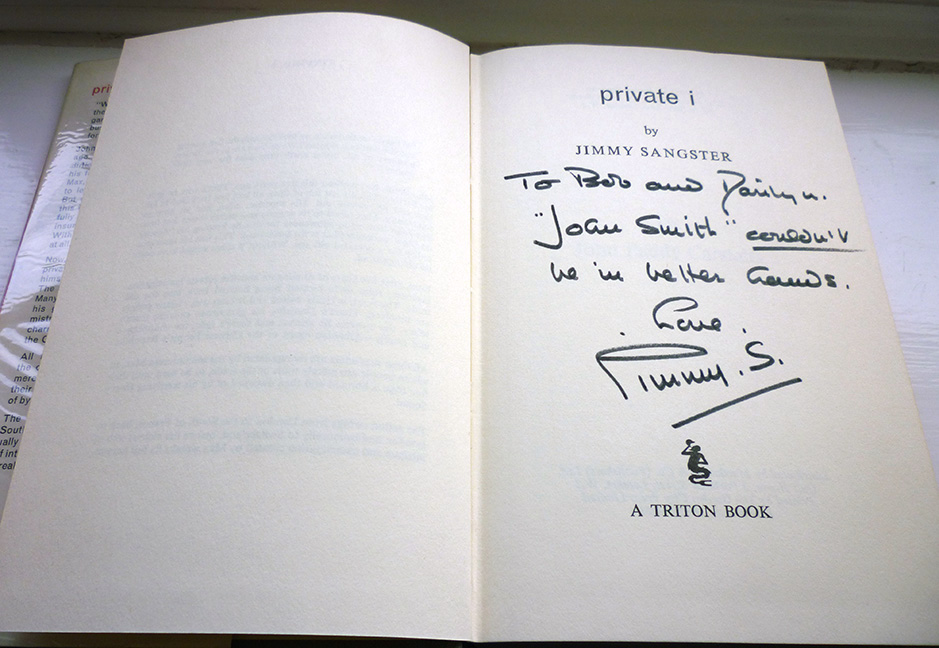
Or rather, these: private i, published by Triton in 1967, dust jacket design by Collis Clements. Now, I suppose the immediate question here is, why do I have two copies of the same book? Answer being, having learned about Sangster's parallel career as a writer of spy fiction (from screenwriter and novelist Stephen Gallagher, no less), I went in search of a first edition of his debut novel – private i – and came across two copies, both of which boasted intriguing inscriptions (written by Sangster, as far as I can determine; the handwriting is a little different in each book, but there are enough similarities – the same black maker pen used, corresponding letterforms – that I'm fairly confident they're from the same hand), one of which being an association copy. And since both books were relatively inexpensive – and being the hopeless case that I am – I bought both of them. (Whether or not I'll keep both of them remains to be seen – I'm planning on doing some eBaying soon.)
The copy on the left has a poem inscribed on the front free endpaper:
It reads:
Roses are Red.
Violets are Blue.
I'll lay odds
I'm higher than you.
Violets are Blue
Roses are Red
If I could find the strength
I'd drag you to bed
Drifting around in a Pale Velvet haze
What a wonderfull way to pass all our days.
Love, Jim xxxx
I've no idea who the poem was written for (although I'd dearly love to find out), but I do know who the other copy of the book, the association copy, was inscribed to, this time on the title page:
The inscription reads:
To Bob and Marilyn.
"John Smith" couldn't be in better hands.
Love
Jimmy S.
Bob and Marilyn are the American actor Robert Horton and his wife; Horton starred in Wagon Train from 1957–1962 and featured in numerous other television series, films and TV movies, one of which being the 1969 television film The Spy Killer, directed by Roy Ward Baker, produced by Jimmy Sangster and with a teleplay by Sangster based on his own novel... private i.
I've not seen The Spy Killer – although there is a clip on YouTube of the opening five minutes, featuring Horton as John Smith walking through Berwick Street Market to the baritone strains of what sounds like Scott Walker (although actually the rather less-well-known John Rowles), and the reviews on IMDB are positive – but I have read private i, and can report that it's a cracking piece of spy fiction – kind of early le Carré crossed with Len Deighton's unnamed working class secret agent and with a dash of Adam Hall's Quiller mixed in for good measure. Narrated by Smith, one-time operative with the Service – i.e. British Intelligence – turned down-at-heel private investigator, it starts out in a cut-price seedy gumshoe vein, with Smith employed by his ex-wife to obtain evidence of her new husband's gay affair, before taking a sharp left turn into the dangerous world of international espionage, as Smith is press-ganged back into service by his former boss, the ruthless and manipulative Max.
The plot is suitably murky and twisty, involving murder, coded secrets and both the Chinese and Russian security services, but it's Smith's sardonic narration which really lifts the thing. When three pages into a spy novel the lead states that he's "nearly two stone overweight, that my digestive system plays up constantly, that my teeth aren't particularly good, and that I have suffered periodically from halitosis, B.O., prickly heat and dandruff", you know you're not in the realm of Bond, and Smith spends the remainder of the novel boozing, leching, failing to get it up with his indifferent girlfriend and crashing around like the low rent – and yet, on occasion, lowly cunning – loser that he is. The only real downside is a regrettable streak of homophobia which runs through the narrative, but even that can be put down to Smith's boorish nature and the prevailing attitudes of the time rather than to whatever prejudices Sangster might or might not have held. And anyway, I can forgive a multitude of sins in any example of the spy fiction form which contains an irreverent passage like this one:
I poured myself a large drink, and read the evening paper. I washed up some dirty dishes and rinsed out a couple of pairs of socks. I washed a nylon shirt and hung it up to dry. I had another drink which I took with me to the bath. I trimmed my toenails, had a crap, read the evening paper again, and then had a shave. After that there seemed to be nothing left to do but to phone Berat's contact and tell him about the rendezvous.
The second and final John Smith spy thriller, Foreign Exchange, was published by Triton in 1968 (and filmed for television in 1970, again with Robert Horton in the lead role), and it's almost as good as private i, sending Smith to Russia as part of a complicated Cold War spy swap plot. A full review will have to wait for another time, however; this post is quite long enough as it is. For now, I invite anyone interested in learning more about the novel – and in reading contemporaneous reviews of private i – to click on the above images of the dust jacket of the Triton edition (designed by Alison Storey).
When Jimmy Sangster died four years ago, his obituaries naturally concentrated largely on his film and TV work (see The Guardian, The Independent, The Telegraph and The New York Times). Sangster was a key figure in the revival of Hammer Films in the late 1950s and through the 1960s; he wrote The Curse of Frankenstein (1957), Dracula (1958), The Mummy (1959) and two dozen other Hammer horrors before moving to America, where he wrote for The Six Million Dollar Man, Kolchak: The Night Stalker, Ironside, Wonder Woman and a bunch more US TV shows.
But Sangster also penned eight novels (plus a couple of novelisations of his own screenplays) besides his film and television work: three murder mysteries published from 1986–88 (1989–90 in the UK) starring expat former Scotland Yard investigator James Reed; one standalone thriller-cum-farce published in 1971 starring gun-running adventurer Anthony Bridges; two spy thrillers published from 1968–70 starring British Intelligence agent Katy Touchfeather; and two half-spy/half-mystery novels published from 1967–68 starring ex-British Intelligence operative turned private investigator John Smith, the first of which is this:
Or rather, these: private i, published by Triton in 1967, dust jacket design by Collis Clements. Now, I suppose the immediate question here is, why do I have two copies of the same book? Answer being, having learned about Sangster's parallel career as a writer of spy fiction (from screenwriter and novelist Stephen Gallagher, no less), I went in search of a first edition of his debut novel – private i – and came across two copies, both of which boasted intriguing inscriptions (written by Sangster, as far as I can determine; the handwriting is a little different in each book, but there are enough similarities – the same black maker pen used, corresponding letterforms – that I'm fairly confident they're from the same hand), one of which being an association copy. And since both books were relatively inexpensive – and being the hopeless case that I am – I bought both of them. (Whether or not I'll keep both of them remains to be seen – I'm planning on doing some eBaying soon.)
The copy on the left has a poem inscribed on the front free endpaper:
Roses are Red.
Violets are Blue.
I'll lay odds
I'm higher than you.
Violets are Blue
Roses are Red
If I could find the strength
I'd drag you to bed
Drifting around in a Pale Velvet haze
What a wonderfull way to pass all our days.
Love, Jim xxxx
I've no idea who the poem was written for (although I'd dearly love to find out), but I do know who the other copy of the book, the association copy, was inscribed to, this time on the title page:
The inscription reads:
To Bob and Marilyn.
"John Smith" couldn't be in better hands.
Love
Jimmy S.
Bob and Marilyn are the American actor Robert Horton and his wife; Horton starred in Wagon Train from 1957–1962 and featured in numerous other television series, films and TV movies, one of which being the 1969 television film The Spy Killer, directed by Roy Ward Baker, produced by Jimmy Sangster and with a teleplay by Sangster based on his own novel... private i.
I've not seen The Spy Killer – although there is a clip on YouTube of the opening five minutes, featuring Horton as John Smith walking through Berwick Street Market to the baritone strains of what sounds like Scott Walker (although actually the rather less-well-known John Rowles), and the reviews on IMDB are positive – but I have read private i, and can report that it's a cracking piece of spy fiction – kind of early le Carré crossed with Len Deighton's unnamed working class secret agent and with a dash of Adam Hall's Quiller mixed in for good measure. Narrated by Smith, one-time operative with the Service – i.e. British Intelligence – turned down-at-heel private investigator, it starts out in a cut-price seedy gumshoe vein, with Smith employed by his ex-wife to obtain evidence of her new husband's gay affair, before taking a sharp left turn into the dangerous world of international espionage, as Smith is press-ganged back into service by his former boss, the ruthless and manipulative Max.
The plot is suitably murky and twisty, involving murder, coded secrets and both the Chinese and Russian security services, but it's Smith's sardonic narration which really lifts the thing. When three pages into a spy novel the lead states that he's "nearly two stone overweight, that my digestive system plays up constantly, that my teeth aren't particularly good, and that I have suffered periodically from halitosis, B.O., prickly heat and dandruff", you know you're not in the realm of Bond, and Smith spends the remainder of the novel boozing, leching, failing to get it up with his indifferent girlfriend and crashing around like the low rent – and yet, on occasion, lowly cunning – loser that he is. The only real downside is a regrettable streak of homophobia which runs through the narrative, but even that can be put down to Smith's boorish nature and the prevailing attitudes of the time rather than to whatever prejudices Sangster might or might not have held. And anyway, I can forgive a multitude of sins in any example of the spy fiction form which contains an irreverent passage like this one:
I poured myself a large drink, and read the evening paper. I washed up some dirty dishes and rinsed out a couple of pairs of socks. I washed a nylon shirt and hung it up to dry. I had another drink which I took with me to the bath. I trimmed my toenails, had a crap, read the evening paper again, and then had a shave. After that there seemed to be nothing left to do but to phone Berat's contact and tell him about the rendezvous.
The second and final John Smith spy thriller, Foreign Exchange, was published by Triton in 1968 (and filmed for television in 1970, again with Robert Horton in the lead role), and it's almost as good as private i, sending Smith to Russia as part of a complicated Cold War spy swap plot. A full review will have to wait for another time, however; this post is quite long enough as it is. For now, I invite anyone interested in learning more about the novel – and in reading contemporaneous reviews of private i – to click on the above images of the dust jacket of the Triton edition (designed by Alison Storey).
Thursday, 8 October 2015
Hong Kong Kill by Bryan Peters, Alias Peter George: Signed Inscribed First Edition (T. V. Boardman, 1958)
NB: Linked in Friday's Forgotten Books, 9/10/15.
I've been on the hunt for a copy of the 1958 T. V. Boardman edition of Bryan Peters's Hong Kong Kill – the first in the author's very short series (in fact just two books) of Cold War spy thrillers starring British secret agent Anthony Brandon and American CIA operative Jess Lundstrum – ever since I got my hands on a copy of the Boardman edition of the second one, 1961's The Big H, three years ago. It wasn't merely the desire to complete a series which drove me to seek out Hong Kong Kill, nor the fact that like The Big H – and indeed almost all the crime and spy novels published under Boardman's Bloodhound Mystery banner – it boasted a dust jacket designed by Denis McLoughlin (although that was admittedly a major factor in my desire to obtain that particular edition); it was also my abiding interest in the man behind the "Bryan Peters" alias: Peter George.
Best known as the co-writer of Stanley Kubrick's Dr. Strangelove or: How I Learned to Stop Worrying and Love the Bomb (1964), George published nine novels from 1952 to 1965 (including in 1963 a novelisation of Dr. Strangelove, which was itself based on George's 1958 novel Two Hours to Doom, alias Red Alert), both under his own name and the pen names Bryan Peters and Peter Bryant. It's a fascinating body of work, comprising on the one hand a handful of straightforward crime thrillers, largely published in the 1950s, and on the other a succession of books from 1958 onwards all preoccupied to a greater or lesser degree with nuclear annihilation – an obsession which in 1966 drove George to take his own life. Somewhere in the middle are the two Bryan Peters spy novels – both of which touch on the threat of obliteration by intercontinental nuclear weapons (The Big H more so than Hong Kong Kill); and spy fiction being a particular passion of mine, and having already acquired (and read, and liked) The Big H, I was keen to get hold of Hong Kong Kill too.
In the end I managed not only to find a fairly inexpensive, fairly decent copy of the uncommon Boardman edition – not ex-library and with a dust jacket that, while edge-worn and chipped, is still bright and presentable (now added to the Denis McLoughlin section in Beautiful British Book Jacket Design of the 1950s and 1960s) – but one which, unusually, is inscribed by George. Signed or inscribed Peter George books really aren't too common; I own an inscribed copy (on an author bookplate) of George's final and perhaps finest novel, Commander-1 (1965), and there are two other signed George books that I can see for sale online at present – one an inscribed copy of his 1958 crime novel Cool Murder priced at £70, the other an inscribed copy of Two Hours to Doom priced at £1,250 – but that's about it.
This copy of Hong Kong Kill is inscribed on the front free endpaper. The simple inscription reads:
Johnny – with best of good wishes – and hopes for a happy new life.
Pete
"Bryan Peters"
As to the novel itself, it's a good but uneven affair – a trifle flat in places, melodramatic in others, with a very dry first third ("The Briefing"; the novel is split into three parts, the other two being "The Kill" and "The Prize") which establishes the background to British Intelligence agent Brandon's mission – to travel to Hong Kong in order to thwart the nefarious activities of the Chinese "Extermination Section" Yellowknife, which is poised to foment trouble and assassinate key individuals – in a little too painstaking detail, and a colonial bias which is a little hard to take nearly sixty years hence. But there are some classic bits of Fleming/Bondesque spy business in the thing: a doomed love affair; a high stakes game of seven-card stud; coded messages conveyed via books (namely, amusingly, Conrad's The Secret Agent and Waugh's Decline and Fall). And it explodes into vivid, evocative life in the final part, as the 1956 Kowloon Riots erupt and Brandon and CIA agent Lundstrum go on the hunt for Yellowknife leader Lily Wang, with some shocking bursts of violence and corpses piling up in the streets around the two leads.
Intriguingly, there's an Author's Note at the start of the book which suggests that there's an element of truth to the novel beyond the (fictionalised) real life riots it features. The note reads:
This story is fiction. Unfortunately, most of the incidents in it are not. Brandon exists, though not under the name I have given him. Lily Wang exists too, though that was not the name under which she operated either. But Brandon still lives. While he does, and all those other nameless people who voluntarily walk in that savage other world, we can feel reasonably content that the other world will not encroach on our carefully balanced, peaceful lives. That was not the reason this story was written, but it is its justification.
I've been on the hunt for a copy of the 1958 T. V. Boardman edition of Bryan Peters's Hong Kong Kill – the first in the author's very short series (in fact just two books) of Cold War spy thrillers starring British secret agent Anthony Brandon and American CIA operative Jess Lundstrum – ever since I got my hands on a copy of the Boardman edition of the second one, 1961's The Big H, three years ago. It wasn't merely the desire to complete a series which drove me to seek out Hong Kong Kill, nor the fact that like The Big H – and indeed almost all the crime and spy novels published under Boardman's Bloodhound Mystery banner – it boasted a dust jacket designed by Denis McLoughlin (although that was admittedly a major factor in my desire to obtain that particular edition); it was also my abiding interest in the man behind the "Bryan Peters" alias: Peter George.
Best known as the co-writer of Stanley Kubrick's Dr. Strangelove or: How I Learned to Stop Worrying and Love the Bomb (1964), George published nine novels from 1952 to 1965 (including in 1963 a novelisation of Dr. Strangelove, which was itself based on George's 1958 novel Two Hours to Doom, alias Red Alert), both under his own name and the pen names Bryan Peters and Peter Bryant. It's a fascinating body of work, comprising on the one hand a handful of straightforward crime thrillers, largely published in the 1950s, and on the other a succession of books from 1958 onwards all preoccupied to a greater or lesser degree with nuclear annihilation – an obsession which in 1966 drove George to take his own life. Somewhere in the middle are the two Bryan Peters spy novels – both of which touch on the threat of obliteration by intercontinental nuclear weapons (The Big H more so than Hong Kong Kill); and spy fiction being a particular passion of mine, and having already acquired (and read, and liked) The Big H, I was keen to get hold of Hong Kong Kill too.
In the end I managed not only to find a fairly inexpensive, fairly decent copy of the uncommon Boardman edition – not ex-library and with a dust jacket that, while edge-worn and chipped, is still bright and presentable (now added to the Denis McLoughlin section in Beautiful British Book Jacket Design of the 1950s and 1960s) – but one which, unusually, is inscribed by George. Signed or inscribed Peter George books really aren't too common; I own an inscribed copy (on an author bookplate) of George's final and perhaps finest novel, Commander-1 (1965), and there are two other signed George books that I can see for sale online at present – one an inscribed copy of his 1958 crime novel Cool Murder priced at £70, the other an inscribed copy of Two Hours to Doom priced at £1,250 – but that's about it.
This copy of Hong Kong Kill is inscribed on the front free endpaper. The simple inscription reads:
Johnny – with best of good wishes – and hopes for a happy new life.
Pete
"Bryan Peters"
As to the novel itself, it's a good but uneven affair – a trifle flat in places, melodramatic in others, with a very dry first third ("The Briefing"; the novel is split into three parts, the other two being "The Kill" and "The Prize") which establishes the background to British Intelligence agent Brandon's mission – to travel to Hong Kong in order to thwart the nefarious activities of the Chinese "Extermination Section" Yellowknife, which is poised to foment trouble and assassinate key individuals – in a little too painstaking detail, and a colonial bias which is a little hard to take nearly sixty years hence. But there are some classic bits of Fleming/Bondesque spy business in the thing: a doomed love affair; a high stakes game of seven-card stud; coded messages conveyed via books (namely, amusingly, Conrad's The Secret Agent and Waugh's Decline and Fall). And it explodes into vivid, evocative life in the final part, as the 1956 Kowloon Riots erupt and Brandon and CIA agent Lundstrum go on the hunt for Yellowknife leader Lily Wang, with some shocking bursts of violence and corpses piling up in the streets around the two leads.
Intriguingly, there's an Author's Note at the start of the book which suggests that there's an element of truth to the novel beyond the (fictionalised) real life riots it features. The note reads:
This story is fiction. Unfortunately, most of the incidents in it are not. Brandon exists, though not under the name I have given him. Lily Wang exists too, though that was not the name under which she operated either. But Brandon still lives. While he does, and all those other nameless people who voluntarily walk in that savage other world, we can feel reasonably content that the other world will not encroach on our carefully balanced, peaceful lives. That was not the reason this story was written, but it is its justification.
Subscribe to:
Posts (Atom)